The Tumbling Waters Trail in the Coosawattee Wildlife Management Area

April 9, 2018

I spent part of spring break at a Bird’s Eye View Cabin in Ellijay, Georgia.  The cabin is on an overbuilt ridge overlooking a valley.  All the species of animals I observed were the same species that are commonly found near my house in Augusta, Georgia.  I saw a turkey vulture eating a road-killed opossum, a raccoon, gray squirrels, bluebirds, an house finch, a robin, a tufted titmouse, and I heard rufous-sided towhees, cardinals, mourning doves, pileated woodpeckers, chickadees, and an hawk.

View of the valley from the Bird’s Eye View Cabin.

We went on an excursion to the Tumbling Waters Trail next to Carter’s Lake, named after that anti-Semite, Jimmy Carter.  I didn’t see any wildlife here, aside from a few dusky wing and tiger swallowtail butterflies.  The trail goes through a forest of oak and hemlock with an undergrowth of rhododendron and ferns, but most of the hemlock trees are dead.  Ice Age forests in north Georgia were dominated by spruce with some oak.  When climate shifted to warmer stages spruce trees started dying, creating more space for oaks, and the environment may have been somewhat similar in appearance, though with older trees. This time of the year about the only greenery in this region are the food plots planted to maximize populations of deer and turkey.  The Coosawattee Wildlife Management Area is 9 square miles of high ridges alternating with narrow stream valleys.  I found oak, hickory, beech, white pine, and Virginia pine.

The trail is between a steep hill and Carter’s Lake.

Carter’s Lake.

Dead hemlock tree in the center of the photo and fallen dead hemlocks in the background.

This is a wildlife management food plot.  It consisted of wheat and peas, I think.

Carters Lake: cross a towering suspension bridge to hike to two waterfalls on the Tumbling Waters Nature Trail


I didn’t have time to finish the trail, so I ripped off a photo of Tumbling Waters from the internet.  This is where the Coosawattee River empties into Carter’s Lake.  The reservoir probably inundated many beautiful shoals like this.
Sadistic American Safari Hunters are Contributing to the Extinction of Africa’s Megafauna

April 2, 2018

Until well into the 20th century tropical diseases and tribal warfare left large areas of Africa uninhabited, and megafauna flourished.  An estimated 10 million elephants lived on the continent in 1900 and populations of rhinos, giraffes, zebras, lions, and other species were much higher than they are today.  Now, there are just 430,000 elephants living in Africa, and all of Africa’s megafauna are in danger of extinction.  The biggest threats are from overpopulation of people and loss of habitat.  Farmers convert wild lands into agricultural plots, and pastoralists with their increasing herds of cattle will not tolerate ungulates competing for grazing range or predator attacks on their livestock.  Illegal poaching is another major threat.  Trophy hunters from America claim they are helping to protect the last remaining populations of megafauna by supporting local groups that protect hunting preserves from poachers.  Instead, these sadistic safari hunters are contributing to the ongoing extinction of Africa’s most iconic animals.

For a price hunters can still go on a safari and kill rare mammals.  Here are some of the prices on the internet I found for guided safari hunts: elephant ($38,000), endangered white rhino ($66,790), lion-leopard-buffalo ($32,500 for a 26 day safari), zebra ($3500), baboon or jackal ($300).  Giraffes are pretty cheap too–$3450.  Incidentally, giraffe populations are in severe decline.  1 hunter paid $350,000 to kill an extremely rare black rhino.  By contrast a 4 day photographic safari costs just $2500. I am not against sustainable hunting for food, but the idea that rich people would spend this much money to slaughter rare animals in poor countries disgusts me.  This is what they do with their recreational budget?  Travel across the world to wipe out the last remaining populations of iconic animals with high powered rifles? These people are sick.  They make me think of the Nazis who killed my relatives during the Holocaust.

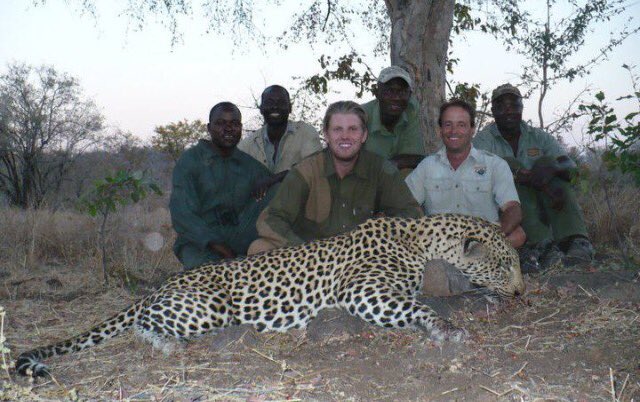
Image result for Donald trump jr safari photos

Here is an example of a Richie Rich douchebag on a safari hunt.  This is 1 of Donald Trump’s sons. He paid a fortune to murder a leopard.  He and his brother went on a safari and killed a leopard, civet cat, antelope, and buffalo. Why the hell would anyone kill a civet cat? He bragged about giving the antelope meat to the locals…the people who can’t afford to hunt these animals themselves.  What a jerk.  Trump’s entire family are a bunch of crooks who are using the White House to personally enrich themselves.  The U.S. is a disgrace for electing such a racist sexist pig to be president.

The claim that these safari hunts help conservation efforts is dubious at best and downright false in most cases.  First of all, there is a moral disconnect between letting rich American hunters slaughter wildlife for trophies,while local poor people are forbidden from hunting for bush meat to help feed their families.  This system stokes the kind of anti-colonial resentment that would foster sympathy for the poachers.  Then, there is the corruption.  Most of these African countries are so corrupt that money spent on safari hunts is pocketed by a few local gangster autocrats, and it does not go toward conserving the wildlife.  For example the $350,000 the hunter spent on killing that black rhino that I mentioned above went to an organization that doesn’t even help conserve black rhinos.  The money is supposed to go to guards that protect the big game animals, but instead it invariably ends up in the hands of some corrupt local politician who doesn’t give a shit about wildlife.  The safari hunters themselves are frequently corrupt.  They often bribe guides to let them get extra trophies above their limit.  Safari hunters claim they only shoot animals past their breeding age.  This demonstrates ignorance about basic biology, and it a ridiculous lie anyway.  None of the big game species they hunt ever live long enough to become infertile with age.  Moreover, they purposefully shoot the best looking trophies–the individuals with the largest horns and the lions with the most luxurious manes–and these animals are the strongest most fertile specimens within the population.  A noted wildlife photographer saw entire lion prides in Botswana wiped out by trophy hunters.  The safari hunters killed all the adult males, so the only male lions left in the area were the cubs that grew up and mated with their mothers, causing inbreeding that led to local extirpation of the pride.  A recent scientific study determined that trophy hunting so weakens the gene pool that it could eventually lead to the extinction of African megafauna.

I think African countries should promote photographic safaris instead of hunting safaris.  Money brought in by safari hunting amounts to less than 1% of tourism dollars brought into Africa by foreigners.  An increase in photographic safaris could easily replace this revenue.  Nevertheless, African megafauna is in big trouble.  As long as a certain percentage of the billion Chinese who live on earth are dumb enough to believe rhino horn is an aphrodisiac, I just don’t see how poaching can be stopped in corrupt African countries.  “Conservation” by safari hunters is a colossal lie that is only contributing to the extinction of these magnificent mammals.

Reference:

Knell, R.; and Carlos Marinez-Ruiz

“Selective Harvest Focused on Sexual Signal Traits can lead to Extinction Under Directional Environmental Change”

Proceedings of the Royal Society of Biological Science November 2017

The Secretary Bird of Pleistocene North America (Buteogallus daggetti)

March 28, 2018

Most species of birds that became extinct at the end of the Pleistocene were dependent upon the megafauna in some way.  The list of extinct species includes 2 relatives of the extant cowbird.  These birds likely followed herds of mammoths and horses around, just like their living cousins follow herds of bison and introduced cattle to feed on stirred-up insects and dislodged grass seeds.  Several species of extinct vultures, condors, and eagles obviously disappeared when there were no longer any carcasses of mammoths, ground sloths, llamas, etc. to feed upon.  Extant California condors, golden eagles, and magpies suffered reduced ranges for the same reason.  There were several species of raptors in the Buteogallus genus living in the southern region of North America during the late Pleistocene.  The Buteogallus genus is classified within the Accipitritidae family which includes the well known Cooper’s hawk and goshawk of North America.  However, the 9 extant species in the Buteogallus genus are restricted to South American and Mexico.  3 extinct species of late Pleistocene Buteogallus ranged into Florida and California.  Perhaps the most interesting was the walking eagle (Buteogallus daggetti).

Related image

Savannah hawk.  The walking eagle was a close relative of the savannah hawk but had even longer legs.

Image result for secretary bird

Secretary bird.  The savannah hawk and walking eagle occupy (ied) a convergent ecological niche with this species–grassland birds that feed upon rodents, reptiles, and large insects stirred up by fire or megafauna.

The walking eagle most closely resembled the living savannah hawk (B. meridionalis) of South America, but it had even longer legs.  It hunted small animals from the air and the ground, like its living relative.  Both species occupy (or occupied in the case of the extinct species) a similar niche exploited by the secretary bird (Sagittarius serpentarius) of Africa today.  All 3 of these tall grassland birds use (or used) their long legs to pummel small vertebrates.  The walking eagle likely preyed on small animals escaping grass fires, like savannah hawks and scissor-tailed swallows do today.  Walking eagles may have preyed upon rodents, reptiles, and large insects forced to come out of hiding in tall grass and reveal themselves when herds of megafauna threatened to trample them.  Subfossil remains of walking eagles have been excavated from northern Mexico and southern California, but they may have been more widespread.  They may have lived in habitats where geological preservation of bird bones is rare.  The dhole (Cuon alpinus) crossed the Bering land bridge and colonized North America during the Pleistocene, but its remains have only been found at 1 site in Mexico. The walking eagle may be another example of a once common animal that left scant fossil evidence of its existence.

Another extinct species in the Buteogallus genus, the fragile eagle (B. fragilis), lived in California until the late Pleistocene–its remains are relatively common from the La Brea Tar Pits.  Remains of the fragile eagle are also known from the mid-Pleistocene of Florida.  Subsequent sea level rise may have inundated fragile eagle habitat in Florida, causing its extirpation there, but it may have continued to occur elsewhere in southeastern North America where it remains undetected in the fossil record.

Image result for great black hawk

Great black hawk.  This species currently inhabits wetlands in the tropics of South America and along both Mexican coasts.  It lived in Florida during the mid-Pleistocene.

The great black hawk (B. urbutinga) occurs today in South America and along both coasts of Mexico.  Remains of this species dating to the mid-Pleistocene have also been found in Florida.  Sea level rise probably caused the extirpation of this species from peninsular Florida too, and it is not known from any other site north of Mexico.  An extinct close relative of the great black hawk (B. borrasi) inhabited Cuba during the late Pleistocene.  It was 33% larger than its living close relative.  B. borrasi probably evolved from a population of B. urbutinga that found their way to Cuba, but it may have been more widespread in the West Indies and maybe even Florida earlier during the Pleistocene.  A less likely but possible explanation is that B. borrasi was formerly more common across southeastern North America but by the late Pleistocene there was just a relic population living on Cuba.  A genetic study could probably solve this mystery.

Reference:

Olson, Storrs

“The Walking Eagle Wetmorgyps daggetti: A scaled up version of the Savannah Hawk”

Ornithological Monographs 63 2007

A Relic Population of Pleistocene Man (Homo sapiens) on North Sentinel Island

March 22, 2018

Homo sapiens first left Africa about 60,000 years ago.  Most of the original tribes that left Africa either perished in the harsh environments of Asia or were replaced by later arriving tribes that had developed superior technology or subsistence strategies.  The people who eventually conquered Asia look and behave quite differently from the initial African colonizers.  However, there is a relic population of early Homo sapiens on the Andaman Islands located in the Bay of Bengal near Malaysia.  Scientists believe a land bridge connected the Andaman Islands with Malaysia during Ice Ages and early Homo sapiens walked there.  Rising sea levels isolated the Andamanese and protected them from being killed or assimilated by groups that later conquered Asia.  Genetic evidence suggests the Andaman Islanders diverged from the rest of humanity 60,000 years ago.

Andaman Islands.PNG

Location of the Andaman Islands.  They were connected to Malaysia during Ice Ages due to lower sea levels.

The Andaman Islanders are related to African pygmies but are considered negrittos–people smaller than average in size but larger than pygmies.  This smaller stature probably helps them survive on islands where they have less food.  It’s an evolutionary advantage to have lower caloric intake needs on islands, and dwarfism is common among large species of mammals that became trapped on islands.  People on 1 particular Andaman Island known as North Sentinel have been isolated longer than any other Andaman Islanders.  Their language is far different from the 2 languages spoken on the other Andaman Islands, and they have incredibly primitive technology.  All attempts to communicate with them have failed because no one in the outside world understands their language. The North Sentinelese kill outsiders on sight, explaining why they have been isolated for so long.  They have no agriculture, and some believe they depend on lightning strikes for fire, though I doubt this.  I think our evolutionary ancestors (H. heidelbergensis and H. erectus) had fire, but who knows–maybe the North Sentinelese forgot fire-making knowledge.

Image result for North Sentinel

The unfriendly North Sentinelese attack outsiders on sight.  Here, they are about to shoot arrows at a passing helicopter. Note the red-ochre painted faces.

There are only 40-400 North Sentinelese living on the 24 square mile island.  The island vegetation prevents an aerial survey of the population.  They eat wild pigs, fish and shellfish, and wild plant foods.  The Indian government (owners of the Andaman Islands) abandoned attempts to contact the tribe and outlawed other outsiders from visiting the island.  It’s unsafe for outsiders because they will be attacked, and introduction of infectious diseases would probably wipe out North Sentinelese because their immune systems have been isolated from other humans for so long.  The North Sentinelese recently murdered 2 drunken fishermen who drifted too close to shore.  Also not long ago, a typhoon wrecked an oil tanker on a coral reef off the island, and the crew had to fight for their lives before being rescued.  The North Sentinelese stripped the ship bare.  They shoot arrows at all passing helicopters.

The North Sentinelese represent what Pleistocene man was like 60,000 years ago.  Pleistocene people were small of stature and dark-skinned.  Genetic evidence of a 10,000 year old skeleton in Britain suggests even some Europeans were dark-skinned during the Pleistocene.  They had primitive technology and were hostile to strangers.  The descendants of these small violent humans conquered the world.

Reference:

Endicott, P. et. al.

“The Genetic Origins of the Andaman Islanders”

American Journal of Human Genetics  72 (1) 2003

An Extinct Map Turtle (Graptemys kerneri) and Pleistocene Sea Level Fluctuations

March 15, 2018

Most species of freshwater turtles can travel overland and occupy new favorable habitat, promoting genetic vigor within the meta population.  They often move between watersheds, and this explains why so many species have such a continuous geographic range.  I’ve seen snapping turtles (Chelydra serpentina) and yellow-bellied sliders (Chrysemys scripta) a considerable distance from any water source.  However, map turtles in the Graptemys genus (10 species) do not travel overland, and their ranges are usually restricted to single river drainages.  So how did closely related Graptemys species colonize different river drainages even though they don’t travel overland?  The dispersal of the Graptemys genus is closely related to Pleistocene sea level fluctuations.

Image result for Barbour's map turtle

Barbour’s map turtle is the closest living relative of the extinct Kerner’s map turtle.

Image result for Barbour's map turtle range

Barbour’s map turtle range.  Note how it is restricted to 1 river system.

Image result for map of Florida during the Last Glacial Maximum

Map of Florida during the Last Glacial Maximum.  Different rivers in Florida isolated by sea level rise today were interconnected on land exposed on the continental shelf due to sea level fall.  This allowed map turtles to colonize adjacent rivers systems where they evolved into distinct species following sea level rise and isolation of populations.

During Ice Ages sea level fell because so much of earth’s atmospheric water became locked in glacial ice.  In Florida dry land habitat extended 120 miles west into the Gulf of Mexico.  Several of Florida’s river systems that are isolated from each other today by sea level rise were interconnected during the Last Glacial Maximum on the land that was exposed by ocean recession.  This allowed an ancestral population of Barbour’s map turtle (Graptemys barbouri), a species today restricted to the Apalachicola-Flint-Chattahoochee River System, to colonize several other rivers in Florida.  Subsequent sea level rise isolated this founder population in the Suwanee, Santa Fe, and Waccasassa Rivers where they evolved into a now extinct species known as Kerner’s map turtle.  Specimens of this species have been found in all 3 of the above mentioned rivers in Florida, and the type specimen (a complete skull) came from the Suwannee.

Kerner’s map turtle had a wider shorter skull than any extant species of map turtle.  Morphologically, it most closely resembles Barbour’s map turtle, the extant species that has the widest shortest skull among living Graptemys turtles.  There is an east-west gradient in the shape of map turtle skulls.  Western species have narrower longer skulls, but map turtle species’ skulls get shorter and wider the farther east they occur.  Kerner’s map turtle was the easternmost species, and it ranged into north central Florida and possibly southeastern Georgia where the Suwannee River headwaters originate.  Rare earth element analysis indicates Kerner’s map turtle lived during the Rancholabrean Age (300,000 years BP-11,000 years BP).  There are no known Graptemys specimens older than the mid-Pleistocene.  The extinction of Kerner’s map turtle likely occurred during a dry climate stage of the mid-Holocene (~6,000 years BP).  Map turtles require fast moving high water where they can disburse up and down rivers.  But drought turns their habitat into stagnant isolated pools that can also be detrimental to their favorite food source–freshwater mussels.  Other species of freshwater turtles and alligators can survive these conditions by moving overland until they find good habitat, but map turtles don’t travel overland.  That’s why most species are restricted to major rivers that rarely, if ever, suffer sporadic flows.

The founding species in the Graptemys genus undoubtedly evolved in the Mississippi River.  Almost all other species exist in other river systems that empty into the Gulf of Mexico.  Pleistocene sea level fluctuations facilitated the colonization and speciation of map turtles in the Apalachicola River drainage, the Guadulupe River System, the Pascagoula River, Mobile Bay drainage, Yellow River System, and Pearl River.  Different map turtle species live in each.  Ocean recession allowed the rivers to become interconnected on the continental shelf, and map turtles were able to colonize adjacent river systems; then sea level rise isolated populations, causing speciation.

Reference:

Ehret, Dana; and J. Bourque

“An Extinct Map Turtle Graptemys kerneri (Testudinae, Emydidae) from the Late Pleistocene of Florida”

Journal of Vertebrate Paleontology 31 (3) May 2011

The Late Pleistocene Extinction of Leopards (Panthera pardus) from Sumatra

March 8, 2018

During temperate climate cycles of the Pleistocene leopards enjoyed an even wider geographic range than they do today, living in Europe as well as Africa and Asia.  Leopards colonized the island of Sumatra during the middle Pleistocene but became extinct there at the end of the Pleistocene, despite continuing to thrive elsewhere in Asia.  Scientists used a statistical model to determine why leopards disappeared from Sumatra.  They considered all potential competing carnivores and total prey biomass in their calculations.   Leopards shared Sumatra with orangutans, monkeys, humans, elephants, deer, tapir, pigs, sun bears, tigers, clouded leopard, Asian golden cats, and dholes.  Tigers are known to depress leopard populations in regions where the 2 species overlap; and dholes, a pack-hunting dog, compete for the same large prey species.  Scientists expected the model to show competition with tigers and dholes caused the extinction of leopards on Sumatra.  However, when they removed the influence of these 2 species from their model, leopards still became extinct.  Leopards also became extinct when humans were removed from the simulation.  Surprisingly, the statistical simulation suggests competition with clouded leopards (Neofelis diardi) and Asian golden cats (Pardofelis temminckii) caused the extinction of leopards on Sumatra.

Image result for map of sumatra

Location of Sumatra.

Image result for asian golden cat

Asian golden cats.  This species along with clouded leopards outcompeted leopards on Sumatra following the end of the Pleistocene.

Image result for clouded leopard

Clouded leopard.

The authors of this study propose ecological changes following the end of the Pleistocene greatly favored smaller forest cats over leopards.  During Ice Ages Sumatra was a mix of savannah, woodland, and forest; but wetter climate fostered the spread of thick forest.  Larger prey species became less common, so leopards were forced to compete with the smaller cats for smaller prey items.  Both of the smaller species of cats reproduce faster than leopards and produce larger litter sizes.  The extremely adaptable leopard was actually squeezed out of its ecological niche on Sumatra by 2 smaller felines.

Adult leopards weight between 80-200 pounds compared to a maximum of 57 pounds for clouded leopards and 35 pounds for Asian golden cats.  The latter 2 species are efficient predators of small animals and need less food than leopards, giving them an advantage when available protein biomass declines.

Clouded leopards are 1 of the most primitive species of living cats and may be related to the evolutionary link between big and small cats.  The Sunda clouded leopard is the species that lives on Sumatra.  It diverged from the other species of clouded leopard ((Neofelis nebulosa) about 70,000 years ago.  Clouded leopards from Borneo crossed a now submerged land bridge and colonized Sumatra following the Tuba volcanic eruption that wiped out much of Sumatra’s wildlife ~70,000 years BP. The Sunda clouded leopard was not recognized as a separate species until 2006.

Reference:

Volmer, R.; et. al.

“Did Panthera pardus (Linneaus 1758) become Extinct in Sumatra because of Competition for Prey?  Modeling Interspecific Competition within the Late Pleistocene Carnivore Guild of the Paday Highlands, Sumatra”

Paleogeography, Paleoclimatology, and Paleoecology 2018

More Evidence against the Climate Change Model of Late Pleistocene Extinctions

March 4, 2018

Many extinct species of Pleistocene megafauna had a wide ranging geographic distribution.  Jefferson’s ground sloth, long-nosed peccary, Columbian mammoth, and mastodon occurred from coast to coast and from Florida to the glacial boundary.  These species and their similar evolutionary ancestors existed across the continent for millions of years, surviving dozens of major and minor climatic fluctuations.  They lived in a variety of environments and were capable of subsisting on many different foods.  Multiple lines of evidence show these pre-historic beasts ate a varied diet.  Mastodon coprolites (subfossil feces) contain bald cypress, buttonbush, spruce twigs, fruit, acorns, aquatic plants, and numerous other items.  Now, a new study of mastodon teeth using dental microwear texture analysis confirms that mastodons ate a wide variety of foods.

Image result for mastodon tooth looked at with microscope

Mastodon tooth.  Scientists looked at mastodon teeth using microscope technology and determined mastodons from different regions ate different foods.

Scientists microscopically examined 65 mastodon teeth that were found in 4 different geographic locations including Florida, Missouri, Indiana, and New York.  The microwear found on mastodon teeth from Florida differed from wear on teeth from northern mastodons.  Florida mastodons primarily ate bald cypress twigs, while northern mastodons ate spruce, hemlock, pine, larch, and juniper.  The differences in tooth wear indicate mastodons could eat a variety of plant foods and were not dependent upon a single species.  The authors of this study also looked at mastodon teeth from different climatic stages in Missouri.  Mastodon teeth from a climate stage when open jack pine and prairie predominated showed little difference from teeth dated to a climate stage when spruce dominated the landscape.  The microwear on mastodon teeth resembles the microwear found on 2 living species–moose and black rhino.  Like mastodon, these 2 species subsist on woody browse.

I think this study is just more evidence against the climate change model of extinction that proposes changes in climate caused corresponding changes in plant composition, leading to megafaunal extinctions through nutritional deficit starvation.  None of the plants mastodons ate ever disappeared or even became rare in the environment. The authors of this study take a more neutral stance toward the debate.  They acknowledge the “plasticity” of mastodon diet but seem reluctant to admit their study is strong evidence against the climate change model of extinction.  Instead, they suggest future studies using dental microwear texture analysis could uncover the reason why megafauna became extinct.  In my opinion it already has.  Their data rules out the climate change model of extinction by revealing the dietary adaptability of mastodons.  Through the process of elimination, human overkill is the only plausible cause left standing.

Reference:

Green, J.; Larisa DeSantis and G. Smith

“Regional Variation in the Browsing Diet of Pleistocene Mammut americanum (Mammalia, Proboscidea) as Recorded by Dental Microwear Texture Analysis”

Paleogeography, Paleoclimatology, and Paleoecology August 2017

The Galerian Migration hypothesis

February 25, 2018

During the middle Pleistocene the faunal diversity of Europe increased.  Scientists attribute this to glacial/interglacial transitions that changed the environment, transforming it from forest to grassland and savannah.  Forests were restricted to narrow corridors along rivers and upper elevations.  Cooling temperatures and aridity caused these changes.  Animals from Africa and Asia colonized the open savannahs that became established along the Danube and Po River valleys.  Red deer, atlas deer, wild boar, bison, aurochs, an extinct species of Indian water buffalo (Hemibos galerianus), and horses invaded from Asia.  An extinct species of temperate-adapted elephant (Elephas antiquus), mammoth (Mammuthus trogontherii), rhino, lion,  leopard, spotted hyena, and Homo erectus came from Africa.  The Galerian Migration Hypothesis posits archaic humans first colonized Europe during this time period because they were a part of this savannah ecosystem, and they used the same route as their contemporaries in the animal world.

Image result for map of Danube, River

Map of the Danube River.  The Po River goes through northern Italy.  The Galerian Migration Hypothesis proposes archaic humans first entered Europe through savannahs in these 2 river valleys.

Data from magnetstratigraphy supports the Galerian Migration Hypothesis.  Scientists can date objects based on which direction the magnetic minerals within associated rocks are oriented.  The earth’s polarity has shifted periodically throughout history, causing magnetic minerals in rocks to point in certain directions.  Scientists calibrate changes in polarity with radiometric dating, so magnetstratigraphy provides useful parameters.  Scientists know from magnetstratigraphy that Homo erectus probably first colonized Europe between 780,000 years BP-990,000 years BP. The oldest  Homo erectus fossil known from Europe falls within these dates. These dates correspond well with environmental changes, and changes in faunal composition.  Homo erectus originated in Africa and colonized Asia and the Middle East as early as 1.9 million years ago, but there was a delay before they reached Europe.

The invasion of humans and spotted hyenas likely drove the extinction of hyena species already in Europe–Pachycrocuta breverosti and Pliocrocuta perra.  The newcomers outcompeted the native hyenas for the narrow hunter/scavenger niche.

During full glacial maximums southern Italy and Spain served as refuges for species such as Elephas antiquus and a temperate-adapted species of rhino.  However, during the Last Glacial Maximum, the superior hunting humans (Homo sapiens) probably overhunted these species to extinction in their glacial refugia.

Reference:

Muttoni G.; Giancarlo Scardio, and Dennis Kane

“Early Hominins in Europe: The Galerian Migration Hypothesis”

Quaternary Science Review 180 Jan 2018

Late Miocene/Early Pliocene Climate Change Caused Sudden Burst of Warbler Speciation

February 18, 2018

I had a good birding day a few weeks ago.  I was walking alongside Woodbridge Lake in Evans, Georgia, and I saw many of the aquatic species I almost always see there–Canadian geese, mallard ducks, pied-billed grebes, cormorants, great blue heron, and great egret.  But much to my surprise, I also saw an immature bald eagle.  When I first spotted it, I assumed it was a black vulture because there was a flock of those scavengers soaring over the lake.  The eagle briefly flew low enough for me to identify it.  A couple osprey were soaring above the eagle, and I wonder if the young eagle was following them to supplement its diet.  Eagles are notorious for stealing fish from ospreys.  A lone Cooper’s hawk was another unexpected species to make my birding list that day.  Away from the water I saw a small flock of pine warblers (Setophaga pinus) roosting near the top of a pine tree.  Pine warblers are the only year round resident warbler species in southeastern North America.  Myrtle warblers (Dendroica coronata) spend winters in the south, and many warbler species either spend summers in the region or pass through during spring and fall on their migrations north and south.  This sighting made me curious about the fossil record of warblers, so I did an internet search.  As far as I could determine, fossil evidence of warblers is non-existent.  This is not surprising.  Warblers inhabit forest environments where their remains are not likely to be preserved.  However, I did come across an interesting genetic study that determined a sudden burst of warbler speciation occurred during the late Miocene/early Pliocene.

Image may contain: 1 person, tree, sky, plant, outdoor and nature

I thought these were pine warblers, but a reader identified them as cedar waxwings, and I agree.  Nevertheless, my mistaken id inspired this blog entry.  I took this photo a few weeks ago.

This speciation event occurred between 4.5 million years BP-7 million years BP when climate became warmer and drier.  The authors of this study note this coincides with a time of faunal turnover.  Rhinos and species of 3-toed horses became extinct when warblers speciated into many different species.  They conclude the aridity fragmented forests, isolating many different populations of warblers that then evolved into unique species.  It’s a remarkable example of adaptive radiation, defined as the evolutionary lineage differentiation into a suite of closely related species differing in their use of ecological resources.  It resulted in the evolution of over 2 dozen species.  Warbler adaptive radiation differs from that of other species groups because there is little morphological difference between the species.  Darwin’s famous Galapagos Island finches evolved different bills depending upon which ecological niche they inhabited, but warblers remained very similar.

By the middle of the Pliocene, habitats began to resemble those that exist today (if left alone by man), and warbler speciation slowed down because existing species came into contact with each other and competed for all of the existing niches.  Still, the evolution of a few species may be linked to glacial/interglacial cycles.  Townsend’s warbler (D. townsendi), hermit warblers (D. occidentalis), and black-throated green warblers (D. virens) may have speciated during the Pleistocene.  Black-throated gray warblers (D. nigrescens ) and Grace’s warbler (D. gracae) may be the result of hybridization events.

The pine warblers of the south are closely related to the founder population of warblers.  The ancestors of all warblers likely were a more adaptable species, like the pine warbler, and less dependent upon migration for survival.  Pine warblers are 1 of the few warbler species that can feed upon seeds.  Most warbler species eat insects and fruit and thus require warmer temperatures.

Rapid adaptive radiation among mammals, like warbler speciation, followed a similar pattern after dinosaurs became extinct.  There was a sudden burst of speciation of mammals occupying newly available niches vacated by dinosaurs.  But the rate of speciation slowed down when enough species evolved that competition increased for those niches.

Reference:

Lovette, I.; and E. Bermingham

“Explosive Speciation in the New World Dendroica Warblers”

Royal Society of Biological Sciences 1999

Pleistocene Squid

February 11, 2018

The cephalopods were the most intelligent creatures on earth for hundreds of millions of years.  Nectocurus pteryx, a squid-like ancestor of all cephalopods, lived 500 million years ago during the Cambrian Age.  Fossil specimens of this species are found in the famous Burgess Shales.  Cephalopods–a group that includes squid, octopus, cuttlefish, nautiloids, and the extinct ammonites–evolved arms they can use to manipulate objects, and squid, through convergent evolution, evolved eyes quite similar to the human eye, so they can see the world like we do.  This explains how they evolved intelligence much greater than that of other invertebrates.

This blog article, like my entry about Pleistocene spiders, is entirely speculative because cephalopods have soft bodies that are also rarely preserved.  During Ice Ages sea levels receded and dry land extended across the continental shelf, today inundated by ocean water.  It seems likely deep water species of squid inhabited waters adjacent to the shore because steep drop-offs existed much closer to land during these climatic stages.  Giant squid (Architeuthis dux), reaching lengths of 43 feet, and colossal squid (Mesonychoteuthis hamiltoni), almost as long, probably lurked near the coast, whereas today they are normally restricted to deeper waters far out to sea.

The Gulf Stream current that keeps land temperatures moderate in the northern hemisphere often shut down or was greatly reduced during episodes of glacial meltwater influxes known as Heinrich Events.  These must have had an impact on squid migration.  Many species of squid migrate long distances to spawning grounds, and Heinrich Events must have altered their paths of movement, species abundance, and species composition.  Large die-offs probably occurred in some species, while others may have benefitted from the chaos.

Squid are an important food source for marine mammals, and deep sea species of whales likely ventured closer to shore in search of squid during Ice Ages.  Seals then living on the shores of the Atlantic Coastal Plain fed on squid.

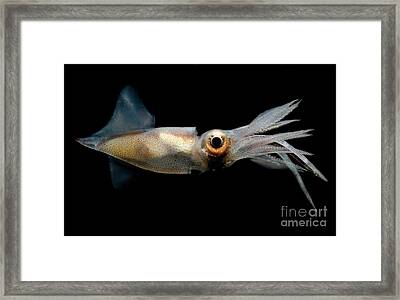
The composition and species abundance of squid during various stages of the Pleistocene will forever remain a mystery.  There are over 300 known species of squid in the world today, but scientists know little about squid species abundance of the present day, let alone of the distant past.  One study of squid off the eastern coast of Florida determined eye flash squid (Abralia cf veranyi), flying squid (Ommastrephidae sp.), and shortfin squid (Illex sp.) were the 3 most abundant genera or families.

Image result for eye flash squid

Eye flash squid are 1 of the most common species found off the coast of eastern Florida.

Image result for shortfin squid

Shortfin squid–another common species.

Image result for flying squid

Flying squid shoot out of the water to escape predators.  

sperm-whale-and-giant-squid_smalldynamiclead_dynamic_lead_hero_image

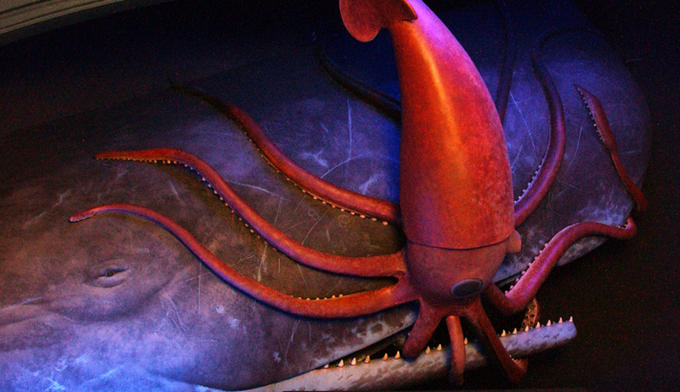
Sperm whales feed mostly on squid.  Individuals can be distinguished by scars from battles with giant squid.

I’m not impressed with the flavor of calamari.  I’ve had it in a Vietnamese pho soup.  The soup itself was delicious, but the calamari was rubbery and tasteless.  I’ve tried fried calamari but this too had no flavor.  The best squid I’ve ever eaten was a canned Korean product.  The squid, packed like sardines, were seasoned with soy sauce and sugar.  The seasoning would’ve made anything taste good.  However, the squid were not cleaned, and I had to be careful chewing so I wouldn’t break a tooth on the hard beaks.

Reference:

Erickson, Carrie; Clyde Roper and Michael Vecchione

“Variability of Paralarval-Squid Occurrence in Meter-net Tows from East of Florida, USA”

Southeastern Naturalist 16 (4) 2017


Design a site like this with WordPress.com
Get started