Tallow Plum (Ximenia americana) and Pre-historic Rafting Events

June 3, 2018

I posted the below photo on the Florida Flora and Systematics Facebook page, and the 2 plants in the picture were identified within about 5 minutes.  I saw this shrub and flower growing at Manatee State Park in Florida, while I was in the sunshine state visiting my sister and mother who recently moved there.  I joined that Facebook group because I am not as familiar with plants found in Florida as I am with Georgia’s flora.  I’ve read about tallow plum, but it was a big help for someone to help me identify it.

The flower in the foreground is Chapman’s pea (Chapmannia floridanus); the scrub bush in the background is tallow plum.

Tallow plum is in the Olalaceae family which includes olive, ash, and privet.  It produces an edible, waxy, sour fruit; and the tree reaches an height of 18 feet.  The tough plant thrives on sandy soils and can even grow on beaches, perhaps explaining its wide geographical distribution.  This species is found throughout most of Florida as well as the Caribbean, Central and South America, Africa, and Australia.  I wondered how it attained such a vast geographic distribution, but when I researched the species on google, I found no scientific studies delving into this mystery, and I learned no genomic wide studies of the Olalaceae family have been conducted yet.  I couldn’t even find any speculative discussions of its range, so the ancient history of this species has been overlooked.

I hypothesize tropical storms disbursed this species on rafts of vegetation to different continents near the equator.  Hurricanes can wash plant material far out to sea, and when it lands on a different continent, surviving flora and fauna can then colonize new territory.  (Animals often cling to these rafts of vegetation.) This hypothesis has also been proposed to explain how monkeys and rodents originating from Africa colonized South America, and it is the commonly accepted explanation for how anole lizards conquered Caribbean Islands and southeastern North America.  The ability of tallow plum to grow on sandy soils helped them set roots on beaches when they made landfall, following severe storms and currents that carried them halfway around the world.  Uprooted plants must have been able to survive for weeks while floating on the ocean before reaching land where perhaps waves or river currents reburied the roots in soil.  Some soil likely clung to the floating uprooted plants, and timely rains helped keep the plants alive.

The only fossil site with specimens of tallow plant is of Pliocene-age, and it is found in Africa.  The site is estimated to be between 4.3 million years BP-3.8 million years BP.  The only other species of tallow plum (X. caffra) is also found in Africa.  It seems likely Africa is the continent of origin for tallow plums.  Geneticists could shed light on the evolutionary history and distribution of tallow plum, if they ever look at its genome.


An Anatomical Comparison Between the Extinct North American Cheetahs (Miracynonyx sp.) and the Late Pleistocene/Holocene Cougar (Puma concolor)

May 28, 2018

One of my readers recently asked whether the cougar (Puma concolor) might be the same species as the extinct North American cheetahs (Miracynonyx inexpectatus and M. trumani).  This is not as ridiculous a question as a layman might think because paleontologists often mistakenly identify multiple species from fossil remains that after re-evaluation are eventually determined to be from 1 species.  I love reading articles about vertebrate paleontology, but I usually skip over anatomical descriptions because they are pretty dry.  But to answer his question, I used google to search for a paper comparing the anatomical differences between Puma and Miracynonyx.  I did not find a journal article with a comprehensive anatomical comparison between the 2, but I did recall a paper I’d already read that discussed some of the differences.  I’ve linked the paper below in  my references.

Cougars and North American cheetahs had different-sized teeth.  Cougars have larger canines and lower molars than North American cheetahs, but they have smaller lower premolars (p4) and smaller upper pre-molars (P3).  They also have a “less reduced protocone on upper premolar P4.”  North American cheetahs had longer limbs than cougars as the below photos from the linked paper show.  So the answer is no.  Cougars were definitely not the same species as the North American cheetahs.

Fossil history of the panther (Puma concolor) and the cheetah-like cat (Miracinonyx inexpectatus) in Florida - Page 208

Comparison of limb bones between cougar and North American cheetah shows the latter had longer hind foot bones and were better runners.

Fossil history of the panther (Puma concolor) and the cheetah-like cat (Miracinonyx inexpectatus) in Florida - Page 210

North American cheetahs had longer front foot bones as well.

Cougars and North Americans cheetahs are closely related, however.  Genetic evidence suggests their shared lineage originated 6-8 million years ago, and a puma-like cat, probably Puma pardoides, crossed the Bering Land Bridge from Asia shortly after this.  In North America the puma-like ancestor diverged into 3 lines: cougars, North American cheetahs, and jaguarundis. The Puma genus diverged from Miracynonyx about 3.2 million years ago.

The fossil evidence shows M. inexpectatus  lived all across North America from the late Pliocene to the middle Pleistocene (~3 million years BP-~300,000 years BP).  In the Florida Museum of Natural History there are 47 records in state of M. inexpectatus at sites thought to date from the Pliocene to the mid-Pleistocene, but they are known from just 1 late Pleistocene site in Florida.  This site is named Lecanto 2A. The only other Late Pleistocene site with a possible M. inexpecatus  fossil (1 leg bone) is in Cavetown, Maryland.  These specimens can’t be radio-carbon dated.  The reason the specimen from Lecanto 2A is considered Late Pleistocene is its association with specimens of other species known from this age including dire wolf, Florida spectacled bear, rice rat, and cotton rat.  It’s possible there were relic populations of M. inexpectatus  still living during the Late Pleistocene, but it seems more likely it’s a case of older fossils getting mixed with younger fossils.

M. inexpectatus  expanded its range at a time coinciding with the expansion of grassland habitat.  Its long legs helped it run down prey.  M. trumani was even more adapted for living in open habitat.  This species appeared during the Late Pleistocene and was restricted to western North America as far as we know from the fossil record.  M. trumani is probably a descendent of M. inexpecatus which had intermediate characteristics between cougars and M. trumani. 

The paleobiology database indicates cougar fossils dating to the Early and Mid Pleistocene in California, Idaho, Washington, and Mexico have been reported.  Nevertheless, cougar fossils predating the Late Pleistocene are rare.  In the Florida Museum of Natural History there are 44 records of cougar from the Late Pleistocene but just 2 from the Mid Pleistocene and 2 from the Early Pleistocene.  The early Pleistocene specimens are referred to as Puma lacrustis, but I searched for this scientific name on google and found nothing, so I’m not sure what these specimens actually were.  Genetic evidence suggests cougars were well established in South America between 300,000 years BP-200,000 years BP, and this corresponds with the widespread fossil evidence of this species throughout North America during this time period.  I hypothesize cougars began to expand their range widely during an early Rancholabrean interglacial from a regional ancestral population undetected in the fossil record.  This time period would correspond to when forested conditions expanded.  Cougars are ambush predators that prefer forests and woodlands.

North American cheetahs are not as closely related to Old World cheetahs as previously thought.  Physical similarities between the 2 are just another example of convergent evolution.

References:

Barnett, Ross; et. al.

“Evolution of the Extinct Sabretooth and the American Cheetah-like Cat”

Current Biology 15 (5) August 2005

Culver, M.; W. Johnson, J. Pecon-Slattery, and S. O’Brien

“Genomic Ancestry of the American Puma (Puma concolor)

Journal of Heredity 91 (3) 2009

Morgan, Gary and Kevin Seymour

“Fossil History of the Panther (Puma concolor)  and the Cheetah-like Cat (Miracynonxy inexpectatus) in Florida”

Bulletin of the Florida Museum of Natural History 1997

http://ufdc.ufl.edu/UF00095787/00001/1j


Florida Cracker Cattle (Bos taurus)

May 23, 2018

Even if there were no historical accounts, modern scientists could determine when European livestock were introduced to the Americas.  Scientists can take cores of sediment, radio-carbon date it, and measure the amount of sporomiella in each dated layer.  Sporomiella is a dung fungus spore found in the excrement of large mammals and is used as a proxy to estimate megafauna populations.  Scientists know when Pleistocene megafauna populations collapsed in some regions based on the amount of sporomiella in sediment, and they also can determine when European livestock were introduced using the same method.  Following the introduction of cows, horses, and pigs; the amount of sporormiella in the environment spiked to levels often equivalent to those of the pre-late Pleistocene extinctions.

Introduced livestock frequently outlasted the initial expeditions that brought them.  Early Spanish explorers of the 16th and 17th centuries perished with regularity in the harsh New World environments, so far from their accustomed European civilization, and some were massacred by Indians, but the cattle, pigs, and horses they brought with them ran wild.  The Europeans and their livestock carried contagious infections that decimated Indian populations with primitive immune systems as well, and feral livestock thrived in environments with low numbers of people.  The husbandry practices of early European settlers facilitated the increase of feral livestock populations.  Busy missionaries and homesteaders let their animals forage in the woods and fields, and the beasts often escaped and joined their free cousins.  Local environmental conditions shaped the evolution of feral livestock, weeding out those not adapted to living wild under each region’s unique conditions.  New breeds were born.

The Florida cracker cattle, also known as the piney woods cattle, rapidly evolved to thrive in the open pine savannahs of Florida and south Georgia.  They are related to the better known Texas longhorn cattle and also descend from cattle brought by the earliest of Spanish explorers.  They were already adapted to the warm climate of Spain, but in Florida the breed evolved tolerance for the humidity and local parasites. The tough cattle readily produced many calves on the low quality grasslands of the region, and their ferocity helped them fend off cougars, wolves, and bears.   Florida cracker cattle may be the “buffalo” that William Oglethorpe, the man who founded the state of Georgia, hunted during the early 18th century.  Colonial Europeans used the term “buffalo” interchangeably for both bison and feral cattle.  William Bartram saw great mixed herds of Florida cracker cattle, horses, and deer when he traveled through Florida in 1776.

Image result for Florida cracker cattle

Florida cracker cattle.  They are small–bulls weigh between 800 pounds to 1200 pounds.  Most are brown or partly brown and white but they come in a variety of coat colors.  The name cracker comes from the British settlers, known as crackers, because they cracked whips when they drove livestock on the road.

Florida cracker cattle were the best breed of cattle able to survive in the deep south until Brahman bulls from India were introduced during the 1930s.  Then, scientists invented antibiotics and medicines to treat parasites, and farmers were able to raise more productive breeds of cattle which they crossbred with the native cattle.  The Florida state legislature passed a law in 1949 outlawing free ranging cattle because farmers wanted to prevent the transmission of diseases from wild cattle to their preferred domestic breeds.  The Florida cracker cattle population plummeted.  Now, there is an effort to save the breed.  38 people still raise Florida cracker cattle, and herds are maintained at the Tallahassee Agricultural Complex, Withlacoochee State Park, Lake Kissimmee State Park, Payne’s Prairie National Wildlife Refuge, and Dudley Farm.  Customers who like free-roaming grass fed beef pay top dollar for meat butchered from the breed.

Manatee State Park and Bradenton, Florida

May 20, 2018

I visited southwestern Florida last week to see my Mom for Mother’s Day.  We spent some time at Manatee State Park as well, and I saw lots of wildlife on my trip through the state.  There are no manatees in Manatee State Park.  Manatee Lake is a manmade reservoir, created when the Manatee River was dammed.  Manatees live in the river but they can’t get past the dam.  Manatee State Park is about 500 acres and hosts a mostly scrub environment of saw palmettos, grape vines, stunted live oaks, and Florida sand pine.  Supposedly, fox squirrels occur in the park, but I just saw gray squirrels.

I saw interesting wildlife on my trip while driving from Augusta, Georgia to Bradenton, Florida; but unfortunately I couldn’t take photos while traveling 70 mph down the highway.  I was lucky enough to spot an extremely rare whooping crane standing by I-75 south of the Tampa exit.  There are only about 100 whooping cranes in Florida.  I expected to see sandhill cranes (which I also saw), but was shocked to see a whooping crane. I saw swallowtail kites 5 times but couldn’t take photos of the birds because they wouldn’t stop moving.  My sister lives on a golf course that recently was a cattle ranch, and the wildlife hasn’t left yet, despite the development.  I did get a decent photo of a bobcat, though it was walking fast.

The list of species I saw in Florida included whooping crane, sandhill crane, swallowtail kite, Mississippi kite, osprey, king rail (I think), cattle egret, great egret, green heron, great blue heron, Canadian goose, turkey, turkey vulture, black vulture, white ibis, mourning dove, mockingbird, rufous sided towhee, blue jay, laughing gull, brown pelican, cormorant, crow, red-winged blackbird, boat-tailed grackle, chimney swift, cardinal, black bellied whistling duck (I think), house sparrows, gray squirrels, and bobcat.  I saw road-killed opossum, armadillo, raccoon, and white tail deer.  I heard barred owl, chuck will’s widow, and tufted titmouse.  In south Georgia species I saw that I didn’t also see in Florida were loggerhead shrike, red-shouldered hawk, feral chicken, and starling.

I remember riding through central Florida in the late 1970s when citrus orchards could be found on both sides of the highway for long stretches.  I didn’t see a single orchard.  Instead, the orchards have been replaced by beautiful cattle ranches with pasture surrounding groves of live oaks.  Big flocks of cattle egrets follow the grazing cows.  It is excellent habitat for black bears and cougars.  Black bears do occur in central Florida, and cougars may eventually establish a permanent population there, but currently breeding females are mostly restricted west of Lake Okeechobee.

Click on the photos below to enlarge them.

Despite the sign, my daughter and I swam in Lake Manatee.  A couple of British tourists were astonished that we dared swim in the lake..  Actually, riding in a car is much more dangerous than swimming with alligators.

Lake Manatee supplies drinking water for 2 counties.

Stunted live oaks at Manatee State Park.  Gray squirrels foraged for acorns here but I didn’t see fox squirrels.

Saw palmetto dominates Manatee State Park.

Love bugs (Plecia nearctia) were mating and were everywhere.  Dead love bugs covered my front fender.

I saw this cormorant drying its wings from my sister’s back porch.  (At least I think it is a cormorant and not an anhinga.  It’s difficult to tell from the back.)

I took a blurry photo of a bobcat on the golf course behind my sister’s house.  It was walking fast and wouldn’t let me take a clearer photo.  It was headed toward an area inhabited by wild pigs.  We heard a squeal shortly after I took this photo.  Maybe the cat grabbed a piglet.

I think this is a black bellied whistling duck.  Initially, there were 3 of them on my sister’s roof.  The fulvous whistling duck also lives in Florida.  Both of these Central and South American species are expanding their range north.  All the houses in my sister’s neighborhood were built with these hurricane-proof roofs.


The Chesser Island Boardwalk in the Okefenokee National Wildlife Refuge

May 16, 2018

Miles of open pine savannahs formerly surrounded the Okefenokee Swamp, but that land has been almost entirely converted into enormous pine tree farms with much less floral and faunal diversity.  100 years ago, developers tried to ruin the swamp itself as well.  They felled cypress forests and attempted to drain the swamp with canals.  Thankfully, they were bankrupted because the swamp was too resilient and impossible to develop, so the government designated it a wildlife refuge.  There is a nice boardwalk at the end of Chesser Island Road that leads to an observation tower.  I walked to the tower last Saturday with my wife and daughter and took the following photos.

The entrance road leads through a slash pine savannah with an undergrowth of saw palmetto, ferns, and wiregrass.

2 big alligators were hanging around a lily-covered roadside ditch.

Ferns are abundant in fire-adapted landscapes, like the Okefenokee.  Ferns were the first plants to sprout following the K-T impact that wiped out the dinosaurs.

Fire creates the open landscape of the Okefenokee.  Without fire it would become a closed canopy cypress forest.

Barred owl.  They are common in the swamp.

The fire of 2013 killed lots of cypress trees.  Note the charred trunks.

The boardwalk is 3/4 of a mile.  I was able to easily push my wife’s wheel chair all the way to the observation tower.

I heard pig frogs and cricket frogs at this pond, and an eastern kingbird was hunting insects over the water.

Open Okefenokee marshes are called “prairies.”

Spanish moss.  Strange as it may seem, Spanish moss is related to pineapple.

Soft shelled turtle.

The list of animal species I saw on this excursion in less than 90 minutes included alligator, soft shelled turtle, rabbit, pileated woodpecker, barred owl, black vulture, red-winged blackbird, boat-tailed grackle, mourning dove, mockingbird, eastern kingbird, yellowthroat warbler, laughing gull, great egret, black swallowtail butterfly, and at least 4 species of dragonflies.  I heard chimney swifts, pig frogs, and cricket frogs, and raccoon scat littered the boardwalk.  I was surprised I saw just 1 wading bird.  On a previous trip to the Okefenokee I saw none.  I saw the laughing gulls near the county landfill just outside the refuge. I couldn’t determine if the rabbit was a cottontail or marsh rabbit.  It slipped into the palmetto before I could take a photo of it.

Recent Items about the Late Pleistocene in the News

May 10, 2018

3 stories relating to the late Pleistocene recently made the mainstream news.  The first story is about the upcoming resurrection of the woolly mammoth (Mammuthus primigenius).  George Church of Harvard University is using CRISPR technology to genetically engineer a woolly mammoth by editing Asian elephant (Elephas maximus) DNA.  (I explained CRISPR technology in a previous blog entry.  See: https://markgelbart.wordpress.com/2016/07/22/possible-resurrection-of-the-mammoth-as-early-as-2018/  ) Scientists at Church’s lab are going to edit in the phenotypical characteristics that make the woolly mammoth able to survive in cold wet climates with extremely short and long days.  These characteristics include a layer of fat, long oily hair, small ears, the ability to withstand cold temperatures, and adjustments to the circadian rhythms animals that live in the Arctic require.  They think they can produce a genetically engineered woolly mammoth by 2019.  Scientists hope to eventually engineer herds of woolly mammoths that can live in Siberia where their activities will convert the tundra landscape into a grassy steppe.  Ecologists believe a grassy steppe environment will better prevent permafrost from melting, thus mitigating anthropogenic global warming.  I’m all in favor of resurrecting herds of woolly mammoths, but I believe their goal of mitigating global warming is a pipe dream, and I doubt woolly mammoths could survive in the present day tundra.  I suspect woolly mammoths were confined to relic steppe habitat during interglacials.  Climate is a much greater influence on sub-Arctic habitat than the activities of megafauna.  Woolly mammoths could probably survive today on the grassy Tibetan steppes but not in the Siberian tundra.  The mammoth steppe of the late Pleistocene was more like the modern Tibetan highlands than the Siberian tundra.

The 2nd story reported the results of a statistical study that determined the average size of mammal species has declined over the past 130,000 years, and the authors of this study squarely blame man.  Humans have been overhunting large mammals that reproduce slowly to extinction, leaving smaller species that can better replenish their populations with faster breeding.  Rabbits breed faster than mammoths and elephants.  The average size of a North American mammal species during the late Pleistocene was 216 pounds compared with the average North American mammal species of today which weighs 16 pounds. This decline in body size is unprecedented over the past 65 million years and hasn’t occurred since the extinction of the dinosaurs.  The fossil record is pronounced…this statistical study just confirms the obvious.

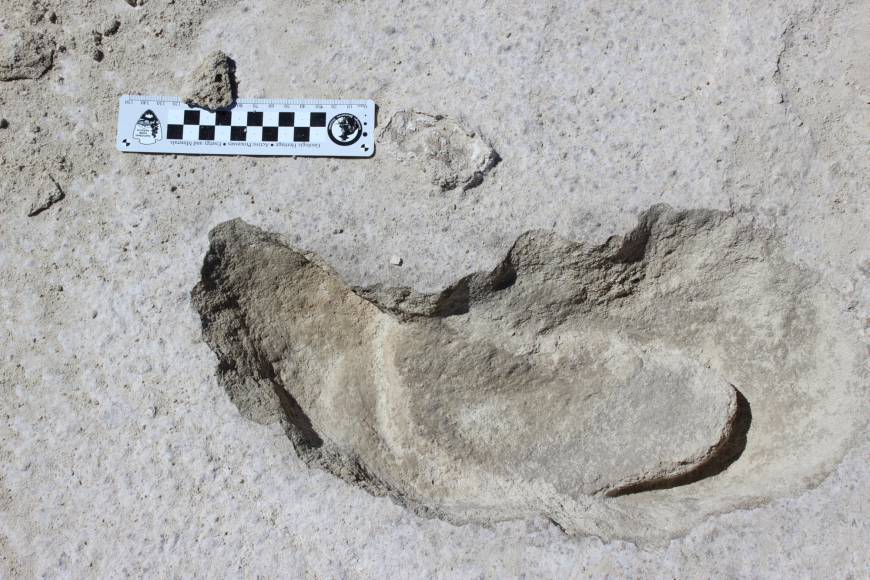
Evidence humans may or may not have tracked a ground sloth in New Mexico is perhaps the most interesting story.  There are thousands of late Pleistocene-aged animal tracks in the White Sands National Monument.  During the Ice Age weather patterns were different due to altered climate cycles, and southwestern North America was much wetter than it is today.  The site of these tracks, presently a desert, was a lake shore then.  The animals walked on the edge of the lake in the mud and the tracks have been preserved for thousands of years.  Scientists found human tracks adjacent and actually within ground sloth tracks.  Ground sloths usually walked in a straight line, but these tracks appear to show the ground sloth zig-zag, as if it was avoiding a predator.  There are 2 sets of human tracks.  One human was directly following the ground sloth–his steps are inside the ground sloth steps; the other human was walking very gently beside the other person, as if on tiptoe.  The ground sloth circled around and appeared to rise up on its legs and bare its claws.  There are claw marks in the ground too.  Scientists suggest 1 human was distracting the ground sloth, while the other was sneaking up on it to deliver a fatal spear thrust or blow to the head with a club.  The end result is not recorded in the tracks.  Other scientists are skeptical of this interpretation.  Some think it unlikely humans would hunt the sloth in such an open landscape.  However, this site was not as open then as it is today, and humans could easily outpace a ground sloth.

Image result for human footprints inside sloth prints

Human footprint inside sloth print.  The sloth print is 22 inches long.  The human footprint is 5 inches.  The sloth had a wider stride, so the human must have been hopping to get his foot inside the sloth’s print.

I wish there were more mainstream news stories about the late Pleistocene.  It’s much more interesting than waiting for Donald Trump to get impeached.

References:

Daley, J.

“Fossil Tracks May Record Ancient Human Hunting Sloth”

Smithsonian April 20, 2018

Smith, F.; et. al.

“Body Size Downgrading of Mammals over the Late Quaternary”

Science  April 2018

Fish Nest Associates

May 6, 2018

The bluehead chub (Nocomis leptocephalus) is a keystone species in piedmont and mountain rivers and streams of southeastern North America.  Dozens of species of shiners spawn and lay their eggs in bluehead chub nests.  Without the existence of bluehead chubs most of these species would probably become extinct.  Bluehead chubs and shiners are members of the minnow family, known scientifically as the Cyprinidae, and bluehead chubs are 1 of the largest minnow species, growing up to 8 inches long.  Bluehead chubs make large gravel nests and aggressively protect their young.  They bury their eggs with large pieces of gravel and in the process bury and protect the eggs of other minnow species.  A complex ecosystem inhabits bluehead chub nests. Many macroinvertebrates live in bluehead chub nests alongside the minnow eggs.  Snails, clams, and the larval stages of dragonflies, dobsonflies, caddisflies, and beetles use the bluehead chub nests for shelter.  Salamanders and darters prey on the invertebrates entering and exiting the nests.  Scientists believe shiners and bluehead chubs both benefit from the congregation of eggs and hatchling fish, referring to the relationship as mutualism.  The great abundance of eggs from several different species dilutes the losses to predators, and more young of each individual species survives.

Image result for blue chub range map

Bluehead chub range map.

Bluehead Chub

Bluehead chub.

Image result for rainbow shiner

Rainbow shiner (Notropis chrosomus).  Some shiners can get quite colorful.

Many other species of fish associate in the same nests.  Rough shiners (Notropis baileyi), saffron shiners (N. rubicroceus), and greenhead shiners (N. chlorocephalus) spawn in creek chub nests.  Redfin shiners (Lythurus umbratalus) spawn in green sunfish (Lepomis cyonellus) nests.  All of these associations result in increased reproductive success for both species.  Some shiners will use central stoneroller nests, but prefer chub nests and will move their spawning activity to bluehead chub nests, if they become available.

The evolution of fish nest association must be very ancient.  It seems likely the host fish evolved first, and the species of fish using the host’s nest lost their ability to make their own nests when they came into contact with the larger  host species because the host could build bigger nests that offered more protection.  Host species are usually larger and better able to defend the nest than the smaller minnows, but they benefit too from the sudden population explosion of potential food for predators that might otherwise eat their hatchlings.

Reference:

Johnston, Carol

“Nest Associate in Fishes: Evolution of Mutualism”

Behavioral Ecology Sociobiology 35 1994

Swartwout, M.; F. Keating, and E. Frimpas

“A Survey of Macroinvertebrates Colonizing Bluehead Chub Nests in a Virginia Stream”

Journal of Freshwater Ecology 2016

Journey of the Pawpaw Seeds

April 29, 2018

Dinosaurs probably ate pawpaws.  The large size of the fruit likely evolved to attract hungry dinosaurs that then deposited the still viable seeds in piles of dung. Scientists identified fossil pawpaw leaves from both late Cretaceous and Eocene age strata.  Though many  Cretaceous plant genera didn’t survive the K-T impact that rubbed out the dinosaurs, pawpaws along with fig, sycamore, and laurel did.  Pawpaws profusely produce sucker roots, and this habit likely allowed them to regrow after the cometary impact incinerated above-ground vegetation.  The species of pawpaw that grew during the Eocene was Asimina eocenica.  Fossil leaves, or rather impressions, of this species have been found in Texas, Colorado, and Wyoming.  Pawpaws no longer range into the latter 2 states, but, of course, climate was much warmer during the Eocene.

There are 7 species of pawpaws.  The most common is the eastern pawpaw (A. triloba) which ranges throughout most of Eastern and Midwestern North America and is found in 26 states.  All other species of pawpaws occur either in south Georgia, Alabama, and Florida or are found exclusively in Florida.  The list of other pawpaw species includes slimleaf pawpaw (A. longifolia), big flower pawpaw (A. obovata), small flower pawpaw (A. parviflora), dwarf pawpaw (A. pygmea), netted pawpaw (A. reticulata), and 4 petal pawpaw (A. tetramera).  The great number of species found in Florida might suggest this may have been a center of evolutionary origin, but pawpaws first evolved before Florida even existed. Instead, pawpaws likely speciated in this region when high interglacial sea levels isolated various populations.  Pawpaws are the only genera within the Annonacea family that can survive in temperate climates.  All other species within this family such as custard apple, cherimoya, and sweetsop are restricted to tropical regions.  The larva of the zebra swallowtail butterfly (Protographium marcellus) feeds exclusively on pawpaw leaves, and it also is a rare temperate member of a mostly tropical subfamily.  There are 150 species of Graphinii butterlies, and the zebra swallowtail is 1 of only 2 species that occur in temperate climates.  There were probably more species in the Annonacea family and Graphinni subfamily that occurred in North America during the Miocene when climate was more tropical to subtroptical, but pawpaw and zebra swallowtails were the only ones that evolved the ability to survive frosts.

Scientists believe the present day patchy distribution of pawpaws indicates it depended upon now extinct megafauna for dispersal.  Beasts such as mastodons and ground sloths ate the large fruit and deposited the seeds throughout the environment.  Today, pawpaws mostly grow as an understory tree in shady bottomland forests, but they produce more fruit in sunny locations.  It seems probable that in the past mastodons would carry the fruit away from the shade in their alimentary tracts and defecate the seeds in a sunnier spot.  In a recent experiment horses and Asian elephants refused to eat pawpaws.  However, mastodons were not the same species as the Asian elephant, and they co-existed with pawpaws (an exceptionally nutritious food source) for millions of years.  Despite the results of this experiment, I believe mastodons ate pawpaws.  Genetic studies suggest pawpaws still have high genetic diversity because not enough time has passed since the extinction of their megafaunal dispersers.  Native Americans cultivated orchards of pawpaws, and  Iroquois Indians may have spread the fruit to its northernmost range limits.

Pawpaw fruit.  I grew saplings from these seeds.  The fruit is very sweet, has the texture of a cooked sweet potato, and exudes a tropical aroma.

Pawpaws are not well known today because they are difficult to market and cultivate.  The fruit has a shelf life of 2 weeks, so it can’t be warehoused, though it can be frozen.  Experimental breeding may eventually prolong the shelf life, however.  Wild strawberries have a shelf life of 1 day, but cultivated strawberries have been bred to last at least a week.  Pawpaws grow slowly and have low pollination rates and thus low fruit production.  Bees don’t pollinate pawpaw flowers.  Instead, the red flesh color of the fruit attracts scavenging beetles, fruit flies, and blow flies.  Flies and beetles are less efficient pollinators than bees.  The center of modern day pawpaw cultivation is in Kentucky.  Many new varieties are being developed and perhaps soon, they will be found in grocery stores or farmer’s markets.  All but 2 of the 60 varieties grown during the early 19th century have been completely lost as the fruit became forgotten by urban and suburban spawn of the rural folks who grew them.

A nice lady from Indiana sent me some pawpaw fruit almost 6 years ago.  I was able to germinate 5 saplings from 30 seeds.  The saplings are growing slowly and the top trunk of 2 of them broke off last fall.  I’m not sure why this happened. I don’t see zebra swallowtails in my neighborhood, but some insect, perhaps another species of swallowtail larva, has been eating the leaves.  I doubt I’ll ever get fruit from these trees.

The best of my 5 year old pawpaw trees.  I’m not going to transplant it.  Thick roots are already growing through holes in the bottom of the pot.

Compare the above 5 year old pawpaw sapling with this 4 year old peach tree that I also planted from seed in my yard.  The peach tree is 12 feet tall and loaded with fruit.  Click to enlarge.

References:

Berrry, Ed

“The Lower Eocene Floras of Southeastern North America”

U.S. Geological Professional Paper 91 1916

Lu, Li; J. Lowe, and S. Crabtree

“Genetic Variation in Pawpaw Cultivation Using Marosatellite Analysis”

Journal of the American Society of Horticulture 2011

Homaza, Jose

“The Pawpaw, a Forgotten North American Fruit Tree

http://www.arboretum.harvard.edu

A Pleistocene Cloud Forest

April 22, 2018

Cloud forests are lush environments unique to high elevations located within tropical latitudes.  Vines cover evergreen trees and ferns carpet the ground.  Cloud forests occur along the Andes Mountains from Central America to Argentina at elevations between 3600-10,800 feet, and most are frost free due to the tropical latitude, though they are cooler than lowland forests.  The low seasonality of cloud forests allows for a diverse assemblage of flora and fauna.  Some common plant species found growing in South American cloud forests are elephant ear, strangler fig, and walking palm.  Over 400 species of birds reside in cloud forests including an astonishing 30 species of hummingbirds.  Mammals such as tapir, peccary, brocket deer, jaguar, cougar, ocelot, and spectacled bear roam cloud forests.  Even more species of reptiles and amphibians abound in the thick vegetation of the understory.  Huge beetles and a butterfly with see-through wings are just some of the countless insects that thrive in cloud forests.

Image result for map of cloud forests

Location of cloud forests around the world.

Image result for cloud forests in Ecuador

A cloud forest in Ecuador.

Image result for Walking palm

Walking palm trees.

Image result for butterfly with see through wings

Invisible wings make this butterfly hard for predatory birds to see.

A site with evidence of a Pleistocene-aged cloud forest was unearthed during the construction of an highway in Ecuador.  Scientists examined pollen, geochemistry, and charcoal excavated from strata here dated to between 45,000 years BP-42,000 years BP. During those 3000 years the site went through 3 successional stages.  Pollen evidence suggests during the initial stage that it was a valley floor swamp dominated by grass, aster flowers, and plants in the nightshade family.  This environment was replaced by a forest of holly and plants in the Melstomataceeae and Weinmannia families.  Melastomataceae is a family of tropical flowering plants, and the Weinmannia family includes 65 tropical plants.  This stage succeeded to an environment dominated by alder, myrtle, and plants in the hedyosum genus which includes 65 tropical species.  The latter 2 stages consisted of plant compositions that don’t occur in present day cloud forests.

The authors of this study also measured the amount of sporormiella in the sediment.  Sporormiella is a dung fungus and is used as a proxy for megafauna abundance when fossil evidence is not available.  The amount of sporormiella suggests megafauna were present but not abundant.  Ground sloths, giant armadillos, and gompotheres (a type of mastodon) compose part of the regional fossil record here.  These species were likely the source of the sporormiella in the 42,000 year old sediment.

Fire is rare in montane cloud forests, but there are plenty of other agents of change that cause the environment to go through successional stages.  Landslides on steep slopes after heavy rains can demolish a forest, opening an opportunity for pioneer plants.  Wind throws and forest dieback from old age, disease, or insect infestation also opens up space for pioneer species.  Megafauna probably had just a minor impact on Pleistocene cloud forests because they were not abundant here and plant growth is rapid.  The authors of this study did find volcanic ash in the sediment.  Volcanic-sparked fires do burn some cloud forests, forcing the environment to regenerate through several successive stages.

Reference:

Loughline, N.; et. al.

“Landscape Scale Drivers of Ecosystem Change in the Montane Forest of the Eastern Andean Flank, Ecuador”

Paleogeography, Paleoclimatology, and Paleoecology 2017

Speculative Distributions of Megafauna in Georgia 36,000 years BP

April 15, 2018

A recent statistical study estimated the abundance and natural ranges of megafauna species (mammals over 40 pounds), if man didn’t exist today.  They analyzed 5,742 megafauna species that have existed over the past 130,000 years, a time span including a full glacial/interglacial cycle.  Not surprisingly, they concluded the natural ranges and abundance of megafauna would be much greater today, if not for man.

Image result for historic and prehistoric human-driven extinctions have reshaped global mammal diversity patterns

Maps showing natural ranges and abundance of megafauna.  The top shows today’s abundance.  The bottom shows abundance today, if man didn’t exist.  Map is from the below reference.

This study inspired me to draw speculative range maps for selected megafauna species that lived in Georgia 36,000 years ago–long before people ruined the wilderness.  I chose this time period because it was an interstadial, a warmer wetter climate phase within the last Ice Age, and I think wildlife populations were higher then than during the Full Glacial Maximum when at least some of Georgia consisted of desert-like habitat.  My maps are educated guesses because the Pleistocene fossil record of Georgia is extremely incomplete.  Megafauna populations were not evenly distributed throughout the state.  I assumed the northern part of the state held more forest and woodland, while the southern half hosted more grassland.  But both environments existed in most of the state, often side-by-side.  Therefore, forest and forest edge species such as tapirs and long-nosed peccaries were more abundant in the northern part of the state.  Bison and horse were more numerous on the coastal plain.  Some animals migrated in and out of the state.  Isotopic evidence suggest mastodons moved back and forth between Florida and Georgia.  Like leaders of today’s elephant herds, experienced matriarchs knew where rich sources of food and mineral licks were located.  Some herds of mammoths probably moved great distances as well.  Flat-headed peccaries likely favored the sand hill scrub habitat along the fall line.

Evidence of caribou in north Georgia dates to the Last Glacial Maximum, but I believe they were so abundant even during interstadials that some herds wandered as far south as Georgia.  There is no fossil evidence of helmeted musk-ox, stag-moose, giant lion, or saber-tooth in Georgia.  I’m certain giant lion and saber-tooth did range into Georgia, and it seems probable helmeted musk-ox and stag-moose did as well.  Fossil evidence of giant lions has been found in Florida and Mississippi.  Saber-tooth bones have been recovered from all the states surrounding Georgia.  Fossil remains of stag-moose and helmeted musk-ox have been excavated from sites on the same latitude as Georgia.

The dots on my maps don’t represent any specific numerical value, but the bigger ones indicate larger populations. The maps include the 10,000 square miles of continental shelf that was above sea level between ~83,000 years BP-~7800 years BP.

Range maps of selected megafauna species in Georgia 36,000 years ago.  Click to enlarge.  I know the labels on the maps are hard to see so from left to right on the top row they are mastodon, mammoth, Jefferson’s ground sloth, stag-moose, stout-legged llama, large-headed llama.  Middle row from left to right: long-horned bison, horse, long-nosed peccary, helmeted musk-ox, giant beaver, saber-tooth.  Bottom row from left to right: tapir, caribou, flat-headed peccary, giant lion, jaguar, dire wolf.

Reference:

Faurby, S; and J.C. Svenning

“Historic and Pre-Historic Human-Driven Extinctions have Reshaped Global Mammal Diversity Patterns”

Diversity and Distribution 21 (10) Augusts 2015


Design a site like this with WordPress.com
Get started