The Pleistocene Range Extension of the American Alligator (Alligator mississippiensis)

February 4, 2018

Paleontologists excavated 6 artesian springs along the Pomme de Terre River in Missouri before they were inundated by a reservoir about 40 years ago.  They recovered many bones of Pleistocene vertebrates, including the remains of 71 mastodons, along with invertebrate material, plant macrofossils, and pollen.  The scientists published their data in 1 of the papers referenced below.  This is 1 of my favorite studies because the subfossil evidence shows how the local environment changed over time.  During a warm interstadial over 40,000 years ago the region was dominated by hardwood forests of oak, hickory, maple, juniper, dogwood, hornbeam, honey locust, ash, cherry, plum, and Osage orange.  As the climate became cooler and more arid, jack pine and prairie expanded on poor soils, while oak was restricted to richer sites.  When the full glacial maximum struck, the environment transformed into an open spruce parkland landscape where spruce had previously been absent.  The remains of at least 2 alligators were recovered from the deposit dating to the warm interstadial.  This is the northernmost known occurrence in the fossil record of Alligator mississippiensis, and it is approximately 300 miles north of its present day range.  The alligator specimens were found associated with the bones of box turtles, soft shelled turtles, ducks, Harlan’s ground sloth, gopher, giant beaver, raccoon, saber-tooth cat, mastodon, mammoth, horse, tapir, camel, white-tail deer, long-horned bison, and woodland muskox.

Image result for american alligator range map

Current range map of the American alligator.  There is a disjunct population in northern Alabama introduced by man but not noted on this map.  Note the northcentral bulge in this species’ range toward its northernmost Pleistocene occurrence in northwestern Missouri.  Pet alligators released in southern Ohio today at approximately the same latitude can survive but can’t reproduce.

The only other possible known occurrence of A. mississippiensis north of its present day range is from Ladds in Bartow County, Georgia; but I think the paper that referenced this did so in error.  The paper (also referenced below) contains a checklist of all vertebrate species known to have occurred in southeastern North America during the Pleistocene, and alligator is noted as being reported from Ladds.  However, I’ve read all the published data about Ladds, and there is no mention of alligator specimens from this site.  The supposed specimen is also not listed in the paleobiology database.  It’s possible (perhaps even probable) alligators occurred in Bartow County, Georgia during warmer climate phases because north Georgia is much lower in latitude than northwestern Missouri where their remains have been found.  If anyone knows of a Bartow County alligator specimen, please contact me.

Some scientists may think the presence of alligators north of their present day range is evidence of temperatures warmer than those of today, but this isn’t necessarily the case. Instead, Ice Ages caused a retraction in the pre-historic range of the alligator, and they perchance have failed to recolonize all of their former stomping grounds.  If average temperatures continue to increase as predicted, alligators may yet expand their range farther north. It’s also possible alligators are able to extend their range during cycles of reduced seasonality.  The earth goes through cycles when it tilts to a lesser degree than it does now causing milder winters but cooler summers.  Annual average temperatures were the same as they are today but more evenly distributed throughout the year.

Alligators are better adapted to colder climate than any other species of crocodilian.  For example during unusual cold spells American crocodiles (Crocodylus acutus) bask in the sun in an attempt to warm themselves and they often perish, but alligators seek shelter in water, and if temperatures drop too much, they live but go dormant.  Adult alligators can survive quite cold temperatures.  In the northern parts of their range alligator reproduction becomes sporadic.  Though adult alligators can survive severe cold spells, juveniles die.  Alligators require several mild winters in a row before their young get large enough to survive an harsh winter.  Cooler summers and springs will result in an all female population–another potential limiting factor in the northern parts of their range.  Alligator eggs in nests with temperatures that fall below 86 degrees F become female.  Nests are warmer than air temperatures due to composting vegetation, but they can still cool, if the surrounding temperatures are low.  Eggs won’t hatch at all when nest temperatures fall below 80 degrees F.  Either decades of severe winters or cool spring/summers or both probably caused the extirpation of the alligator in Missouri during the late Pleistocene.

Image result for alligator brumating in ice

Alligator brumating (going dormant) in ice.

The American alligator is an extremely adaptable species having survived countless climatic changes.  It has existed relatively unchanged as a species for at least 5 million years.  Scientists aren’t even able to discern a definite difference between modern alligators and fossil specimens from 5-12 million years old, so the American alligator may be a 12 million year old species.  Alligators from the early Miocene are assigned to a different species (A. olseni), and this is the probable ancestor of the modern day alligator.  A. olseni specimens have been found in Tennessee, but climate was much warmer during the early Miocene than it is today.

Reference:

King, James; and Jeff Saunders

“Environmental Insularity and the Extinction of the American Mastodont”

in Quaternary Extinctions: A Prehistoric Revolution  edited by Paul Martin and Richard Klein

University of Arizona Press 1984

Russell, D.A.; F. Rich, V. Schneider, J. Lynch-Stieglitz

“A Warm Thermal Enclave in the Late Pleistocene of the Southeastern U.S.

Biology Reviews 84 (2) May 2009

Scientists Recognize New Species of Late Pleistocene Horse (Haringtonhippus francisi)

January 29, 2018

Scientists recently recognized a new species and genera of extinct Pleistocene horse from fossil specimens already in museums.  Some of these specimens were collected over 100 years ago and were wrongly assumed to represent previously known species or genera.  During the Pleistocene there were 3 lineages of horses in the Americas–the caballine horses, the New World stilt-legged horses, and the hippidion horses.  The caballine horses belong to the Equus genus which includes all living species of horses, donkeys, and zebras.  The species of caballine horses that lived in North and South America likely included the predecessor of the modern day domesticated horse.  It was probably the same species.  The New World stilt-legged horses so anatomically resembled Asiatic wild asses and donkeys that paleontologists mistakenly thought they were closely related.  In recent years paleontologists began to reject this assumed affinity, and the genetic study cited in this blog entry supports their re-assessment.  The hippidion horses were robust species restricted to South America.  A new genetic study determined the New World stilt-legged horses, previously classified as belonging to the equus genus, were different enough to deserve their own genus.  Scientists gave this species the scientific name Haringtonhippus francisi. The species was named after the renowned Canadian paleontologist, Richard Harington.  The type specimen anatomically described in the paper was originally discovered in Wharton County, Texas.

Image result for Harringtonhippus francisi

Artists’s representation of Haringtonhippus francisi.  The coat color is the artist’s fanciful guess.

The genetic evidence suggests haringtonhippus  horses diverged from equus horses between 4-5 million years ago.  The hippidion horses diverged from the equus/haringtonhippus genera between 5-7 million years ago.  Convergent evolution explains why haringtonhippus horses anatomically resembled Old World asses.  Both evolved long slender limbs as an adaptation to arid environments.

Fossil remains of Haringtonhippus francisi  have been found in east Texas, eastern Mexico, Kansas, Nevada, California, the Yukon, and Alaska.  Stilt-legged horse fossils are known from sites thought to be 3 million years old, and they occurred until as recently as 12,000 years ago about the time man became prevalent on the continent.

If scientists are able to extract DNA from even more ancient extinct genera of horses, they may be able to straighten out horse evolution.  Many biology textbooks use the fossil record of horses and their ancestors as an example of evolution, but these family trees are based on anatomical analyses that can be misleading.  DNA evidence would produce more reliable family trees.

Reference:

Heinztman, P; et. al.

“A New Genus of Horse from Pleistocene North America”

Genomics and Evolutionary Biology Nov. 2017

Raccoon (Procyon lotor) and Swamp Rabbit (Sylvilagus aquaticus) Latrines

January 23, 2018

Many animals defecate to mark their territory, but raccoons share communal latrines where all the individuals in an area deposit their feces. Communal raccoon latrines impact the ecosystem. The raccoon roundworm (Baylisascaris procyonis) is a parasite that spends part of its lifecycle in a raccoon’s intestine. Raccoons can live with this parasite, but it can kill mice, birds, and humans. Therefore, mice and birds avoid raccoon latrines, despite the nutritional value found in undigested seeds embedded in raccoon feces. Somehow, they evolved the ability to sense the danger of a parasite playground. However, raccoon roundworm is not dangerous to rats, so raccoon latrines actually attract rats seeking edible seeds. Seeds that survive transport through a raccoon’s digestive system and are overlooked by rats may then germinate. Raccoon’s play a role in the dispersal of some plant species.

Image result for raccoon latrines

Raccoon latrine.  This batch is full of blackberry seeds.

Unlike raccoons, swamp rabbits don’t defecate in communal latrines, but oddly enough they often crap on moss-covered stumps or fallen logs. Perhaps the moss disguises the odor, preventing predators from triangulating their scent. It is also elevated, so a predator following its nose might miss it.  Researchers surveying swamp rabbit populations use these latrines to record their presence because this nocturnal species is difficult to find in the thick swamps and wetlands where they range.

Image result for swamp rabbit latrines

Swamp rabbit latrine. Note the moss.

Swamp rabbits are a species of cottontail that inhabits aquatic habitats from the Mississippi River Valley east to western Georgia and northwestern South Carolina. Another species of semi-aquatic cottontail–the marsh rabbit (S. palustris)–inhabits wetlands from western Georgia to the Atlantic Ocean and throughout all of Florida. There is little overlap between the 2 species, though they occupy the same ecological niche. How curious?

Swamp rabbit genetics has rarely been studied. A 20 year old genetic study determined swamp rabbits and marsh rabbits are closely related sister species, but this doesn’t explain why their ranges don’t overlap. So far, no geneticist has employed a molecular clock to estimate when swamp rabbits and marsh rabbits diverged or when they diverged from eastern cottontails (S. floridanus). The latter is an habitat generalist with an extensive Pleistocene fossil record. Specimens of Pleistocene eastern cottontails have been found all over North America. By contrast marsh rabbit remains dating to the Pleistocene are restricted to 8 sites in Florida and 1 site near the Georgia coast. Pleistocene swamp rabbit remains are even less common, having been discovered at 1 site in Missouri, and 1 site in Tennessee where Pleistocene remains were mixed with Holocene material, so this specimen might not even be from the Pleistocene. Some marsh rabbit remains date to the Sangamonian Interglacial (132,000 years BP-118,000 years BP). Swamp rabbits, as a species, are probably at least that old too. Both species thrived during wetter stages of climate when wetland habitat expanded. I hypothesize the common ancestor of both was a semi-aquatic species that was isolated into 2 separate founder populations during arid Ice Ages when unsuitable desert grassland habitat expanded between refuges along the Mississippi River Valley and Florida. But I still can’t figure out why they haven’t invaded each other’s ranges since then.

Genetic studies may be the best way to resolve this mystery because the fossil evidence is scant. I hope a geneticist takes an interest in this unresolved secret of nature.

References:

Fantz, Debbie; et. al.

“Swamp Rabbit Distribution on the Northern Edge of their Range in Missouri”

Southeastern Naturalist  16 (4) 2017

Halanych, K.; T. Robingon

“Phylogenetic Relationships of Cottontail (Sylvilagus, Lagamorpha) Congruence of 125r DNA and Cytogenetic Data”

Molecular Phylogenetics and Evolution 7 (3) June 1997

Weinstein, Sara; et. al.

“Fear of Feces? Trade-offs between Disease Risk and Foraging Drive Animal Activity around Raccoon Latrines”

Oikos  Jan 2018

The Ancient Rivalry Between Cats and Dogs

January 18, 2018

The PBS documentary series, Nature, recently featured a 2 part episode about cats.  During the first episode the narrator claimed cats caused the extinction of at least 40 species of dogs after the felines colonized North America.  I knew there had to be a journal article behind this claim, so I googled “cats caused extinction of 40 dog species.”  I found the paper (referenced below) and also discovered 90% of media outlets misreported the conclusions of the study.  Cats did contribute to the extinction of many dog species, but competition with other dog species and the extinct carnivores known as Barbourofelidae were also responsible for the extinctions.

Dogs originally evolved in North America, while cats originated in Asia.  About 40 million years ago a land bridge began to periodically emerge across the Bering Strait, allowing cats and dogs to colonize each other’s continent of origin.  When cats first colonized North America there were 3 subfamilies of dogs–the Hesperocyoninae, the Borophaginae (or bone-eating dogs), and the Caninae.  The Hesperocyoninae and the Borophaginae are extinct.  All living species of dogs, jackals, wolves, and foxes belong to the Caninae subfamily.

The scientists who authored the below referenced paper collected data about climate change, and the fossil occurrences of predators including Felidae (cats), Amphicyonidae (the extinct bear-dogs), Barbourofelidae, Nimravidae (false saber-tooths), and the Ursidae (true bears).  They used statistics to determine whether climate change or competition with other carnivores caused the extinction of some species of dogs.  They concluded the extinction of 1 subfamily of dogs, the Hesperocyoninae, was caused by competition with another subfamily of dogs, the Borophaginae.  Cooler climate may have contributed to the extinction of some Borophaginae species 15 million years ago.  Finally, competition with Barbourofelidae, cats, and the surviving subfamily of dogs (the caninae) drove the remaining species of Borophaginae into extinction.

Image result for Barbourofelidae

The Barbourofelidae are an extinct group of carnivores distantly related to cats but different enough to be classified as a separate family.

The species of dogs that did become extinct were often cat-like in build and probably occupied ecological niches preferred by cats.  So cats were just better than these cat-like canids at surviving in these niches.  But the Caninae were also better adapted to survive in the constantly evolving environment.  The cat and dog species that emerged from this age-old competition have achieved a kind of stalemate.  Representatives of both naturally occur on every continent but Antarctica and Australia.  (Dingos were brought to Australia by man.)  1 species of each–Canis familiaris and Felis catus —live in our homes and compete for our affections today.

Image result for cats and dogs playing together

References:

Silvestri, D.; A. Antonelli, N. Salamin, and T. Quentas

“The Role of Clade Competition in the Diversification of North American Canids”

PNAS 112 (28) 2015

Pterosaurs may have Cared for their Young

January 11, 2018

Some imagine the Cretaceous and Jurassic Ages as a time when the earth was strange and full of terrifying monsters.    The earth was a vast wilderness then, dangerous perhaps for most creatures, but it was no more strange or terrifying than the world we live in today–the Anthropocene with its genocides, terrorism, potential nuclear war, and extensive environmental destruction caused by a single dominant species.  The dinosaur world hosted species different from those of modern day earth, but these organisms were part of ecosystems recognizably comparable to those of today.  For example fish-eating pterosaurs nested in communal colonies, not unlike present day heron and egret rookeries.  Pterosaurs were not dinosaurs but instead were flying reptiles–the only vertebrates besides birds and bats to evolve the ability to fly. After their initial evolution the early Jurassic pterosaurs radiated into many species and occupied different ecological niches.  From the middle of the Jurassic until their extinction at the end of the Cretaceous 66 million years ago, there were probably about as many species of pterosaurs living in the world as there are birds today.  Evidence from 1 site in northwest China suggests pterosaurs, like so many modern day vertebrates, cared for their young.

Paleontologists found 215 fossilized eggs of a species of pterosaur known as Hamipterus tianshanensis, a fish-eating species that nested communally.  The fossils from this site date to about 120 million years BP, and they are from many generations. The nests were located next to a lake at the time of deposition.  Apparently, pterosaurs used this site annually.  Perhaps it was difficult for predators to access.  Some of the eggs contain visible embryos.  The embryos show well developed legs but underdeveloped wing bones.  This suggests the hatchlings couldn’t fly and depended upon parental care for food until their wings developed.  However this conclusion isn’t certain.  The fossils are of an embryonic stage, not actual hatchlings.  The wing bones may have developed at a later embryonic stage.

Image result for pterodactyl vs green lantern

Artist’s representations of pterosaurs have changed over the years.  In this old issue of Green Lantern from the early 1970s the pterosaur is larger than a man, featherless, and conveniently yellow.  Green Lantern’s power ring doesn’t work against yellow objects.  The wingspans of some species of pterosaurs were longer than the length of a man, but they could not have seized and carried a man away.  They were able to leap straight up and fly though, unlike large modern bird species which must take a running start.

Image result for hamipterus tianshanensis

This more modern representation of pterosaurs by Masato Hattori, a depiction of Hamipterus tianshanensis, shows the reptile covered with hair-like feather structures.  It also had teeth.

Cretaceous-aged outcroppings occur near Columbus, Georgia and the Chattahoochee River.  These are the only regions in the state where Cretaceous fossils have been found.  David Schwimmer, a professor at Columbus State, excavated 3 pterosaur wing bones from an outcropping here–the only evidence pterosaurs formerly existed in the state.

References:

Deeming, Charles

“How Pterosaurs Bred”

Science 358 (6367) December 2017

Wang, Xi; et. al.

“Egg Accumulation with 3-D Embryos Provides Insights into the Life History of a Pterosaur”

Science 358 (6367) December 2017

Pleistocene Wood Ducks (Aix sponsa)

January 4, 2018

Wood ducks differ from most other species of ducks because they nest in hollow trees, rather than in thick wetland vegetation.  Unlike migratory species of ducks that prefer to fly over open water or high in the sky, wood ducks comfortably fly between trees.  However, wood ducks do share a love of water with their kin.   Shortly after wood ducklings hatch, they jump out of their nest and follow their parent to water.  Oftentimes, their den tree is located in flooded terrain and the water guarantees a safe landing.  But the ducklings are so light they can land on solid ground without sustaining injury, though they are not yet able to fly.

Image result for wood duck

Male wood ducks are much more colorful than females.  I’ve only seen wood ducks on 1 occasion, while I was visiting Phinizy Swamp Park in Augusta, Georgia.

Wood ducks probably first speciated during the early Pliocene when Ice Ages began occurring, and glaciers caused a divergence in the Holarctic ancestral population that also gave rise to their closest living relative, the mandarin duck (Aix galericulata) of east Asia–the only other species of duck in the Aix genus.  Fossil evidence of wood ducks dating to the late Pliocene and Pleistocene has been found at 6 sites in Florida and 1 each in Oregon, New Mexico, and Georgia; suggesting the species has been widespread for millions of years.  (Pleistocene wood duck remains in Georgia were excavated from Kingston Saltpeter Cave, Bartow County.)  Wood ducks were likely most common during interglacials and interstadials when their favored habitat–beaver ponds and woodlands with abundant streams–expanded.  Wood ducks eat acorns, seeds, berries, and insects.  Oaks increased in abundance during wetter climate phases, therefore providing more acorns for wood ducks to eat.

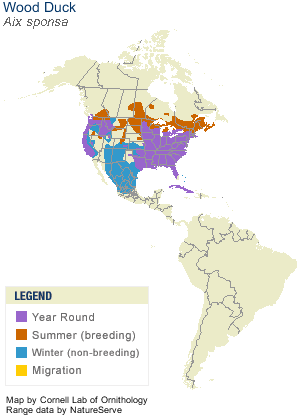
There are eastern and western populations of wood ducks.

Image result for wood duck range map

Wood duck range map.

Genetic evidence suggests these populations diverged ~34,000 years ago.  This is consistent with the record of climate change.  The stage 2 stadial that included the Last Glacial Maximum started about 29,000 years ago and before this climate frequently fluctuated between stadial and interstadial. Any 1 of the previous stadials preceding stage 2 or stage 2 itself could have caused the ecological changes isolating the 2 populations.  Dry grassland habitat expanded and streams dried up, so that eastern and western populations were separated into different refugia.  They still haven’t reconnected, even though the 2 populations come so close to each other in the midwest.

Reference:

Peters, J.L.; W. Gretes, and K. Omland

“Late Pleistocene Divergence between Eastern and Western Populations of Wood Ducks (Aix sponsa) inferred by the ‘Isolation with Migration’ Coalescent Method”

Molecular Ecology (11) October 2005

Pleistocene Fish of the Tennessee River System

December 28, 2017

Many Italians like to celebrate Christmas Eve with the feast of the 7 fishes.  I’m not Italian, but I like to eat seafood during the holiday season too, though my immediate family is small, and we enjoy the feast of the 2 fishes.  I wonder what species would’ve composed a feast of fishes for Paleo-Indians when they first entered the Tennessee River Valley.  Fish populations were much higher in the pristine pellucid waters of all southeastern rivers before man began destroying the environment, but the composition of species is poorly known because fish remains that old are rarely preserved.  A new study of fish remains excavated from Bell Cave partially unveils this mystery.  Bell Cave in Colbert County, Alabama overlooks the Tennessee River and floods periodically stranded fish inside the cave from ~13,000 calendar years BP-~30,000 calendar years BP.  Predators carried fish into the cave as well.  Scientists collected vertebrate bones from this cave between 1984-1987, but no one identified the fish remains and published the data until 2016.  This study also catalogued fish remains from other sites near the Tennessee River including Baker Bluff Cave, Beartown Cave, Guy Wilson Cave, Cheekbend Cave, Dust Cave, Little Bear Cave, Appalachian Caverns, and Saltville.

Image result for Tennessee River map

Map of the Tennessee River.

The authors of this study identified 41 taxa and 38 species that lived in the Tennessee River during the late Wisconsin Ice Age.  The number of species they identified is a subset of the population that actually swam in the river because, by chance, many species just never got trapped in the cave or were too decayed to be identified.  This is especially true for smaller species.  Almost all of the species they identified still live in the Tennessee River system today, but there are 3 exceptions.  Northern pike (Esox lucius) no longer naturally occurs this far south, although man has introduced this species into some bodies of water.  (Muskellunge, a related species, surprisingly still occurs in the Tennessee River.  Fossil evidence suggests they were fairly common here during the Ice Age.)  Northern madtom (Noturus stigmosis), a small species of catfish, also no longer occurs this far south. The harelip suckerfish (Moxostoma lacerum) became extinct during the late 19th century.  This species required very clear water with gravel bottoms, but deforestation and agriculture caused erosion that muddied its spawning grounds.  Pleistocene rives were clear enough for this species.

Image result for northern pike

Northern pike.

Image result for noturus stigmosis

Northern madtom.

Image result for moxostoma lacerum

Harelip sucker.

Rock bass were the most commonly represented fish from the Centrarchidae family catalogued in this study, but curiously they found not a single specimen of sunfish.  Bluegill sunfish are 1 of the most common fish in the Tennessee River today because they thrive in manmade reservoirs, but that kind of environment was rare before man began impounding rivers.  Sunfish probably lived in oxbow lakes that weren’t close enough to caves where their remains could’ve been preserved.

A Paleo-Indian trapping fish in the Tennessee River could’ve enjoyed a feast of 7 fishes consisting of sturgeon, northern pike, walleye, sauger, freshwater drum, bullhead catfish, and eel.  These were probably the best tasting fish available to them then.

Reference:

Jacquemin, S.; J. Ebersole, W. Dickinson, G. Ciampaglio

“Late Pleistocene Fishes of the Tennessee River Basin: an Analysis of a Late Pleistocene Freshwater Fish Fauna from Bell Cave (site Acb-2) in Colbert County, Alabama”

Peer J 2016

The Presence of Caribou in Southeastern North America during the Pleistocene and it Paleoecological Implications

December 19, 2017


The reindeer, legendary conveyor of Santa’s sleigh, is an Holarctic animal, meaning it lives south of the Arctic Circle in both North America and Eurasia.  In North America the reindeer is more commonly known as caribou.  When Europeans colonized the New World caribou lived as far south as upstate New York, but today their range in North America is restricted to Canada and Alaska.  During Ice Ages, however, almost all of their present day range was under glaciers–unsuitable habitat even for such a cold hardy animal.  Caribou range shifted south then, and caribou fossil material has been found at numerous southeastern sites including Bell Cave in Alabama, Yarbrough Cave in Georgia, 3 caves in Tennessee, off the North Carolina coast, off Myrtle Beach, and in Charleston, South Carolina (the most southeastern known occurrence).  Apparently, caribou occurred at least as far south as the piedmont region.

Image result for reindeer
Reindeer and Caribou are the same species.
Caribou fossils have been found associated with an interesting mix of species at the above-mentioned fossil sites, though it’s unclear if they all lived at those localities during the same climatic phases.  Cave and offshore sites can collect the bones of animals from many different time periods.  Nevertheless, caribou bones have been found with the remains of giant beavers, flat-headed peccary, long-nosed peccary, woodland muskox, white tail deer, stag-moose, horse, tapir, mastodon, ground sloth, jaguar, and dire wolf.  Pleistocene caribou in eastern North America likely preferred open spruce woodlands interspersed with prairies.  This habitat would have also been favorable for horse, flat-headed peccary, bison, and mammoth.  By chance caribou remains haven’t been found with the latter 2, but they probably co-occurred at some locations.  Dire wolves, habitat generalists, likely co-occurred with caribou as well and probably preyed on them.
Baker Bluff Cave in northeastern Tennessee has well stratified deposits that contain many vertebrate bones from 2 different climate phases.  Information from this site can help determine the faunal composition that co-occurred with caribou.  The oldest deposits at Baker Bluff Cave are interpreted as representing a temperate forest consisting of oak, northern pine, birch, beech, etc.  Gradually, this environment gave way to the open spruce woodland/prairie as the climate became colder and drier during the Last Glacial Maximum.  White-tailed deer remains are abundant throughout all layers of the deposit, and they co-occur with caribou in Canada today, so undoubtedly they were a contemporary of Pleistocene caribou.  Long-nosed peccary, a forest edge species, like white-tail deer, likely co-occurred with caribou as well.  Mastodon, giant beaver, and stag-moose inhabited wetland environments adjacent to caribou habitat, and I’m certain they were contemporaries with caribou.  Woodland musk-ox, another likely contemporary, foraged in shrub habitat near caribou range.
A jaguar tooth found at Baker’s Bluff Cave was excavated from the lowest oldest level.  This is evidence Pleistocene jaguars inhabited cool temperate forests, but it seems unlikely they survived in the region when the forest gave way to boreal environments.  However, caribou may have also occurred in the southeast during interstadials.  (Good carbon-dating of regional caribou fossils has yet to be conducted.)  It’s impossible to determine from available data whether jaguars inhabited the same range as caribou.  The same can be said for the tapir, a species that preferred thick forest.
Cave deposits contain an even greater abundance of small vertebrate fossils.  Most smaller animals are more restricted to certain environments than larger species, and their composition better reveals what natural communities of this locality were like.  The Baker Bluff Cave deposits are particularly interesting.  Fossil material of species still found in the region today (gray squirrels, eastern chipmunks, southern flying squirrels) were present throughout the deposit but were less common during the open spruce woodland/prairie phase.  By contrast some species that today live to the north and west of the region (13-lined ground squirrels, least chipmunks, northern flying squirrels, badgers, pine martens, fishers, magpies) were also found throughout the deposit but were less common during the cool temperate forest stage.  Red squirrels were also less common during this phase but more common after the landscape changed.  Fossil remains of 13-lined ground squirrels have been excavated from sites throughout the southeast but no longer occur east of the Mississippi.  Fossil material of birds that prefer open spaces such as upland sandpiper and prairie chicken were excavated from Bell Cave and Yarbrough Cave.  The presence of these species is evidence prairie habitat was common in the region during Ice Ages.  Pine marten specimens, dating to the Pleistocene, were discovered as far south as northern Alabama, and Pleistocene fisher specimens turned up in northern Alabama and north Georgia.  This is evidence of boreal environments in the upper south.
I hypothesize Ice Age ecosystems in southeastern North America were more diverse than they are today due to rapid climate fluctuations.  Climate phases of warm wet interstadials (but cooler on average than today) and cold arid stadials alternated but the response of the floral and faunal composition to these rapid climate changes lagged behind.  Some climate phases lasted for a few thousand years or perhaps just centuries or even decades.  They weren’t long enough to completely eliminate habitat for species with warm temperate affinities, nor did they last long enough to extirpate habitat favorable for species with boreal affinities.  This explains why eastern chipmunks co-occurred with least chipmunks, and why caribou may have shared the range with jaguars and tapirs.  During cold phases though prairie and boreal forest expanded, oak woodlands persisted on some tracts of land, especially south-facing slopes.  During warm phases oak woodlands expanded, but spruce forests persisted on north facing slopes.
Herds of caribou formerly wandered through Georgia followed by packs of dire wolves and prides of lions.  The herds traveled through fingers of prairie between open woods consisting of pine and spruce and oak where turkeys foraged on the ground and fishers chased gray squirrels through the tree tops.  Landscapes of present day Georgia are unrecognizable by comparison.
Reference:
Guilday, John; H. Hamilton, E. Anderson, and P. Parmalee
“The Baker Bluff Cave Deposit, and the Late Pleistocene Faunal Gradient”
Bulletin of the Carnegie Museum 1978

The Large Otter (Enhydritherium terraenovae) of Miocene North America

December 13, 2017

A large otter lived across North America during the Miocene and early Pliocene from at least 6.5 million years BP to about 4.5 million years ago.  Fossils of this extinct species weren’t discovered until 1985 at a site known as Palmetto Mine located in Florida.  Scientists examined the material (a jaw and teeth) and gave it the scientific name Enhydritherium terranovae.  They assumed this species of otter subsisted mostly on marine shellfish because its teeth resembled that of the extant sea otter (Enhydra lutra).  Though sea otters eat some fish and cephalopods, a great part of their diet consists of shellfish. However, a nearly complete skeleton was later discovered at the Moss Acres Race Track site located about 75 miles from where the coastline was when the specimen died.  A concentration of fish bones, otherwise rare at the site, was found in the matrix alongside the otter specimen.  Scientists interpreted the concentration of fish bones as the stomach contents of this particular otter.  This species ate fish and shellfish.  Scientists now believed Enhydritherium occupied both fresh and salt water habitats, but still thought of it as a coastal species.  Fossil remains of Enhydritherium have been discovered at 8 sites in Florida and 3 in California, so scientists wondered how a coastal species dispersed from Florida to California.  A recent discovery of Enhydritherium bones in Mexico about 125 miles from the Gulf of Mexico (and even farther from the Pacific) solves this mystery. Enhydritherium was not a coastal species, but instead occurred in freshwater habitats well inland.  Enhydritherium likely followed river systems and could travel overland for considerable distances between water sheds much like modern day river otters (Lontra canadensis) do.  I’ve seen road-killed river otters and beavers many miles from the nearest creek.

Enhydritherium exceeded the size of all extant species of otter.  They averaged 50-100 lbs.  By contrast sea otters and the giant otter of South America (Pteronura brasiliensis) normally reach maximum weights of 75 lbs. Enhydritherium also differed from modern otters in the way they swam.  Modern otters use all 4 limbs but rely primarily on their legs when they swim.  Enhydritherium had robust forelimbs, and most of their propulsion came from their arms instead of their legs.

At the Moss Acres Race Track site the Enhydritherium skeleton was found in association with the bones of rhino, horse, gompothere, and borophagine dog.  Rhinos became extinct in North America about the same time Enhydritherium did.  This faunal turnover occurred when Ice Ages began cycling.  Nevertheless, Florida, southern California, and Mexico remained subtropical during Ice Ages. Pollen evidence from the Moss Acres Race Track included oak, pine, and grass; but no tropical species.  The reason for the end of Miocene faunal turnover is unknown and probably complex.  Perhaps ecological changes caused by climate change and competition with new species were factors.

Today, there are 13 species of otters in the world.  The North American river otter and the Eurasian otter (Lontra lutra) probably descend from an extinct genus known as Satherium which was widespread during the Pliocene.  Several South American species may also descend from this genus, but genetic analysis suggests the giant otter of Brazil is most closely related to the smooth-coated otter of the Far East.  Evidentally, there was more than 1 otter dispersal from Eurasia to the Americas.

River otter fossil material is fairly common at Pleistocene-aged fossil sites in southeastern North America including Ladds, Bartow County, Georgia.  They thrive wherever they can find enough fish to eat.  Presently in Georgia, river otters are most abundant in coastal plain rivers and salt marshes, but their population gradually decreases upriver until they are rare but present in the mountain region.  I’ve been seeing more road-killed otters in recent years.  Maybe it is coincidence, but I believe fur-trapping in going out of style, and river otters are on the increase as a result.

References:

Lambert, W.D.

“The Osteology and Paleoecology of the Giant Otter Enhydritherium terraenovae”

Journal of Vertebrate Paleontology 17 1997

Tseng, Jack Z.; et. al.

“Discovery of the Fossil Otter (Enhydritherium terranovae) Carnivora; Mammalia in Mexico Resolves a Paleoecological Mystery

Biology Letters 13 (6) June 2017

https://www.floridamuseum.ufl.edu/florida-vertebrate-fossils/species/enhydritherium-terraenovae/


Capybaras and Hippos Take II

December 6, 2017

(Note: I tried publishing this post yesterday but due to undetermined technical difficulties the text disappeared.  Hopefully, this entry will have text.)

I planned on writing a blog article about Pleistocene capybaras of southeastern North America, but when I began researching the topic on google I discovered I’d already written a pretty good essay 2 years ago.  (See: https://markgelbart.wordpress.com/2015/12/07/megafauna-habitat-modification-and-pleistocene-capybaras-in-southeastern-north-america/https://markgelbart.wordpress.com/2015/12/07/megafauna-habitat-modification-and-pleistocene-capybaras-in-southeastern-north-america/ ) I’ve written 601 articles for my blog, and it’s hard for me to remember everything I’ve already covered.  Much to my disappointment, there has been little recent academic research about the extinct species of capybaras.  There were 2 species that lived in Florida, Georgia, South Carolina, and probably the Gulf States during the Pleistocene–Neochoerus pinkneyi  and Hydrochoerus holmesi.  Both were more than twice as large as the 2 extant species of capybaras that are presently confined to Central and South America near the equator.  I hypothesize the extinct species could endure somewhat colder air temperatures than their modern day kin due to their larger size.  Nevertheless, they probably extended their range during warmer wetter climate cycles. In my previous blog entry linked above  I think I mentioned how capybaras occupy an ecological niche similar to that occupied by African hippos.  Both are aquatic species that graze adjacent water’s edge marshes into lawn-like environments.  But I didn’t note the remarkable evolutionary convergence in the physical appearance between the 2 unrelated animals.

Image result for capybara

Capybara and young.

Convergent evolution is when 2 unrelated organisms evolve similar characteristics to adapt to similar environments.  Capybaras and hippos have similar height to weight ratios.  They also share other characteristics such as small round ears, short necks, square faces, and thick hides.

Hippos remind me of ancient extinct animals from earlier ages…like the kind of monstrous beasts of the Miocene or Eocene.  They should be appreciated for their resemblance to primitive extinct evolutionary dead-ends and ancestral species.  Hippos are most closely related to whales, having shared a common ancestor 28 million years ago known as Epirigenys lokonensis. Hippos resemble the primitive ancestors of whales.

Several extinct species of hippos were widespread in Europe during the Pleistocene but disappeared during the Last Glacial Maximum when available habitat shrank into small refugia where they were more easily hunted into extinction by man. Several species of hippos were also driven into extinction when man colonized Madagascar.  Dwarf species of hippos lived on the Mediterranean Islands of Crete, Cyprus, Sicily, and Malta until man discovered those places.  Just 2 extant species of hippo remain —Hippopotamus amphibious and Hexaprotodon lieberiensis. 

Hippos are the most dangerous non-human vertebrate in Africa.  They are responsible for an average of 2900 deaths every year.  However, mosquitoes and flies spread tropical diseases that kill about 655,000 people annually.  Paradoxically, these tiny pests are a greater hazard than a 2 ton hippo.


Design a site like this with WordPress.com
Get started