Reed Creek, Columbia County, Georgia; a 20,000 Year Natural History Timeline

January 3, 2020

The U.S. Army stationed my nephew at Fort Gordon, a short drive from where I reside.  As a consequence, we didn’t have to go out of town to visit relatives for the holidays.  He is renting an house in an hilly wooded neighborhood with nice 2 story houses, and on Christmas day I took a stroll around the vicinity.  I came across Reed Creek, a minor tributary of the Savannah River.  The name of this stream intrigues me.  Common reed ( Phragamites sp. ) is not native to North America, and whoever named this creek was likely  referring to bamboo cane ( Arundinerea gigantea ), a species that used to occur in pure stands for miles along piedmont rivers and streams.  (See: https://markgelbart.wordpress.com/2013/01/28/canebrakes-are-forlorn-landscapes/ ) I did find a very small patch of short cane near the creek, but this plant’s distribution is nowhere near as extensive as it was 200 years ago.  Most of the houses in this neighborhood are no more than 40 years old.  As I walked I began to imagine the natural history of this Reed Creek vicinity before houses were built on it.

From the map it looks like Reed Creek is impeded by 8 manmade dams and flows under 7 major roads and through a sewage treatment plant before emptying into the Savannah River.

Rocky shoal in Reed Creek.  Note the sewage pipe.

This boulder alongside Reed Creek existed 20,000 years ago, but there was likely no flowing stream next to it, and it may have been more exposed and surrounded by scarce vegetation, maybe some pine trees and grass. There was no ravine either and the land where the creek is now was level to it.  Maybe a saber-tooth cat rested in the shade of it once in a while on an hot afternoon.

Reed Creek likely did not exist as a flowing stream 20,000 years ago during the Last Glacial Maximum because the water table was lower then.  Less precipitation fell and the ocean was farther east than it is today.  Instead, along the route of the present day stream, there were disconnected isolated springs that emerged above the ground.  These wetland habitats were surrounded by centuries old cottonwood, sycamore, water oak, and white oak trees.  Cottonwood is often found today growing next to rivers that flow through prairies.  The water holes attracted mastodon, mammoth, bison, horse, llama, peccary, and deer.  Wolves and big cats waited in ambush along the megafauna game trails leading to these water holes.  Condors and ravens perched in the trees, looking for dead meat.  The surrounding hills were covered in widely spaced shortleaf pine and post oak with an understory of grass, flowers, and bare dirt.  Scrub vegetation grew on the top of the hills.

15,000 years ago, glaciers to the north melted, releasing an increase in precipitation.  Between 15,000 years BP and 8,000 years BP, water began to flow between these isolated springs until they joined the Savannah River.  Formerly, the river was braided and clogged with sandbars, but now it began to meander and a period of supermeanders following huge storms caused its banks to overflow, flooding and killing trees.  Bamboo cane, up until that time a minor local component of the flora, thrived in the sunny environments where leafless dead trees did not block out the sun light.  Herds of bison, horses, and mammoths increased at first because the bamboo provided a rich new source of food.  But man, newly arrived in the area, ambushed the herds, wiping out all the megafauna in the region, except for deer and bear that learned to avoid men.  The surrounding hills became more thickly wooded in the wetter climate with greatly reduced large mammal populations, though turkey and smaller animals still abounded.

For thousands of years Indians continued setting fire to the  woods to improve habitat for game.  The thermal pruning created an open environment where scattered ancient old oaks, hickories, and pines grew far apart in beautiful grass and flower-covered meadows. The frequent fires burned all the way to the edges of Reed Creek, further improving habitat for bamboo cane.  During the 17th century diseases introduced by Europeans decimated Indian populations and the corn fields they abandoned near the creek also gave way to bamboo cane.  When the first Europeans settled in this district 100 years later they saw an extensive impenetrable stand of bamboo here, and they called it Reed Creek.

Europeans drove away the remaining Indians, killed all the deer, bear, and turkey; and stopped the annual practice of setting the woods afire.  Trees shaded out some bamboo groves, farmer’s livestock fed on others until they were gone, and planters converted the rest of the creek bottomlands to cotton fields.  Soon, the surrounding hills were clear-cut, and the vicinity looked bare and ugly.  The boll weevil infestation bankrupted the farmers during the depression, and they left, and the trees grew back.  The deer returned.  40-50 years ago, real estate developers took ownership of the land, and now the surrounding hills have houses filled with human beings inside who shit into pipes that lead to the sewage plant where it is treated and released into Reed Creek.

Pleistocene Aspirin

December 27, 2019

The oldest human civilizations used plants high in salicylic acid to reduce pain and inflammation.  If the Sumerians were aware of these beneficial plant extracts 4500 years ago, it seems likely some individuals ancestral to them enjoyed this knowledge as far back as the Pleistocene.  I hypothesize this knowledge was lost and re-discovered countless times during the pre-history of man.  I’m sure people got sick and even died experimenting with the nutritional and mechanical benefits of various plants.

Salicylic acid is found in willow bark, meadowsweet ( Filipendula ulmaria ), myrtle, and numerous other plants.  Many different species of willow are found in the northern hemisphere, and they are common alongside streams and within wetlands.  Black willow ( Salix nigra ) is an abundant tree in eastern North America, but about 100 species of shrubs in the willow family occur across the continent.  They are all well adapted for living alongside streams.  Broken willow twigs floating down a stream can take root after becoming lodged in moist ground, giving them an additional mechanism for distribution.  Willow pollen is often found in sediment dating to the Pleistocene age, so it has long been found throughout the environment.  Ancient people made a tea from willow bark to relieve headaches and fever.  However, they couldn’t control the dosage, and pure salicylic acid irritates the stomach.

Black Willow Tree is the most significant willow species in the world. The black willow tree referred to as Salix nigra, swamp willow, or weeping willow; The tree found near wetlands in eastern parts of the United States; The average tree grows at the height of 50 to 65 feet tall.

Black willow tree.

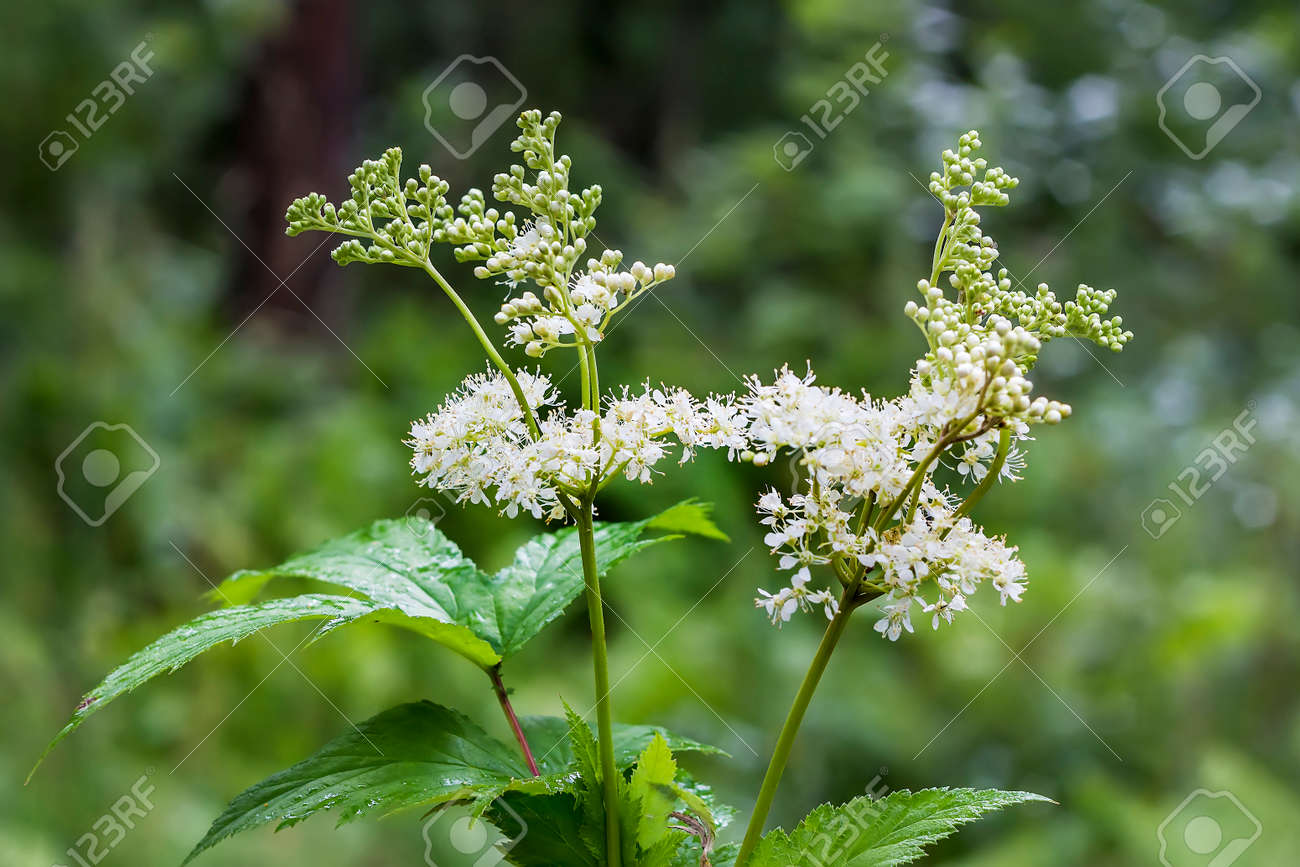
Meadowsweet (Latin name Filipendula ulmaria). Medicinal plant in the natural environment of growth, Russia,Siberia Stock Photo - 67570243

Meadowsweet is also high in salicylic acid.

During the 18th century, the age of reason, chemists began experimental trials using salicylic acid.  In 1838 salicylic acid was first isolated from the extract of meadowsweet.  The first clinical trial of salicylic acid extracted from meadowsweet took place in 1876.  Felix Huffman, working for Bayer pharmaceutical company, invented modern day aspirin when he combined salicylic acid with an acetyl compound, creating acetylsalicylic acid. He had been treating his father’s arthritis with a sodium and salicylic acid compound that severely upset his dad’s stomach.  The aspirin was easier on his dad’s stomach.  Bayer started selling aspirin in 1899, and people no longer had to weigh whether getting rid of an headache was worth getting an upset stomach.  The drug was widely available by 1915, and when the world was at war with Germany, non-German companies started producing it.  There was no competition for aspirin until Tylenol went on sale in 1956, followed by ibuprofen in 1962.  Nevertheless, sales of aspirin remain strong, especially since doctors began prescribing a daily low dose of it for people with an high risk of an heart attack.


Migrating Carolina Bays

December 21, 2019

Referenced within the study I wrote about last week was another interesting paper that determined some Carolina Bays migrated.  I’ve written about Carolina Bays previously (See: https://markgelbart.wordpress.com/2012/04/30/a-young-carolina-bay-in-north-carolina/ ), but I did not know this.  Carolina Bays are elliptically-shaped depressions found in the Carolinas and Georgia, mostly on the coastal plain.  Wind and water erosion during wildly fluctuating Ice Age climates created these fascinating geological features.  Some are in the process of originating now.  Wind during cold arid climate cycles blew out unconsolidated sediment, and wind-driven water during wetter warmer cycles shaped them.  They vary in size and water content.  Some hold water year round, while others are seasonally dry.  They provide important wetland habitat, especially for amphibians because frog and salamander-eating fish are often absent.  Like so many other natural features, a majority of them have been destroyed by development.  Farmers drain and plough over them.

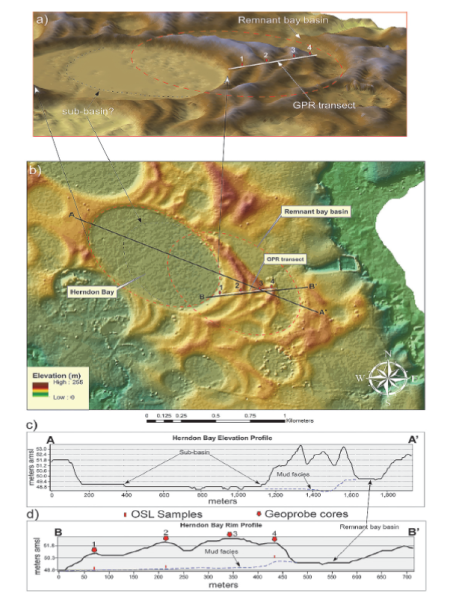
Scientists studied Herndon Bay in North Carolina.  They used ground penetrating radar to find abandoned rims, also known as lips. The abandoned rims date to 36.7, 29.6, and 27.2 thousand years old, and these dates are associated with climate cycle transitions.  In between these dates Herndon Bay stabilized.  Apparently, Herndon Bay was pushed by wind and moved across the landscape in a process that was too slow for the human eye to follow.  It has stabilized at different locations, and one could say this is a kind of migration across the landscape.

Moore_Fig3

Ground Penetrating Radar Image from the below reference.  Note the former basins of Herndon Bay.  It has migrated across the landscape.

Image result for Carolina Bay

Carolina Bay located in Aiken, South Carolina.

Some crackpot scientists think Carolina Bays are craters formed by either comet impact ricochet or a comet striking a glacier, thus causing chunks of ice to fly thousands of miles before landing in southeastern North America.  A single fact debunks this idea–Carolina Bays originated at different times and some are still forming.  They are not the same age, ruling out a single extraterrestrial event.  There are 500,000 Carolina bays, yet less than 200 confirmed impact craters on earth, so this makes it seem highly unlikely as well that they result from multiple impacts.

Reference:

Moore, Christopher & Brooks, Mark & Mallinson, David & Parham, Peter & Ivester, Andrew & K. Feathers, James. (2016).

The Quaternary evolution of Herndon Bay, a Carolina Bay on the Coastal Plain of North Carolina (USA): implications for paleoclimate and oriented lake genesis.

Southeastern Geology. 51. 145-171.


Proxy Evidence for an Increase in Human Populations at a site in South Carolina Circa 12,838 Years BP

December 14, 2019

The Younger Dryas Impact Hypothesis, or YDIH for short, is a crank theory that has been thoroughly debunked.  The YDIH proposes a comet impact on a glacier in the Northern Hemisphere 12,900 years ago sparked continent wide fires, caused a sudden drastic climate reversal, and resulted in the extinction of Pleistocene megafauna.  The Younger Dryas was a climate stage that lasted for about 1500 years; and it was a sudden return to cold, arid Ice Age conditions, following thousands of years of warmer, wetter climate.  It’s named for a flower that flourished in Europe during this climate phase.

The Dryas octopetala flower

Dryas octopetalus likes open, cold, landscapes.

The YDIH is fatally flawed.  There is no known impact crater, dating to the proposed time of impact.  The Hiawatha Crater recently discovered in Greenland has been proposed as the possible impact crater, but the lack of a young ejecta blanket suggests it is millions rather than thousands of years old.  Its ejecta blanket has eroded away–a process that would take a very long time.  There is no evidence of continent wide fires.  Instead, the sites first noted by YDIH proponents to have evidence of the fires dated to many different ages both before and after 12,900 years BP, and the fires were most likely caused by lightning or humans.  Many of the other claimed impact indicators date to different ages.  Megafauna extinctions and extirpations also occurred at various ages–not all at 12,900 years BP.  Some of the so-called impact indicators are not necessarily diagnostic of an impact but can have terrestrial origins.  Other scientists looking for impact markers have not been able to replicate the results of the original YDIH studies.

The Younger Dryas was caused by well understood cyclical climate variations known as Heinrich Events.  12,900 years ago, an ice dam in Canada broke, leading to an enormous influx of cold fresh water into the North Atlantic.  This shut down thermohaline circulation, causing temperatures in the Northern Hemisphere to plunge.  This is the explanation for the Younger Dryas I accept.  Nevertheless, the ridiculous YDIH just will not die.  A paper advocating this bizarre almost pseudo-scientific belief was published as recently as October of this year.  Though I reject the YDIH, this paper had interesting data that I interpret differently from the authors.

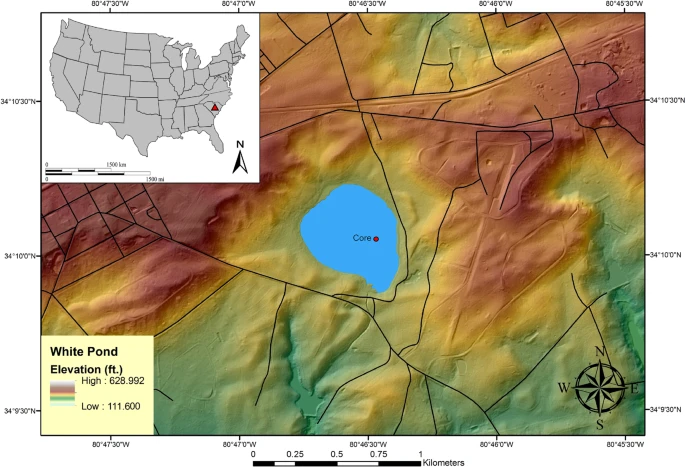
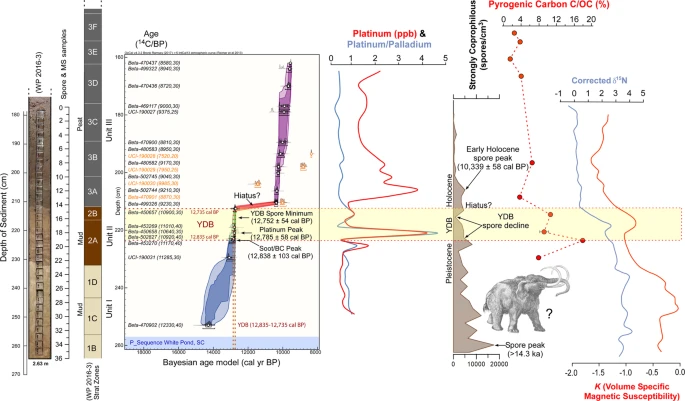
Scientists who published this paper took a 1 meter core of sediment from White Pond in South Carolina. White Pond is a ~32,000 year old Carolina Bay.  Carolina Bays are bodies of water formed by wind and water erosion during dry climate phases of Ice Ages, and they are found throughout the Carolinas and Georgia.  The scientists dated the sediment layer by layer and looked for charcoal and sporomiella.  The abundance of charcoal indicates fire in the environment, and sporormiella is a fungus that grows on megafauna feces and is used as proxy evidence for the abundance of large mammal populations.  The scientists found charcoal amounts peaked at 12,838 years ago, indicating lots of fire on the landscape.  Megafauna populations declined to a low point 12,752 years ago.  The authors of this study think the fire was caused by the comet impact, and the resulting changes in the environment led to the local extirpation of the megafauna.

figure1

Location of White Pond where this study took place.  Image from the below reference.

My interpretation is different.  I think the fires were set by humans to improve habitat for megafauna. (Indians set fire to southeastern landscapes until Europeans removed them from the region.)  Then it took 86 years for humans to wipe out megafauna at this locality.  Nomadic hunters possibly moved away after eliminating most of the big game, allowing megafauna populations to rebound until 10,399 years BP when they disappear again from the region, this time permanently.

figure2

Graph from the below referenced paper.  Note how megafauna populations rebounded until 10,399 years ago–2500 years after the proposed comet impact.  This suggests the proposed comet impact could not have been a factor in their extinctions.

The authors of this study note there is an unconformity in the core dating to the Younger Dryas.  Normally, during wet climate cycles sediment builds up as vegetation dies and turns into soil.  But during dry phases when vegetation is sparse, exposed soil erodes and is blown away by wind, and there is little to no sedimentation.  If this is the case, there should be a gap rather than a continuous line in the graph.  I’m not sure how this impacts the conveyed data.  However, the data is interesting to me because I think it shows when humans arrived at this locality in significant numbers, and how long it took them to extirpate the megafauna.

Reference:

Moore. C; et. al.

“Sediment Core from White Pond, South Carolina contains a Platinum Anomaly, Pyrogenic Carbon Peak, and Coprophilous Decline at 12.8 Ka”

Scientific Reports October 2019

https://www.nature.com/articles/s41598-019-51552-8


Pleistocene Blue Jays (Cyanocitta cristata)

December 7, 2019

When I was attending 3rd grade during the 1970/1971 school year, Perry Harvey came home with me everyday after school.  On occasion he could be reckless.  One unfortunate day he swung a baseball bat at an oak tree, and the bat rebounded, struck him in the head, and knocked him out cold; taking the old cliché “knock yourself out” to a literal reality.  Another day he made the mistake of picking up a baby blue jay that had fallen out of its nest.  Every blue jay in the neighborhood screeched and dive-bombed us.  He put the blue jay down, and the birds chased us into the house in a scene reminiscent of the Alfred Hitchcock classic The Birds. Like some other species of birds, blue jays practice communal defense.

YouTube video of a blue jay attacking a gardener.

Blue jays are intelligent birds from the corvid family which also includes crows and magpies.  They are well adapted for living in the temperate deciduous woods of eastern North America and have probably occupied that habitat for many millions of years.  However, I have been unable to find any studies of blue jay genetics, and I don’t know how long they have existed as a distinct species.  It seems likely they diverged from the common ancestor of the gray, Florida scrub, and Stellar’s jays before the beginning of the Pliocene over 5 million years ago.  Fossil remains of blue jays dating to the Pleistocene have been found at 3 sites in Florida, 1 site in Georgia, 1 site in Alabama, 1 site in Tennessee, and 3 sites in Virginia.

Blue jays played an important role in the spread of oak, beech, and chestnut trees north following the ends of Ice Ages.  Nuts and acorns are a major part of a blue jay’s diet, and they often carry excess food to distant locations where they hide them for later use.  A scientific study concluded blue jays were the sole reason oaks, beech, and chestnut were able to colonize deglaciated territory so rapidly after the end of the last Ice Age.  Squirrels invariably bury acorns and nuts so near the roots of the parent tree that they could not have been the agent of dispersal.  But blue jays carry nuts as much as an half a mile away.  Without blue jays there would be no oak or beech trees in eastern Canada and northern New England today.

Reference:

Johnson and Webb

“The Role of Blue Jays (Cyanocitta cristata) in the Post Glacial Dispersal of Fagaceous Trees in Eastern North America”

Journal of Biogeography 16 1989

Adding a Loggerhead Shrike to my Bird Photo Checklist

November 30, 2019

I’ve made several unsuccessful excursions to look for loggerhead shrikes because they are an uncommon species.  They prefer cow pastures with plenty of short trees–a landscape that is being replaced by expanding suburban development.  My sister and her husband recently moved to a gated community in south Florida that was formerly a cattle ranch but has been converted to an housing development built around a golf course.  Abundant wildlife still occurs in the neighborhood, and on my first visit I was able to get a nice photograph of a large bobcat.  I visited my sister on Thanksgiving and was able to get several photographs of a loggerhead shrike–a species I had only seen 3 times prior to this occasion.  I never thought I would get a good look at this bird, let alone get a photo of it.

Loggerhead shrike in Bradenton, Florida.  Click to enlarge.

I’ve written a blog entry about shrikes previously.  See: https://markgelbart.wordpress.com/2016/01/18/pleistocene-pastures-and-loggerhead-shrikes-lanius-ludovicianus/

I took a walk around the golf course on Thanksgiving.  It is a maritime forest consisting of live oak, loblolly pine, saw palmetto, Carolina palmetto, red maple, grape vine,  a non-native flower related to evening primrose, and sedge.  The water traps host anhingas, herons, cormorants, coots, and many other birds.  I saw red dragonflies and azure butterflies.

This is a non-native plant related to evening primrose.  It is very common in this woodlot.

At the hotel I saw the same species of birds as I did last Thanksgiving.  A flock of white ibis must live there year round.

The same flock of white ibis I saw last year along with a great egret.

Thanksgiving Special: Eating Rabbits and Pigeons

November 23, 2019

The expansion of temperate climate environments following the end of the Ice Age led to the extinction of many species of megafauna because it resulted in an increase in the population of humans.  Oak woodlands and forests provided acorns, nuts, and fruits that could sustain humans when they overhunted and extirpated big game within their range.  Most predators are not common enough to consume all of their prey…otherwise they would starve and become extinct.  But humans are so adaptable, they can survive on other sources of food.  Wiping out megafauna had no impact on human populations because they could switch to hunting smaller animals and also rely on plant foods for survival.  Resource rich environments meant more humans which in turn meant more hunting pressure on large, slow reproducing species such as mammoths, mastodons, and ground sloths.  Fish and small rapidly reproducing species such as rabbits, squirrels, and pigeons easily replaced the sources of protein lost when larger animals became scarce or extinct.

I visited a Vietnamese grocery store recently and found some items that were commonly eaten in the U.S. until the 1940s when American diets became more homogenized with the rise of mechanized farming and chain supermarkets.  Today’s grocery store meat departments sell beef, pork, chicken, turkey, and occasionally lamb; but rarely any other kind of meat.  Modern kids grow up on a diet of hamburgers and chicken nuggets.  I get bored with this monotonous fare.  So when I saw pigeon and rabbit at the Vietnamese store I snatched them up.

A baby pigeon, also known as squab.  They are expensive.

Broiled pigeon is delicious comparable to duck.

The pigeon came uneviscerated. I was afraid this would be a problem, but I learned eviscerating poultry is even easier than cleaning a fish.  Simply chop off the head and cut a slit near the bird’s anus.  Pull the front and the back apart until the keel bone breaks.  Then just pull the intestines and organs out.  I fed the intestines and gizzard to the cats, and they enjoyed eating them.  I ate the heart and the liver myself.  I decided to cook the pigeon just like I prepare quail.  I seasoned it with lemon juice, salt, and black pepper; and stuck it under a 375 degree broiler for 20 minutes.  Pigeon meat is very good.  It is a rich, dark meat, similar to duck, and it also has crispy skin and delicious fat.  Pigeons are built for endurance flying, and they have an high amount of hemoglobin, explaining why the meat is so dark.  The juice that came out when I was pulling the bird apart and eating it was black.  The main drawback to eating pigeon is the small birds just don’t have a lot of meat on them.

Pot-roasted rabbit.

Rabbit meat is just the opposite of pigeon meat.  Pigeon muscles are almost entirely slow-twitch, and therefore dark.  Rabbit muscles are fast-twitch and built for speed, not endurance.  Rabbit meat is all white and has very little fat.  I’ve made rabbit 6 or 7 times, so I’m more familiar with it.  It is good stewing meat.  Most people fry rabbit meat, and it is ok that way, but it is rather dry because it is so lean.  I chose to pot roast the rabbit, using a recipe I often use for a beef roast.  I put the whole rabbit in a casserole dish, seasoned it with salt and pepper, and smothered it with ketchup, celery and onion.  I poured a bottle of good beer in the casserole dish, and baked it, covered, in a 300 degree oven for 3 hours, until the meat was falling off the bone.


Why the Western Hebrides are Mostly Treeless

November 16, 2019

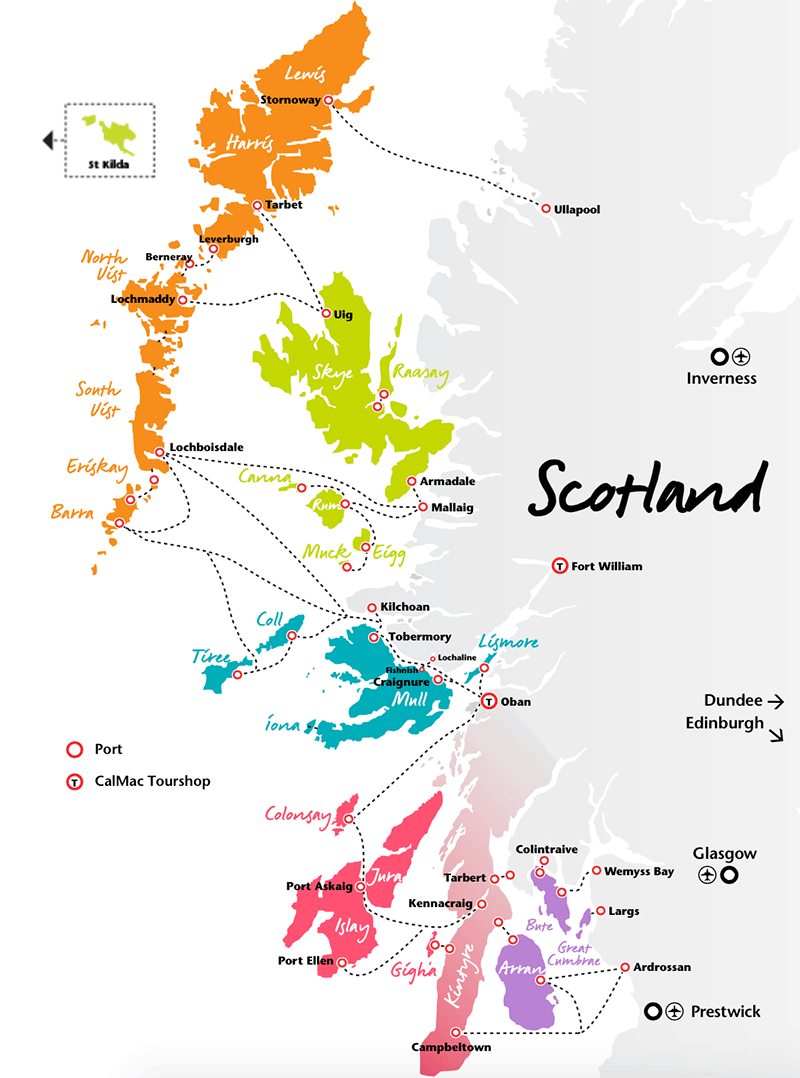
During fall of 1773 Samuel Johnson and James Boswell traveled together on the western islands of Scotland, also known as the Hebrides.  They wrote separate accounts about this journey, and both are included in  a volume I’ve been reading for the past couple of weeks.  Samuel Johnson frequently noted and joked about the scarcity of trees in the region.  I wondered why a temperate locality with plenty of precipitation was mostly treeless, so I researched the natural history of western Scotland and learned there is a fascinating and complex ecological explanation.

Map courtesy of www.calmac.co.uk

Map of the Western Hebrides.  Johnson and Boswell traveled on the inner islands.

Scottish peat bog and heather.  These are also known as moors.

The first explanation I found on google seemed implausible and I was right.  Some claimed the Vikings stripped the island of trees to prevent rivals from using the wood to build boats.  This is an unlikely explanation because a people who lived by pillaging would not be keen on all the labor required in felling and removing all that lumber.  Moreover, trees would grow back within a generation.  I dug deeper and found a better, more scientifically sound explanation.

During the Ice Age glaciers completely covered Scotland, and there were no trees.  11,400 years ago, the glaciers retreated and a scrub forest of birch, willow, hazel, and rowan advanced over the tundra.  These scrub forests co-existed with peat bogs.  By 8500 years ago, oak, elm, and Scotch pine began to grow as well but were uncommon and local in distribution on the Hebrides.  From 9300 years BP-7900 years BP open woodlands of birch, willow, aspen, and hazel with plenty of grassy meadows between the trees prevailed.  But then, peat bogs began to expand while areas consisting of woodlands contracted so that by 2500 years ago peat bogs were the dominant environment on the Western Hebrides.  This predates the Viking invasion by 1500 years.  Instead, natural disturbance and soil chemistry shaped the landscape of the region.

Severe storm events about 8000 years ago felled the trees.  Without trees drinking up the water, the water table rose.  Tree deaths caused a positive feedback loop for peat bog expansion at the expense of woodlands.  The cool moist climate slows down evaporation, and the water just sits on impervious bed rock.  Water dissolves acids in the rock, further helping the growth of acid-loving sphagnum peat and heath but reducing the fertility in the soil required by trees. Peat bogs are dominated by sphagnum peat, sedges, and carnivorous plants, while heath grows on the better drained sites.  Trees just can’t grow in these conditions.

About 400 years ago humans cleared the remaining woodlands on the islands and converted them to agricultural use.  Now, an organization known as the Hebridean Ark hopes to re-establish at least some forests on the islands.  They’ve planted 100,000 trees including rowan, birch, willow, hazel, juniper, and aspen.  According to Johnson and Boswell, attempts to plant trees on the islands during the 18th century mostly failed.  Modern scientists may have a better idea of what they are doing, however.

References:

Fossitt

“Late Quaternary Vegetation History of the Western Isles of Scotland”

New Phytologist 132 1996

Johnson, S. and James Boswell

A Journey to the Western Islands of Scotland and The Journal of a Tour to the Hebrides

Penguin Classics 1984

Leopardus amnicola and More Additional Specimens of Cenozoic Fauna from South Carolina

November 9, 2019

The Florida Museum of Natural History just published an exciting new bulletin.  The paper describes every Cenozoic fossil specimen found in South Carolina and examined by scientists for the last 17 years–since the late Al Sanders published  Additions to the Pleistocene Mammal Faunas of South Carolina, North Carolina, and Georgia. A link to this new bulletin is at the bottom of this blog entry.

Several new specimens of Pleistocene age are notable.  Fossil hunters found the partial tooth of an extinct species of margay cat ( Leopardus amnicola) from the Ashley River phosphate beds–a first for the state of South Carolina.  A close relative of this species ( L. weidii  ) still occurs in tropical Central and South America.   L. amnicola remains have been found at 12 sites in Florida, 3 in Mississippi, 2 in Georgia, and 1 in Alabama.  Apparently, it was a widespread species occupying forests of southeastern North America.  It likely became extinct during the Last Glacial Maximum when environmental conditions changed to more open landscapes.

A margay cat.  An extinct relative of this species formerly occurred across southeastern North America. 

The most remarkable find was the limb bone (a tibia) of a pseudo-cheetah found on Edisto Beach. Scientists tentatively assiged it to  Miracinonyx ? trumani–a species previously unknown east of the Mississippi.  However, assignment was based on the age (late Pleistocene).   M. inexpectus, a species of pseudo-cheetah common from the Pliocene-mid Pleistocene, is rarely, if uncertainly known from the late Pleistocene.  I’m not convinced the limb belonged to a pseud-cheetah.  Pleistocene cougars ( Puma concolor) grew larger than modern day cougars, and I don’t believe scientists can discern with certainty the difference between pseudo-cheetahs and cougars without examining a skull or teeth.  Pseudo-cheetahs grew larger than cougars, but large Pleistocene cougars overlapped in size with small pseudo-cheetahs.  I covered this topic on a previous blog entry.  (See: https://markgelbart.wordpress.com/2018/05/28/an-anatomical-comparison-between-the-extinct-north-american-cheetahs-miracynonyx-sp-and-the-late-pleistocene-holocene-cougar-puma-concolor/ ) Edisto Beach abounds with subfossil remains of big cats including saber-tooths, giant lions, jaguars, cougars, bobcats, and now possibly pseudo-cheetahs.

More bones of helmeted musk-ox, caribou, and walrus have been found in South Carolina over the past 17 years.  Most people think of these species as beasts of the far north, so it’s curious to realized how far south they occurred before man disrupted the ecosystem.

caribou, Bob Stevens, US Fish and Wildlife Service

Caribou ranged into the middle-south during cooler climate phases.

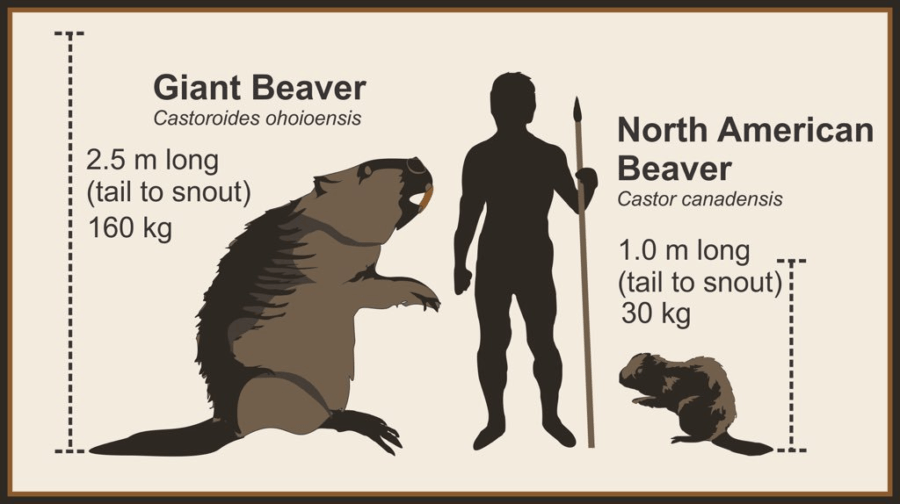
This is the first paper I’ve read that identified giant beavers from the mid-south as  Casteroides dilophidus.   Recently, paleontologists recognized that extinct giant beavers of the mid-west ( C. ohioensis) were not the same species as giant beavers from the southeast.

Giant Beaver Size Comparison

There were 2 species of giant beavers. C. ohioensis and C. dilophidus.

Several other first specimens found in South Carolina are interesting enough to note here.  The remains of the giant armadillo (Holmesina floridanus) were discovered in Clapp Creek, Williamsburg County.  It dates to the early Pleistocene.  Imagine a 300 pound armadillo.  There is also the first record of a Pleistocene coyote (Canis latrans) from in state.  Pre-Pleistocene first South Carolina finds include fossils of the bone-eating dog ( Borophagus hilli), dating to the Miocene, and hell pig (an entelodont), dating to the Oligocene.

The below linked paper really has some nice tables of South Carolina Pleistocene-aged fossil sites and all the species found at each. Although specimens of 13-lined ground squirrels were already known, I was surprised to learn just how common and widespread they were.  This species prefers open habitats and is absent from the region today.  Its presence suggests more prairie habitats during Ice Ages.

Reference:

Albright III, L. et. al.

“Cenozoic Vertebrate Biostratigraphy of South Carolina, USA and Additions to the Fauna”

Bulletin of the Florida Museum of Natural History  57 (2) October 2019

https://www.floridamuseum.ufl.edu/wp-content/uploads/sites/35/2019/10/Vol57No2archival.pdf


Peanut Soup

November 2, 2019

The modern peanut (Arachis hypogaea) originated in the region encompassing northwestern Argentina and southeastern Bolivia.  Peanuts are a sun-loving legume that thrives on the open grassy pampas and in fire adapted woodlands. Remains of peanuts were excavated from an archaeological site dated to 7600 years BP, and it seems likely humans were eating wild peanuts thousands of years earlier than this date.  The modern peanut is an hybrid species resulting from a cross between 2 species of peanut still found in the wild–A. duranensis and A. iapensis.  Cultivation of the peanut spread rapidly across South America, and during European colonization it was introduced to Africa where it mostly replaced the native goober nut (a distant relative) in popularity.   There are 5 groups of peanut cultivars including thousands of varieties.  Cultivars include Spanish, Virginia, runner, Valencia, and Tennessee red and white.  Oily Spanish peanuts are my favorite snack.  In addition to human consumption peanuts are used as animal feed and in hundreds of various industrial products.  Surprisingly, the U.S. ranks 4th in worldwide production behind China, India and Nigeria.  Sudan, a desert nation, almost grows as many peanuts as the U.S.

The peanut is not actually a nut, but instead is a legume related to beans and peas.  I grew peanuts in my garden 1 summer.  The plant flowers on a stem.  Following pollination, the stem grows into the ground, and the peanut shell forms at the end of the stem underground.  They are easy to grow in climates with long summers, and they don’t require much fertilization.

During Colonial times peanuts were mostly used as animal feed, but Inns did serve peanut soup.  I went through 3 pages of peanut soup recipes on a google search and discovered that none of them were the original peanut soup recipe served in Colonial era Inns.  The following is the correct recipe for peanut soup.  All other recipes on the internet are wrong, unless they follow this recipe.

Peanut soup made the way it is supposed to be made.

Fry 6 strips of bacon.  Cut up 4 stalks of celery and 1 onion.  Remove the bacon from the pan and add the celery and onion to the bacon grease.  (Celery really pairs well with peanut butter.  The crisp texture of the celery contrasts with the creamy fat of the peanut butter.)  Sautee the vegetables until just tender and add 1/3rd cup of flour.  Add the vegetables and flour to a quart of low sodium chicken broth along with a cup of peanut butter and a pinch of cayenne pepper.  Stir and heat until the peanut butter is mixed well with the chicken broth and there are no lumps.  Serve with crumbled bacon and/or chopped peanuts on top.

This recipe must include celery and bacon.

Jiff is by far the best brand of peanut butter on the market.

The original recipe includes 2 cups of milk with 3 cups of chicken broth instead of just a quart of chicken broth.  I never add milk to mine.

The original recipe also uses white pepper.  I prefer cayenne.  I never use white pepper because it literally smells like crap.

Reference:

Tullie’s Receipts

The Kitchen Guild of the Atlanta Historical Society

Atlanta Historical Society 1976


Design a site like this with WordPress.com
Get started