Pleistocene Ant Lions (Myrmeleontadae sp.)

April 29, 2021

Ant lion pits line the bare soil areas next to the back wall of my house. Ant lions, as the name suggests, prey on ants, though they will eat anything small enough to become trapped in their pits. The larval stage of most species is the monster hidden just below the sand of the bottom of the pit. When an ant lion larva senses an ant walking near the edge of the pit, it flicks sand at the ant, knocking the ant into the side of the pit. The action of flicking sand destabilizes the wall of the pit, forcing the ant to fall within the reach of the ant lion’s jaws. The ant lion then injects venom and devours the ant, or rather sucks the juices out of it. Ant lion larva can live for years without eating and during winter they dig deeper down to avoid frosts. But after they’ve had a meal, they go into a cocoon stage before emerging as adults. They survive on nectar for energy in their brief adult stage spent searching for mates. Fertilized females lay eggs in sand and the cycle begins again.

Some species of flies lay their eggs in abandoned ant lion pits, and their larva use the same strategy as ant lion larva. At least 1 species of parasitic wasp allows itself to be captured. It stings the ant lion larva and lays on egg on it, thus turning predator into prey.

Ant lion adult and larva. Image from below reference. The larva prey on ants and other small arthropods.
Ant lion pits next to the side of my house. Ant lions prefer sandy soil and are common in arid environments. They likely were abundant in the southeast during Ice Ages when the climate was dry and bare soil environments predominated.

There are about 2000 species of ant lions, and there are species on every continent except Antarctica. Their closest living relatives are owl flies and lace wings. They are most common in tropical dry climates, but they thrive anywhere they can find a sandy substrate. I hypothesize they were abundant in southeastern North America during Ice Ages when arid climates prevailed, resulting in vast landscapes with sparse vegetation. Pleistocene climate changes likely increased species diversification when populations became isolated from each other during wetter climate phases that turned sandy environments into isolated refuges.

Ant lions are rare in the fossil record. Ant Lions have been found in 99 million year old amber at a site located in Burma. Scientists think ant lions first evolved about 150 million years ago, so they lived under the feet of dinosaurs. There are no dinosaurs in my yard (unless one includes birds), but their contemporaries live right up next to my house.

Reference:

Badano, D.; M. Engel, P. Basso, B. Wang, P. Cerretti

“Diverse Cretaceous Larvae Reveal the Evolutionary and Behavioral History of Ant Lions and Lace Wings”

Nature Communications (9) 257 August 2018

The Former Abundance of Green Sea Turtles (Chelonia mydas)

April 22, 2021

Our ancestors didn’t appreciate wildlife. For them wild animals were considered either a pest or a resource to be ruthlessly exploited until that particular species was annihilated. I came across an article entitled “Turtling in Florida” written during 1890 and learned how abundant green sea turtles formerly were. According to the author, slaughtering turtles was great sport. So many turtles populated some lagoons that a man could theoretically walk from 1 side to the other by walking on their backs. Turtle stampedes endangered men’s lives. Sea turtles crawling on beaches to lay their eggs could become frightened by men hunting them and their eggs, and hundreds of 800 pound panicking turtles could crush men too slow to get out of their way.

Of course, man is much more dangerous to sea turtles than they are to us. In North America before man invaded the continent, adult sea turtles had few enemies–bears on beaches and tiger sharks in the sea. But man killed too many turtles and gathered too many eggs, and now green sea turtles are endangered. Several methods were formerly used to catch green sea turtles. Some men used nets, though in south Florida, they encountered problems with sharks and sawfish that often destroyed the nets. (Both sawfish and sharks are much more rare now than they were in 1890.) Other turtle-hunters used harpoons in a process called “pegging.” The harpoons were designed to just barely penetrate the shell, so the turtle could be reeled in and kept alive for as long as possible. Some Seminole Indians actually dove to the bottom of the sea, grabbed the turtles, wrestled them to the surface, lassoed them, and pulled them onto the boat. The most common method of hunting sea turtles was to simply sneak up on them while they were laying eggs on the beach, and turn them over. Sea turtles are helpless when on their backs. This method could be hazardous. The turtle-hunters could run into a bear in the dark (turtles lay their eggs at night). The article reports 1 expedition shooting and killing 5 bears on a night of turtle-hunting, and they could have killed more, if the sand flies hadn’t been driving them crazy. There was also the possibility of getting crushed in the aforementioned turtle stampedes.

Green sea turtles inhabit shallow coastal waters where they feed upon sea weed. They nest on tropical beaches.
Green sea turtle range map. They often stray far from where they nest.
Green sea turtles are considered a delicacy due to their vegetarian diet. They were formerly abundant, but overhunting by men has greatly reduced their numbers.
Aborigines can still get away with hunting sea turtles.

Green sea turtles were a popular delicacy over 100 years ago. Adult green sea turtles live on a diet of seaweed, giving their flesh a delicious flavor, according to old time accounts. People enjoyed eating turtle eggs too. No matter how long a turtle egg is cooked, the white part never solidifies. The eggs must have made cakes moist when they were used as an ingredient. The turtle shells were used to manufacture women’s jewelry as well. Now, green sea turtle populations are low and even raising them on farms for food is illegal. Nevertheless, various aboriginal groups around the world still hunt them and collect their eggs.

Reference:

Murphy, J.M.

“Turtling in Florida” from

Tales of Old Florida

Castle Books 1987

Pleistocene Whitefish (Coregonus clupeaformis)

April 17, 2021

Fish have an amazing ability to replenish and increase their populations. Lake whitefish, a species related to salmon and trout, can lay between 8,000-130,000 eggs. During Ice Ages 90% of their present day range was covered by glaciers, making it uninhabitable for them. Yet, in less than 12,000 years they recolonized this enormous territory. The reproductive ability of this species outpaced the population of predatory fish and birds that fed upon them. Scientists used a study of genetics to determine modern day whitefish descend from 2 different refugial populations that clung to survival during the Last Glacial Maximum. 1 population survived in Beringia–the area of Alaska and the Yukon that remained free of glacial ice. They may have survived in lakes now located near Nahanni National Park. The other population occurred in the Missouri/Mississippi River Drainage just south of the Laurentide Ice Sheet. Following the retreat of the Ice Sheet, lake whitefish populations exploded in the newly formed Great Lakes and managed to swim their way into lakes all over Canada. Whitefish are a cold water species and probably didn’t ever live far from Ice Age glaciers.

Map of present day range of lake whitfish. Most of this range was under glacial ice during Ice ages.
Lake whitfish.

Lake whitefish average 4 lbs. as adults, though the record for a rod and reel catch is 15.5 lbs. They spawn during fall, winter, and spring. Their diet consists of snails, clams, and insects. There are 2 ecotypes of whitefish that do not interbreed: the normal population that inhabits the bottom region of lakes and the dwarf population that swims in the upper layer of open water. Commercial fishermen net whitefish, and they are a popular food fish in cities and towns along the Great Lakes, but I can’t remember if I ever had the opportunity to try them when I lived in Ohio as a boy.

Reference:

Foote, C.; J. Clayton, C. Lyndsay, and R. Bodaly

“Evolution of Lake Whitefish (Coregonus clupeaformis) in North America during the Pleistocene: Evidence for a Nahanni Glacial Refuge in the northern Cordilleran Region”

Canadian Journal of Fisheries and Aquatic Services 49(4) April 2011

McDermid, J., J. Riest, R. Bodaly

“Phylogeography and Post Glacial Dispersal of Whitefish ( C. clupeaformis complex) in Northwest North America”

Advances in Limnology 60 Jan 2007

First Record of the Giant Short-Faced Bear (Arctodus simus) in South Carolina

April 8, 2021

Increased currents from the periodic release of water from an upstream reservoir on the Cooper River in South Carolina disturbs the sediment at the bottom of this river. Fossil hunters take advantage and scuba dive for fossils in the disturbed sediment. Recently, Eric Proulx discovered a fossil tooth while scuba diving in the river. He didn’t know what pre-historic animal it was from, and he showed it to Dave Cicimurri, curator of the Columbia Museum. The curator misidentified the tooth, mistaking it for a lion (Panthera atrox) canine. The photo of the tooth in a news article was shared on a Florida fossil hunters Facebook page where it became an object of some derision. Most of the amateur fossil hunters recognized the tooth as bear, not lion. (A lion’s canine is much longer.) Richard Hulbert of the University of the Florida Museum of Natural History looked at it and confirmed it belonged to a giant short-faced bear. This is the first record of this species in the state of South Carolina. Though fossil specimens of this species are more common in western states, they have been found in Fern Cave, Alabama, the Withlacoochee River in Florida, and at least 1 site in Virginia. This specimen shows this species ranged all the way to the eastern seaboard.

Eric Prouix found this tooth of a giant short-faced bear in the Cooper River in South Carolina while he was scuba diving. This is the first record of this extinct species in the state.

This map is from the below reference. I added the blue dot to indicate where the short-faced bear specimen was found in South Carolina.
Typical inaccurate image of a giant short-faced bear. Recent studies determined its legs were not as long as previously thought and its face not as short.

Much of what scientists thought about the giant short-faced bear has been revised. It was a very large bear, averaging as big as a Kodiak bear, the subspecies of brown bear that enjoys an high protein diet of salmon. This diet results in a bear able to reach weights of over 1000 pounds. But giant short-faced bears did not have unusually long legs, and their faces were not particularly short. So every illustration of this species on the web is wrong. Scientists also formerly thought giant short-faced bears were highly carnivorous, scavenging by driving other predators from their kills. Though I’m sure this happened on occasion, an isotopic study determined short-faced bears were omnivorous, just like most other species of bears.

The presence of giant short-faced bears in South Carolina shows 3 species of bears co-existed throughout southeastern North America during the Pleistocene. Florida spectacled bears and black bears shared the land with their larger cousins. In addition grizzly bears lived at least as far southeast as Kentucky, and polar bears may have occasionally roamed south along the Atlantic Coast when glaciers covered most of their present day habitat.

Reference:

Schubert, B.; R. Hulbert, B. MacFadden, and S. Sourle

“Giant Short-Faced Bears (Arctodus simus ) in Pleistocene Florida, U.S.A., a Substantial Range Extension”

Journal of Paleontology 84 (1) 2010

Tigers (Panthera tigris) Suppress Dhole (Cuon alpinus) Populations.

April 1, 2021

A new study determined tigers suppress dhole pack sizes in India. Dhole packs are smaller in areas with higher densities of tigers, even if there is an higher density of potential prey species. The scientists conducting the study used camera traps to estimate pack size and tiger numbers. In Tadoba-Andhari Tiger Reserve where tiger density is high, there were 7 dhole packs averaging 6.4 dholes per pack. In Navegaon-Naziri Tiger Reserve where tiger density is lower, there were 5 dhole packs averaging 16.8 dogs per pack. Pack sizes were 2.6 times greater in areas with lower tiger density. Both reserves are in a subtropical dry deciduous forest zone dominated by teak, argun, and giant crepe myrtle trees. The terrain is somewhat hilly. Leopards are another important large predator in the reserves, and the leopard population is also negatively impacted by tigers. Common prey species in the reserves include spotted deer, sambar deer, barking deer, nilgai antelope, wild boar, and gaur–a large species of cattle. Dhole pack sizes do increase in areas with greater prey density, but the abundance of tigers is a greater influence on pack size. Dholes tend to prey on smaller animals in areas with lots of tigers, so they can consume more of the animal before a tiger drives them away from the kill. Tigers depress dhole populations by directly hunting them and by chasing packs away from their kills.

Map of tiger reserves where the below referenced study took place. Map from the below referenced study.

Tigers totally dominate dholes. The authors of the study saw tigers kill dholes on 5 different occasions and drive packs away from their kills 23 times. They saw no instances of dholes killing tigers or driving them away from their kills.

Spotted deer are an important prey item for tigers and dholes.
Nilgai antelope, also known as blue buck are another important prey item for tigers and dholes. Hunters introduced nilgai antelope to Texas about 100 years ago, and now there is a feral population of 37,000 in that state.

India has the highest dhole population in the world. There are small packs in the northern montane forest, and larger packs in the dry deciduous forests of central and south India. Since tigers were eliminated from Laos, dhole populations have increased there. Dholes formerly ranged across most of Asia, and during the Pleistocene they ranged into North America, though fossil evidence there is limited to 1 site in Mexico.

Siberian tigers are known to depress wolf populations, and lions depress hyena and hunting dog populations in Africa. I wonder if big cats suppressed canid populations in Pleistocene North America. Saber-tooths were very powerful fanged cats, and American lions grew larger than any big cat species. Pleistocene jaguars grew as large or larger than modern tigers and are at least as common as dire wolves in the fossil record of Florida. There really is no way to know because abundance in the fossil record doesn’t necessarily reflect actual abundance in life.

Reference:

Bhanda, A.; P. Ghaskodbi, P. Nigram, and B. Habib

“Dhole Pack Size Variation: Assessing the Effect of Prey Availability and Apex Predator”

Ecology and Evolution March 29, 2021

Pleistocene Megaherbivores of India

March 25, 2021

388 species of land mammals occur in India today, including 15 species of flying squirrels, 20 species of bovids, 18 species of deer, 16 species of cats, 19 species of monkeys, and 3 species of apes.  The diversity of habitats in India from high mountains to desert plains with subtropical forests and mangrove swamps in between supports this great variety of mammals.  Africa has 1100 land and marine species of mammals and Pleistocene North America had 540, but they are whole continents.  India is just a subcontinent.  Compared to North America but like Africa, India didn’t suffer many late Pleistocene extinctions.  However, there were a few notable species that became extinct or extirpated in India.

Gelada baboons (Theropithecus gelades) today are restricted to the Ethiopian Highlands, but fossil evidence from the Billasugrun Cave Complex showed they formerly ranged into India.  Ostriches also formerly extended their range into India during the Pleistocene, but no longer occur there.

Screenshot (186)

Gelada baboons are restricted to the Ethiopian Highlands today, but during the Pleistocene their range extended into India.

Today, Asiatic elephants still live in India, but during the Pleistocene 2 additional species of elephants occurred in India–the Asian straight-tusked elephant (Paleoloxodon namadicus) and stegodon (Stegodon namadicus).  The former may have been the largest land mammal to ever live on earth.  Both species went extinct about 30,000 years ago when men began using projectile weapons.

Palaeoloxodon namadicus is a prehistoric straight-tusked elephant that ranged through Pleistocene Asia, fro… | Prehistoric animals, Extinct animals, Ancient animals

Scientists think the Asian straight-tusked elephant may have been the largest land mammal ever.  It became extinct in India soon after humans began using projectile weapons ~30,000 years ago.

What are the differences between Stegodon and Palaeoloxodon? - Quora

Stegodon namadicus.  The fossil record suggests it was formerly more abundant than the Asiatic elephant.  It too became extinct about the time man began using projectile weapons.

The pygmy hippo (Hexaprotodon) lasted in India until about 16,000 years ago.  There still is plenty of available habitat for pygmy hippos in India today, so man must be responsible for the disappearance of this species.  An horse (Equus namadicus) became extinct in India.  I can’t find much about this species, and I think it may have been the same species as the modern horse.  The wild ancestor of modern cattle (Bos namadicus) also vanished from India during the late Pleistocene, but its domesticated descendants are extremely abundant now.

File:Hexaprotodon.liberiensis-ZOO.Jihlava1.jpg - Wikimedia Commons

African pygmy hippo.  A species of pygmy hippo lasted in India until about 16,000 years ago when humans wiped them out.

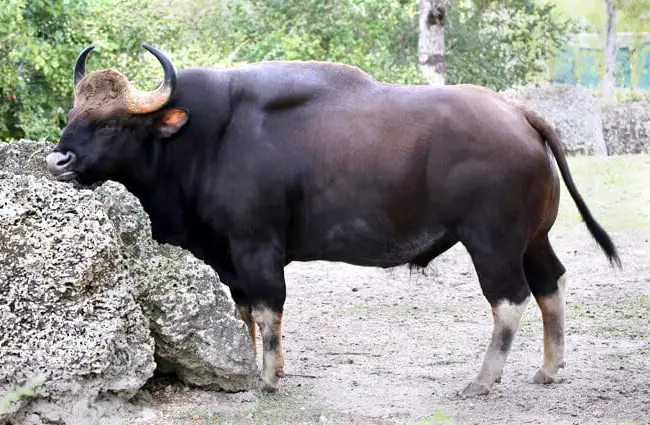
Gaur - Description, Habitat, Image, Diet, and Interesting Facts

The gaur along with Asiatic elephants and Indian rhinos are still extant but endangered in India.

Scientists hypothesize India suffered fewer end Pleistocene extinctions than elsewhere because the animals there slowly co-evolved with man and learned to be wary of us.  They think this allowed for a robust population network in climatic refugia that could then rebound following local extirpations.  While this might be partially true, I have a different hypothesis.  I propose that in India (and Africa) tropical diseases and tribal warfare kept human populations relatively low.  Large tracts of land remained uninhabited for centuries.  These were the refugia that allowed animal populations to rebound and replenish regions with diminished or extirpated populations.  The Hindu religion’s reverence for life originated at least 6300 years ago and may be an additional factor in the persistence of abundant wildlife on the Indian subcontinent.  When India’s population of humans eventually did increase, the Hindu religion prevented the wonton slaughter of wildlife that plagued other regions such as China where tigers and elephants have been wiped out.

References:

Jukar, A.; S. Lyons, P. Wagner, M. Uhen

“Late Pleistocene Extinctions in the Indian Subcontinent”

Palaeogeography, Palaeoclimatology, Palaeoecology 562 (15) 2020

Roberts, P.; et. al.

“Continuity of Mammalian Fauna over the Last 200,000 Years in the Indian Subcontinent”

PNAS 111 (16) 2014

Tegu Lizards (Salvator merianae) are Invading Georgia

March 18, 2021

You know who I hate (besides Trumpanzees)?  I hate the hypocritical sadistic do-gooders who hunt Burmese pythons in south Florida.  For generations the ecosystem there has been out of whack because large predators have been reduced or exterminated.  Finally, a new large predator has been introduced (though accidentally), but these stupid jerks are wiping them out too.  Burmese pythons can help control the overpopulation of raccoons and wild hogs in South Florida that destroy eggs of endangered species of turtles.  The snake-killers refuse to acknowledge this benefit, and instead they are doing their best to eliminate another large predator that simply is substituting for the wolves and cougars that humans also try to wipe out.  I hope these assholes fail.  I root for the snake.  In fact I hope 1 day a Burmese python squeezes the life out of a snake-killing hypocrite who is trying to exterminate them. I would celebrate the irony.  I’d love to write the headline “Burmese Python Euthanizes Human.”

The Argentine black and white tegu is another newly colonizing species (which alarmists call invasive) that has wildlife biologists hyperventilating.  This species is native to South America and a popular pet among reptile-lovers.  However, they grow to 3 feet long and reach weights of 15 pounds.  Pet-owners get tired of taking care of such a large lizard, and they release them into the wild.  Tegus established a breeding population in south central Florida where they’ve been munching down on alligator and turtle eggs for 20 years.  Over the past 3 years there have been over 50 sightings of tegus in Georgia, mostly in Toombs and Tatnall Counties.  To determine whether a breeding population exists in south Georgia, scientists conducted a study.  They set out 75 live traps in 3 different locations in those 2 counties for a couple of months.  The scientists caught 2 breeding age females in all that time, indicating to me that they are still uncommon but present.  The authors of the paper wrote they “euthanized” the lizards by shooting them with a .22 rifle.  I hate the word, euthanize, because it makes killing a creature sound sanitized.

Argentine Black And White Giant Tegu, Tupinambis Merianae Or.. Stock Photo, Picture And Royalty Free Image. Image 94513894.

Black and white tegu lizards, native to Argentina and other South American countries, have established a population in Florida and are invading Georgia.  Do-gooder assholes want to wipe them out, but I think for the most part they are harmless.

Native range map for black and white Argentine tegus.

Verified and unverified sightings of tegu lizards in Georgia + trapping sites of the below referenced study.  .

Map of verified and unverified sightings of tegus in Georgia and Florida.  Surprisingly, some of them have been from quite far north in Georgia.  Tegus are partially warm-blooded and can dig burrows, helping them survive in cooler climates.  Map also from the below referenced study.

Most of Georgia is ideal habitat for tegu lizards.  They are partially warm-blooded and can did burrows to escape cold and hot weather.  Females lay about 30 eggs, and the young become full grown and sexually mature in 2 years.  They are also omnivorous, eating insects, other arthropods, small animals, eggs, and fruit.  The stomach contents of 7 tegu lizards trapped in Georgia included blackberry, strawberry, insects, other arthropods, crayfish, wood frogs, and a toad.  This list hardly sounds like an animal that is destabilizing the environment.  Wildlife biologists are concerned the lizards might eat eggs of the endangered gopher tortoise, and they have been found in gopher tortoise burrows, but native raccoons are much more abundant and have hardier appetites.  If gopher tortoises can co-occur with raccoon predation, they can endure the impact of a few lizards.  Unlike Burmese pythons, tegu lizards are much more vulnerable to native predators.  I’m sure bobcats, coyotes, hawks, owls, and snakes can control their numbers.

Reference:

Haro, D.; et. al.

“Evidence for an Established Population of Tegu Lizards (Salvatore merianae) in Southeastern Georgia”

Southeastern Naturalist (19) 4 2020

Deinosuchus rugosus Given a New Scientific Name–D. Schwimmeri

March 11, 2021

My wife took a geology class 40 years ago at Columbus State University, and it was taught by David Schwimmer who now has the honor of having an extinct species of crocodylian named after him.  The paleontologists who named the species after him consider it a new species (or species novum), but it is really not a species new to science.  The first scientist to name the species gave it the scientific name Deinosuchus rugosus.  However, the type specimen used to name the species is not considered diagnostic as it could represent any of the 3 known species of Deinosuchus.  So they used other more complete specimens to describe the anatomy of the species, and they decided to give it the scientific name D. schwimmeri after David Schwimmer who published a book about Deinosuchus during 2002.

Species named after Columbus State professor David Schwimmer | Columbus  Ledger-Enquirer

David Schwimmer of Columbus State University, my wife’s college geology professor.  He wrote a book about Deinosuchus, a giant extinct alligatoroid.  Deinosuchus rugosus has been renamed in his honor as D. schwimmeri.

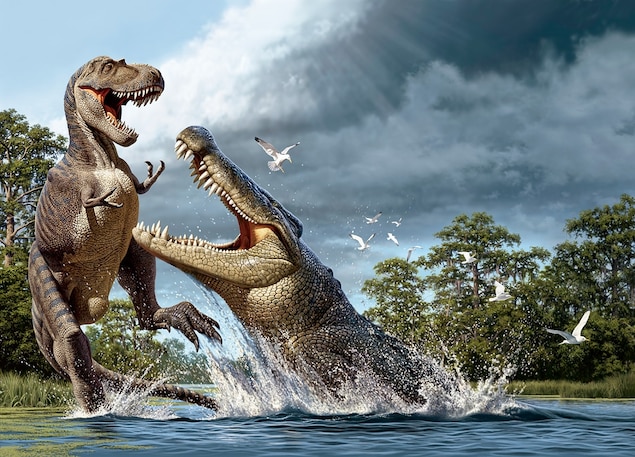
Feces, Bite Marks Flesh Out Giant Dino-Eating Crocs

Deinosuchus preyed on tyrannosaurs and other dinosaurs.

Fossil evidence suggests there were 3 species of Deinosuchus living in North America during the late Cretaceous from ~80 million years BP-~73 million years BP.  The North American continent was split into 3 land masses by the Western Interior Sea then.  D. schwimmeri is the species that lived on the eastern part of North America, and D. riograndis lived on the western part.  D. hatcheri, a poorly known species, also lived on the western part.  D. riograndis tended to grow larger than D. schwimmeri.  All species of Deinosuchus were 36 foot long 12,000 pound monsters that ate Tyrannosaurus rex for breakfast.  Fossil specimens of Deinosuchus have been found in Georgia, New Jersey, North Carolina, Alabama, Mississippi, Texas, Utah, Nebraska, Wyoming, Montana, and Mexico.  Scientists aren’t sure how Deinosuchus came to live on both sides of the Western Interior Sea.  They likely were saltwater tolerant and perhaps island-hopped from 1 side to the other.  Alternatively, when the Western Interior Sea flooded the Great Plains, the 2 founding populations were separated.

Deinosuchus is considered an alligatoroid or in other words they are thought to have been more closely related to alligators than crocodiles.  They were not ancestral to modern alligators.  Instead they were related to the direct ancestor of modern day alligators.

References:

Gossette, A; and C. Bracho

“A Systematic Review of the Giant Alligatoroids Deinosuchus from the Cretaceous of North America and its Implications for the Relationships at the Root of Crocodylia”

Journal of Vertebrate Paleontology 40 (1) 2020

Schwimmer, David

King of the Crocodylians: The Paleobiology of Deinosuchus

Indiana University Press 2002


Ancient Bear Hybridization

March 4, 2021

It’s always surprising when studies of an animal’s genetic history yield unexpected results, and the latest look at spectacled bear (Tremarctos ornatus) DNA is no exception.  The study (referenced below) examined 3 specimens of the extinct giant short-faced bear (Arctodus simus) and 1 specimen of the extinct Arctotherium sp. and compared their genetics with that of the extant spectacled bear.  The giant short-faced bear specimens came from the Yukon and Alaska and dated to ~47,000 years BP and ~24,000 years BP.  The Arctotherium specimen came from Chile and dated to 12,000 years BP.  Although Arctotherium anatomically resembled A. simus, results of the study determined the 2 species never interbred.  The giant short-faced bear was a North American species, and Arctotherium was a South American species, but their ranges did overlap in Mexico.  However, the study indicated the extinct Arctotherium did hybridize with the extant spectacled bear during the late Pleistocene.  Both are South American species  and their ranges did overlap extensively.  This is a surprising result because scientists estimate the ancestor of the spectacled bear diverged from the ancestor of Arctotherium about 3.6 million years ago, and they were quite distinct species.

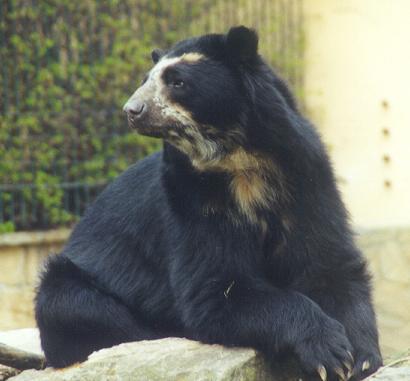
ADW: Tremarctos ornatus: PICTURES

Spectacled bear–the only extant tremarctine bear.  Genetic evidence from a new study suggests they occasionally interbred with the extinct Arctotherium bears during the late Pleistocene and they also interbred with the common ancestor of modern grizzly and black bears during the Pliocene.

Arctotherium Angustidens : Naturewasmetal

Artist’s depiction of the extinct Arctotherium.

The study produced an additional surprising result, but before I discuss this I need to digress and explain the 2 lineages of bears.  Ursine bears (black, grizzly, polar, Asiatic black, sun, and sloth) diverged from tremarctine bears about 10 million years ago.  The spectacled bear is the only tremarctine bear still extant, but during the late Pleistocene there were 3 additional species including the giant short-faced, Arctotherium, and the Florida spectacled bear (T. floridanus).  Results of this study suggests the ancestor of the South American spectacled bear did hybridize with the common ancestor of the black bear and grizzly bear.  The ancestor of black bears diverged from the ancestor of grizzly bears at least 1.5 million years ago, so this hybridization event likely occurred during the Pliocene.  The giant short-faced bears and Arctotherium never hybridized with ursine bears, but different species of ursine bears hybridized with each other numerous times.

In the future it would be interesting to see the results of a genetic study of T. floridanus.  The Florida spectacled bear ranged throughout southeastern North America during the Pleistocene and it shared the range with black bears.  Did these 2 species ever hybridize?

Reference:

Salis, A.; et. al.

“Ancient Genomes Reveal Hybridization between Extinct Short-faced bears and the Extant Spectacled Bear (T. ornatus)

BioRxiv Feb 2021

https://www.biorxiv.org/content/10.1101/2021.02.05.429853v1

Alfred Hitchcock in 1232 Words and my Favorite 15 Hitchcock Movies

February 25, 2021

Alfred Hitchcock is my all-time favorite movie director, and I have seen at least 30 of his movies–some multiple times.  I recently read an 800 page biography of Alfred Hitchcock.  For those interested in him but not interested enough to spend 6 weeks reading his biography, I put forth a synopsis of his life, then list my 15 favorite Hitchcock movies.

NPG x194278; Alma Reville; Patricia Hitchcock; Alfred Hitchcock - Portrait - National Portrait Gallery

Alfred Hitchcock with his wife, Alma, and his daughter, Pat.  Today, Pat is 92 years old.

Alfred Hitchcock was born during 1899 in London, England, a child of Catholic parents in a mostly Protestant country.  He was the youngest of 3 children, and his brother and sister were nearly a decade older than him.  His father owned a produce stand, but later took over a fish and chips shop, and the family lived on the 2nd story over the store.  Hitchcock didn’t have friends when he was a child, but instead would watch and observe other children playing.  He frequently attended plays and early silent movies, and by the time he was a teenager he was already reading movie trade publications.  He expressed the desire to become a nautical engineer and attended a technical school for a year.  Hitchcock was 15 years old when his father died of alcoholism.  Hitchcock’s brother took over the fish and chips shop, and Hitchcock got a job working for Henley’s Telegraph and Cable company as a sales clerk.  He was later promoted to the advertising department where he honed his design skills.  He also wrote for the company literary magazine, producing flash fiction notably Hitchcockian–suspenseful with humorous twist endings.  At the age of 21 Hitchcock took a job with Gainsborough Movie Productions writing the title cards for silent movies.  He was then promoted to art director.  Unfortunately, most of these early movies he worked on have been lost.

Hitchcock met his wife, Alma, while working for Gainsborough.  She was already working there when he was first hired.  He hired her when he became director of his first movie, a German film entitled Pleasure Garden. Alma was the love of his life and an important contributor for all of his movies.  She worked on screenplays, edited, and critiqued.  Hitchcock never had any long lasting affairs outside his marriage, but may or may not have gotten occasional blow jobs from actresses (perhaps even Ingrid Bergman).  It’s unclear whether these incidents ever happened.  Hitchcock often told dirty jokes just before filming an actress to put her at ease or to make her feel uncomfortable (whichever response he was trying to elicit for the role).  Most actresses thought this habit was funny, but a few didn’t like it.  Hitchcock likely would have gotten in trouble with the modern #metoo movement today, despite admittedly being incapable of sexual intercourse since the early 1940s due to his weight.  (Oral sex may have been the only sex act he could enjoy.)  Alma also had an unfulfilled love affair with a gay screenwriter.  But Hitchcock and his wife stayed together until the end and deeply cared about each other.

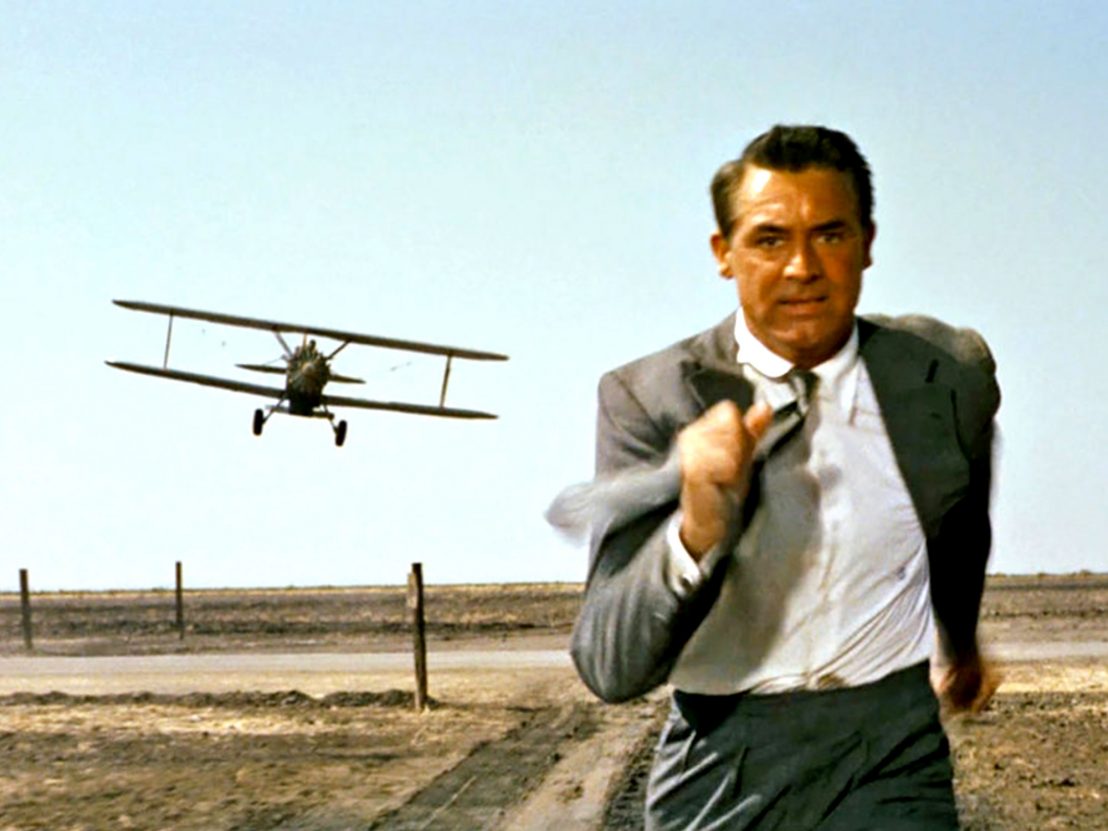
Hitchcock directed 5 movies for Gainsborough Pictures, then 11 for British International Pictures.  His first talking movie was Blackmail made in 1929.  Some British movie producers thought talking movies were just a fad, and one can see the influence making silent movies had on Hitchcock.  His most memorable scenes are visual and need no sound.  Examples include the shower scene from Psycho, the crop duster attack in North by Northwest, and the villain falling off the Statue of Liberty in The Saboteur. 

British International Pictures fired Hitchcock during 1932, and he freelanced Waltzes from Vienna in 1934 before being hired by Gaumont Pictures where he made 8 movies including some pretty good ones such as The 39 Steps and The Lady Vanishes.  His final British movie was Jamaica Inn for Mayflower Pictures with Charles Loughton.

Hitchcock wanted to make movies in America.  In England the weather was bad, often delaying shooting, and British film companies were always in financial difficulty, verging on bankruptcy.  So he signed an insultingly low paying contract with David Selznick Productions, making $50,000 to make 2 movies per year–less than half of what mediocre American directors averaged at the time.  The Hitchcock family moved to California and became American citizens, and soon Hitchcock started making really good movies with fat American budgets and big name stars.

Five Things to Watch for in Vertigo – Facets Blog

Scene from Vertigo, my favorite Hitchcock movie.  He began his career during the era of silent movies, and his work always reflected that.  His most famous scenes are all visual.

SABOTEUR Deconstruction of a scene: The Statue of Liberty finale – Alfred Hitch-blog

Scene from The Saboteur of a man falling off the statue of liberty.
Alfred Hitchcock's North by Northwest and the art of the chase

Famous scene from North by Northwest of Cary Grant being chased by a crop duster.  Hitchcock’s movies didn’t always make logical sense.  Why didn’t the bad guys just have a man with a high powered rifle assassinate him?  I suppose that wouldn’t have been as interesting to watch.

The first American movie Hitchcock directed, Rebecca, won a best producer Oscar for David Selznick.  Selznick loaned Hitchcock out to RKO, Universal Productions, Skirball Productions, and 20th Century Fox; and Hitchcock made a string of critical and commercially successful movies.  He also returned to England for a while and made propaganda films for the British Ministry of Information during World War II. After the war he completed his contract with Selznick Productions by directing Spellbound and The Paradine Case.  The latter and his next 2 movies–Rope and Under Capricorn–were box office flops.  Hitchcock signed his next contract with Warner Brothers and made critical and commercially successful movies including Stage Fright, Strangers on a Train, and Dial M for Murder.  Hitchcock reached his creative zenith during the mid-1950’s through the early 1960’s, making his most famous films.  Rear Window was the 3rd best selling movie of 1954.  He followed this with some of the best movies he ever made–Vertigo, North by Northwest, and Psycho.  

Hitchcock’s television series, Alfred Hitchcock Presents made him a huge celebrity, and by now he was finally making big money.  He produced and hosted the show for a decade from 1955-1965.  During the early seasons he also directed 3-4 episodes a season, though by later years he was directing just 1-2 episodes per season.  But he chose the scripting, screenwriters, and actors for each episode.  The show, an anthology series focusing on unusual murders, was both humorous and suspenseful, and it was an instant hit with critics.  It remained popular and highly rated during its entire run, and the only reason the show ended was because Hitchcock’s health declined, and he no longer had the energy to make movies and produce a television show.

Later Hitchcock movies seem bloated, old-fashioned, and mediocre.  Marnie, Topaz, and Torn Curtain are nothing to get excited about.  But Hitchcock did make 1 really good movie in his later years–Frenzy (filmed in England for Universal Pictures).  Hitchcock’s last movie, The Family Plot, was released in 1976.  By this time Hitchcock was a wealthy man, the third largest stockholder of Universal Pictures.  However, he suffered from obesity and heavy drinking, and 1 day, despite no apparent illness, he went to bed and refused to get up or eat (unusual for a man who enjoyed 4 hour feasts).  He stayed in bed for weeks and died at the age of 80 during 1980–almost as if he willed himself to die.

The American Film Institute periodically ranks the top 100 movies of all time.  One year 4 Hitchcock movies made the top 10 with Psycho as number 1.  Here are my 15 favorite Hitchcock movies.

One: Vertigo–The plot is improbable.  A man afraid of heights fails to save the woman he loves when she falls from a great height.  But she’s not dead.  The man (played by Jimmy Stewart) finds a lookalike (or is it really her?  What?) and tries to dress her to look like his lost love.  I can’t really explain why I love this movie so much.  Perhaps, I admire the weirdness of it all.

Two: North by Northwest–Cary Grant escapes the bad guys by running into an auction where he starts making stupid bids, attracting a police escort to kick him out.  I crack up laughing every time I see this scene.  The movie has suspense, romance, and humor…like most Hitchcock movies.

Three: Rear Window–Jimmy Stewart, laid up with a broken leg, gets to play voyeur when he looks at the apartment building on the other side of the street.  He suspects a man has murdered his wife.  He has.

Four: Spellbound–Hitchcock didn’t think much of this movie, but I enjoy the psuedo-Psychiatry.

Five: Dial M for Murder–A tight screenplay with the twist of a murder plot gone wrong.

Six: Psycho–Hitchcock’s most famous movie.  A cultural icon.

Seven: The Saboteur–Unforgettable scene of the bad guy falling off the Statue of Liberty.

Eight: Foreign Correspondent–Trouble in a wind mill.

Nine: The Birds–Another cultural icon.  A many layered story, though Hitchcock denied there was any deeper meaning than birds going amok.

Ten: Frenzy–The usual blend of Hitchcock humor and suspense.

Eleven: Rebecca–A masterpiece.

Twelve: Shadow of a Doubt–This is Hitchcock’s personal favorite.  What do you do when you discover your favorite uncle is a serial killer?

Thirteen: Rope–2 gay dudes murder their friend for kicks.  Just to see if they can get away with it.  The movie was ahead of its time.

Fourteen: Lifeboat–Survivors of a sunk ship are trapped on a lifeboat with the Nazi submarine commander who just sunk the ship.  What could go wrong?

Fifteen: Notorious–The movie studio executives thought the concept of an atomic bomb was ridiculous and wanted to change the screenplay. A few months after the movie was released, the U.S. dropped atomic bombs on Japan.

Reference:

McGilligan, Patrick

Alfred Hitchcock: A life in darkness and light

Regan Books 2003


Design a site like this with WordPress.com
Get started