A cat parasite (Toxoplasma gondii) infects about 30% of the worldwide human population. There is no cure. The human body has no way of ridding itself of these parasites, and there is no medicine that can be used to treat them. Billions of people on earth have cysts on their brains caused by the cat parasites in their bodies. Fortunately, most people suffer no symptoms from hosting cat parasites. A small number of people may experience flu-like symptoms, but most people are unaware they host cat parasites. Cat parasites can cause an increased risk of miscarriages for pregnant women, and they can cause problems for people with weakened immune systems, but they are harmless for the vast majority of human hosts.
Toxoplasm gondii has an interesting life cycle. This parasite can only reproduce inside a cat’s digestive system because they depend upon the high level of linoleic acid in a cat’s gut. For some unexplained reason mice with toxoplasm in their brains become sexually interested in cat feces. This causes them to behave recklessly, and they are more likely to be eaten by a cat, thus propagating more parasites. Cats are clean animals, and people do not get toxoplasm by petting cats. Instead, people get infected when they eat raw meats, fruits, or vegetables that have toxoplasm on them. Cat feces with toxoplasm in it is common throughout the environment, and the parasite just gets on everything and is consumed by animals that people eat.
Cats are clean, but they defecate in the environment and their parasites can contaminate meat and plants.
Toxoplasm gondii lifecycle.
Toxoplasm gondii.
Toxoplasm also causes infected humans to act recklessly. A study of hundreds of people in Turkey found humans who were infected with toxoplasm were more likely to be involved in car accidents. Other studies suggest infected people are more prone to rage. However, another study indicates reckless behavior can have positive benefits. A study of hundreds of businessmen found those infected made on average $6000 more per year than uninfected businessmen.
Toxoplasm influences wolf behavior as well. Infected wolves are more likely to be pack leaders. Infected chimpanzees lose their aversion to leopard urine. And infected hyena cubs wander closer to lions. How weird that a micro-organism actually influences the behavior of much more advanced animals. In the words of the fictional Cosmo Kramer, “nature is a mad scientist.”
References:
Genova, B. ; S. Wilson, J. Dubey, L. Knoll
“Intestinal Delta-6 desaturase activist Determines Host Range for Toxoplasm Reproduction”
PLOS Biology 2019
Lerner , D.; L. Akaersu. S. Johnson
“Nothing Ventured, Nothing Gained: Parasite Infection is Associated with Entrepreneurial Initiation, Engagement, and Performance”
Entrepreneurship Theory and Practice 45 (1) 2020
Meyer, C.; et. al.
“Parasite Infection Increases Risk-taking in a Social Intermediate Host Carnivore”
Communication Biology 2022
Yerelis, K; I. Balciogles, A. Ozlilgia
“Is Toxoplasm gondii a Potential Risk for Traffic Accidents in Turkey?”
Imagine a human who could jump about the length of a football field. The incredible jumping mice can leap over 40 times the length of their bodies (not counting their long tails), the equivalent of a human who could jump from their own 20-yard line on a football field to their opponent’s goal line. This ability to leap 10 feet away helps them escape predators when the mice leap to safety in dense grass or leaf litter.
There are 4 known species and 2 genera of jumping mice in North America including the meadow jumping mouse (Zapus hudsonius), the western jumping mouse (Z. princeps), the Pacific jumping mouse (Z. trintotatus), and the woodland jumping mouse (Napaeozapus insignis). The woodland jumping mouse is considered to be in a different genus because they have fewer teeth and quite different penis and ear bones. Though morphologically, there are 4 recognized species in North America, a genetic study suggests there are 28 different lineages, and statistically there should be 15 species. Fossil remains of jumping mice date to the early Pliocene, and they originally evolved at least 5 million years ago. Climate fluctuations during the Pleistocene caused speciation. Still, they are closely related. Pacific and western jumping mice can interbreed.
Range map for the 4 species of North American jumping mice.
Woodland jumping mouse. The extra-long tail distinguishes jumping mice from field mice in the Peromyscus genus.
Jumping mice are adapted to live in cool moist climates. Woodland jumping mice prefer grassy habitat near streams that flow through spruce forests. They occur in just the northernmost area of Georgia. The subspecies that lives in the southern Appalachians is known as N. insignis roanensis. They ranged farther south during Ice Ages. Fossil remains of meadow jumping mice were found at Ladds in Bartow County, Georgia, and it still ranges through areas of northern Georgia.
Jumping mice feed upon grass seeds, fungi, fruit, and insects. They hibernate during winter in shallow underground burrows, under tree roots, or in hollow logs. If they didn’t put enough fat on during summer and early fall, they will die during hibernation. Jumping mice that colonize human dwellings don’t hibernate. Not much is known about jumping mice because they kill their young in captivity and can’t be kept for observation for more than 1 generation like other mice can.
Reference:
Malone, J.; J. Domboski, J. Cook
“Integrative Species Delimitation of the Widespread North America Jumping Mice (Zapodinae)”
A fossil found by Professor Russell Long 60 years ago on McFaddin Beach, Texas looked like an unimpressive rock shaped round by ocean waves. The unidentified specimen was stuck in a drawer and nearly forgotten for decades. Recently, scientists looked at the specimen using x-ray computed tomography, and they discovered an unerupted canine diagnostic of the scimitar-toothed cat (Homotherium). The species was probably Homotherium serum because this is the only species of that genus known from North America during the late Pleistocene. Genetic studies suggest this wide-ranging apex predator was likely the same species as Homotherium latidens that also ranged across Eurasia in low numbers. Some studies suggest scimitar-toothed cats mostly ate grass-consuming animals such as bison, horses, and juvenile mammoths. An ancient scimitar-toothed cat den found at the Friesenhahn site in Bexar County, Texas yielded dozens of bones from baby mammoths. The specimen (see the below image) was the first ever found on the Gulf Coast of Texas indicating its range included the entire state. Scimitar-toothed cats are less famous and were probably less common than saber-toothed cats (Smilodon fatalis).
Location of McFaddin Beach where the below specimen was found. Fossils wash ashore from an offshore deposit (yet to be found) originating when the site was above sea level.
Specimen found on McFaddin Beach 60 years ago. Scientists couldn’t identify it until they just recently used x-ray to look at it.
The McFaddin Beach fossil site is similar to Edisto Beach, South Carolina. Apparently, there is an exposed fossil site offshore, and currents are carrying fossil remains on to the beach. The fossils accumulated in the offshore fossil deposit during the last Ice Age when sea level was much lower than it is today, and dry land habitat existed as much as 50 miles into what is now the Gulf of Mexico. Coastlines are always changing. The species from this fossil site date to the Late Pleistocene, probably to the Last Glacial Maximum between 28,000 years BP-15,000 years BP before sea level rose to modern levels. The list of species remains found on McFaddin Beach includes mammoth, mastodon, bison, horse, llama, long-nosed peccary, tapir, giant short-faced bear, Florida spectacled bear, saber-toothed cats (Smilodon fatalis), scimitar-toothed cats, raccoon, cottontail rabbit, capybara, beaver, prairie dog, cotton rat, eremotherium (a huge ground sloth), pampathere (a 300-pound armadillo), alligator, gar, catfish, and sunfish. These species represent animals found in grassland, woodland, and wetland habitats. Gulf coastal plains in Texas presented a warm corridor for tropical species to colonize Florida and the coastal plains of Georgia and South Carolina. Warm ocean currents pooled in the Gulf of Mexico because glacial meltwater shut down the Gulf Stream, and the climate was much warmer here than at northern latitudes during Ice Ages. Frequent tropical storms kept it well-watered compared to the eastern region of North America then.
Over 100 Clovis arrowheads have been found on McFaddin Beach–more than in any other county in North America. Arrowheads from the Archaic Indian Age are found here too, but they likely were left when the coastline was closer to where it is today. The arrowheads originate from 59 different rock formations, showing how nomadic ancient Indians were. Some of these arrowheads were manufactured as far away as New Mexico, Nebraska, Arkansas, and Colorado.
Reference:
Moretti, J.; et al
“The Scimitar-cat Homotherium from the Submerged Continental Shelf of the Gulf Coast of Texas”
Evidence suggests elk (Cervus canadensis), known as red deer in Eurasia, crossed the Bering Land Bridge and colonized much of North America ~15,000 years ago about the same time people did. Although most people don’t think of elk when they consider fauna of the deep south, there is archaeological and historical evidence elk inhabited southeastern North America until the 19th century at least as far south as the piedmont region. There is no evidence elk occurred on the lower coastal plain or Florida, so the piedmont was likely the southeasternmost limit for this species. Oddly enough, it seems the open pine savannahs of the coastal plain would’ve been good habitat for elk because they are grazers, but apparently, they were absent there. Perhaps, they couldn’t adapt to the types of flies and gnats that tormented them on these humid plains. Good habitat on the piedmont included pine savannahs and woodlands on foothills and fall line hills, kept open by frequent fire. An example of elk friendly habitat in this region can be found on Burke’s Mountain in northern Columbia County, Georgia where ultramafic soils inhibit tree growth and allow grasslands to predominate. This site might be where William Bartram found elk, bison, and deer bones mixed with human remains when he traveled through the south during 1776. An elk bone was found in Kingston Saltpeter Cave in Bartow County, Georgia, but this specimen was never described. Another elk specimen was found near Charleston, South Carolina, but the best evidence of elk in the south is from Alabama.
Burke’s Mountain in Columbia, County Georgia. This is the type of habitat elk inhabited in the piedmont region of southeastern North America. Photo by Alan Cressler.
Map showing where elk remains dating to the late Pleistocene and the Holocene have been found in Alabama. Image from the below reference by Ebersole.
As the above map shows, elk remains dating to the late Pleistocene and from just a few thousand years ago has been found at a number of sites in Alabama including Greene County, Pickens County, Dekalb County, and along the Tongbigbee River. The elk remains in Pickens County probably date to between 5,000-12,000 years ago. Elk toe bones found at the Bluff Creek Site before it was flooded by the Tennessee Valley Authority when they constructed the Pickwick Landing Dam were modified by humans. One of the toe bones was burned, and the other was ingested and defecated by a carnivore, but archaeologists can still determine they were modified by Indians.
Indians made fishhooks from deer and elk toe bones, but the ones found in Alabama were gaming pieces. Indians played a game with them that required great dexterity. They polished the elk toe bones, bored holes in them, and attached them to a string that was in turn attached to a needle. 3-9 toe bones were attached to this needle. While holding the needle, the player would toss the toe bones in the air and try to get them to land on the needle. The winner was the person who got the most toe bones to land on the needle. The Sioux Indians played this game. It seems low tech but challenging.
Image of elk toe bones discovered in Lauderdale County in northwest Alabama. From the below reference by Lev-Tov.
Image of elk toe bones used in the ring and pin game. Note the boreholes. From the below reference by Lev-Tov.
Illustration of the ring and pin game played by the Sioux and other Indians. The player held the bottom end of the needle and tried to get the bones and loops of beads to land on the needle.
References:
Ebersole, J.; and S. Ebersole
“Late Pleistocene Mammals of Alabama: A Comprehensive Faunal Review with 21 Previously Unreported Taxa”
Alabama Museum of Natural History Bulletin December 2011
Lev-Tov, J.
“The Function, Date, and Cultural Implications of Modified Phalanges from Russell Cave and the Bluff Creek Site in Alabama”
Alabama Medicine: Journal of the Medical Association of the State of Alabama 48 (1) Jan 2002
Franklin Roosevelt was the 2nd greatest President in American history in my opinion. Abraham Lincoln saved the United States from being shattered into at least 2 different countries, and this makes him the greatest, but Roosevelt led the U.S. out of the Great Depression and prevented our country from becoming a totalitarian state. He accomplished this despite being stricken with polio during the early part of his political career. For the rest of his life he was forced to spend most of his time in a wheelchair. During the 1920’s he learned about Warm Springs, Georgia. Cold water flows from most springs in Georgia, but Warm Springs was unique. Warm mineral rich water flows here, and people mistakenly thought this would be a curative for his condition. He did feel better when he went in the warm waters, probably because he was able to stand in 4 feet of water without help. His experience inspired him to purchase farmland around the springs, and he had a vacation home built nearby. He visited his vacation home over 40 times and would spend weeks at a time there. It became known as the Little White House after he became President because he spent so much time there. Many well-to-do northerners spent winter vacations in Georgia during the early 20th century. Florida was still mostly undeveloped, and Georgia was not as long a train ride.
The springs emerge into a manmade swimming pool, but that attraction was closed for maintenance when we visited.
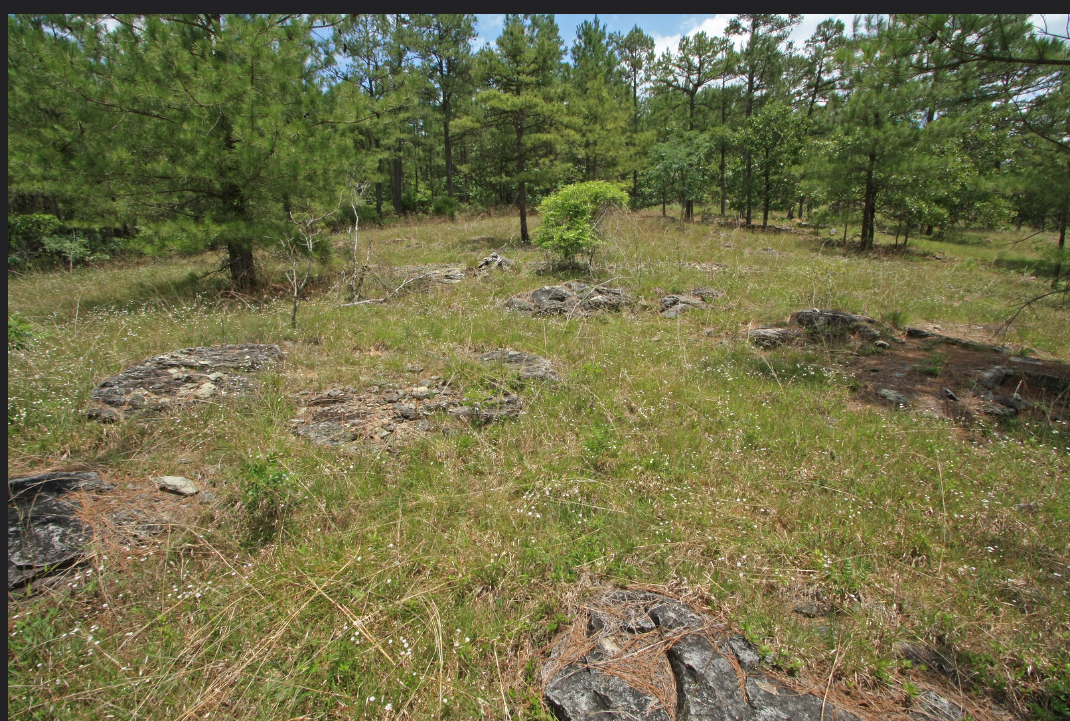
This was FDR’s favorite picnic spot. It’s located a few minutes from the Little White House and is next to FDR State Park.
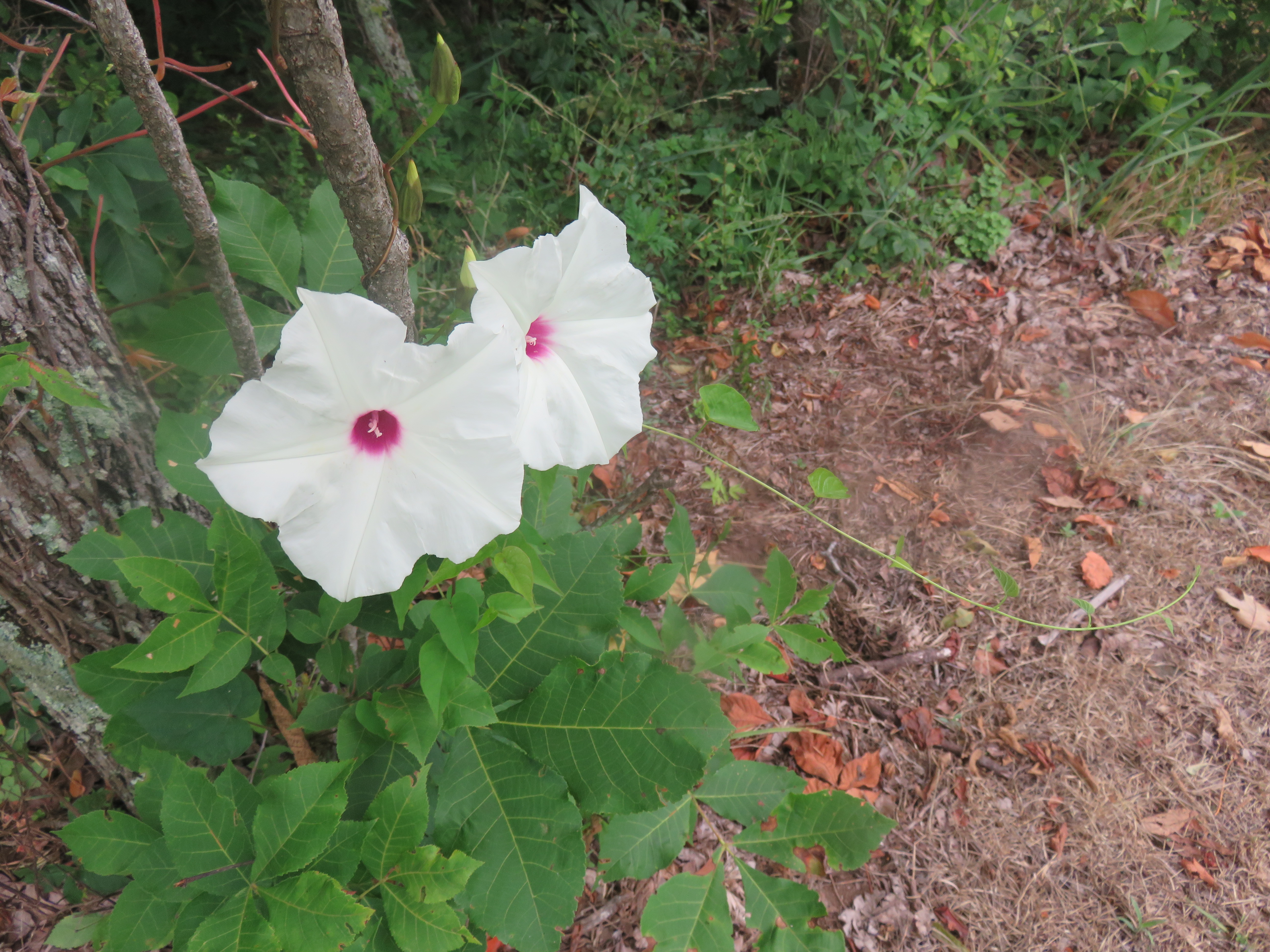
Many beautiful wildflowers occur at Roosevelt’s favorite picnic spot.This is a species of morning glory, Ipomoea pandurata.
The area around Warm Springs has more hickory trees than I have ever seen in my life. I also heard a cuckoo in the surrounding forests.
This is the view from Roosevelt’s favorite picnic spot. During his time there were a lot less trees, and it was mostly cleared farmland.
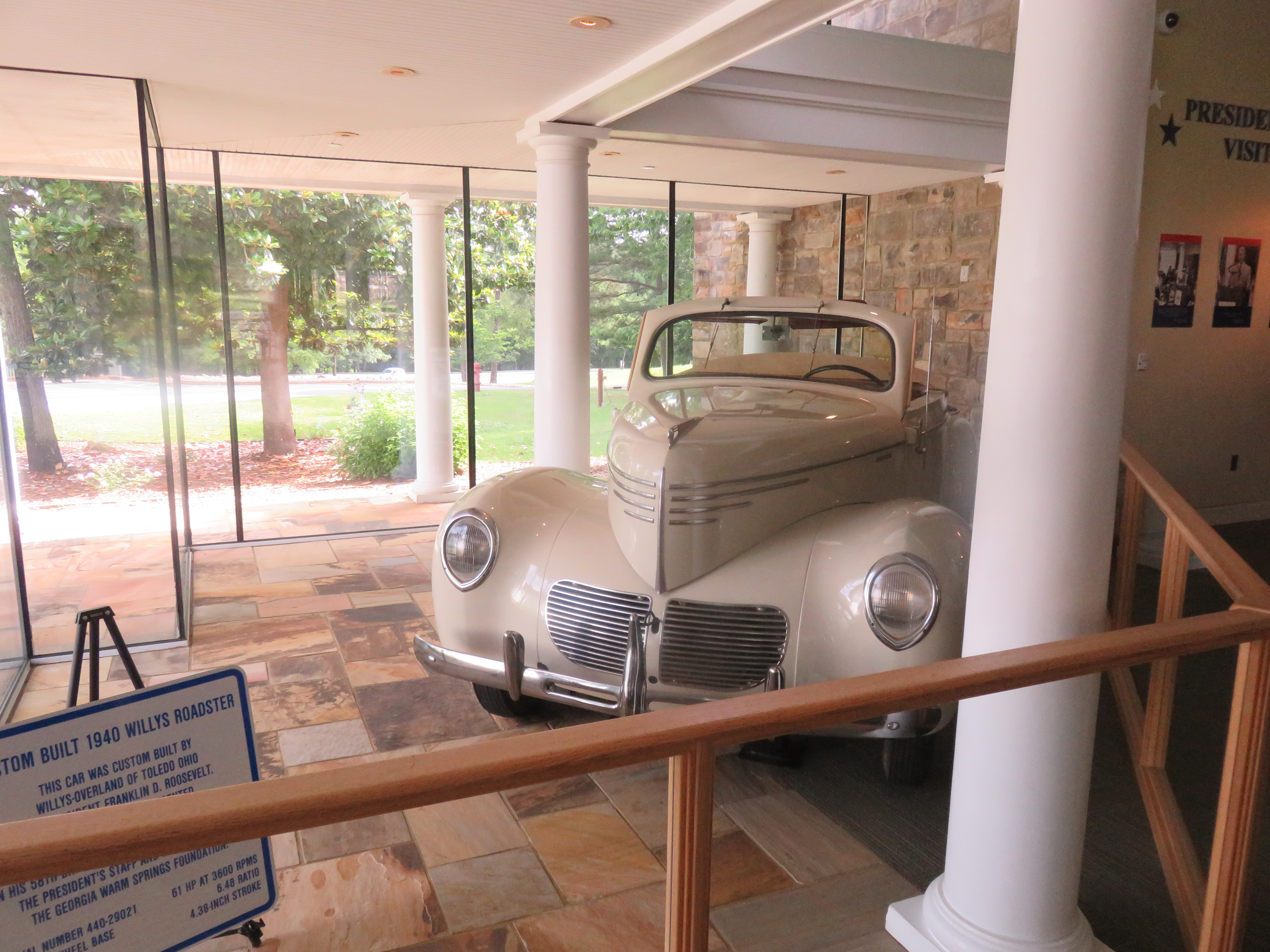
One of Roosevelt’s cars. He had special hand controls installed, so he could drive because his legs were somewhat useless.
Roosevelt’s other car. Special hand controls were installed on this too. He also had a horse driven buggy.
Roosevelt’s wheelchair and leg braces. When he made long public speeches assistants would help him stand up, then the leg braces would keep him in a standing position.
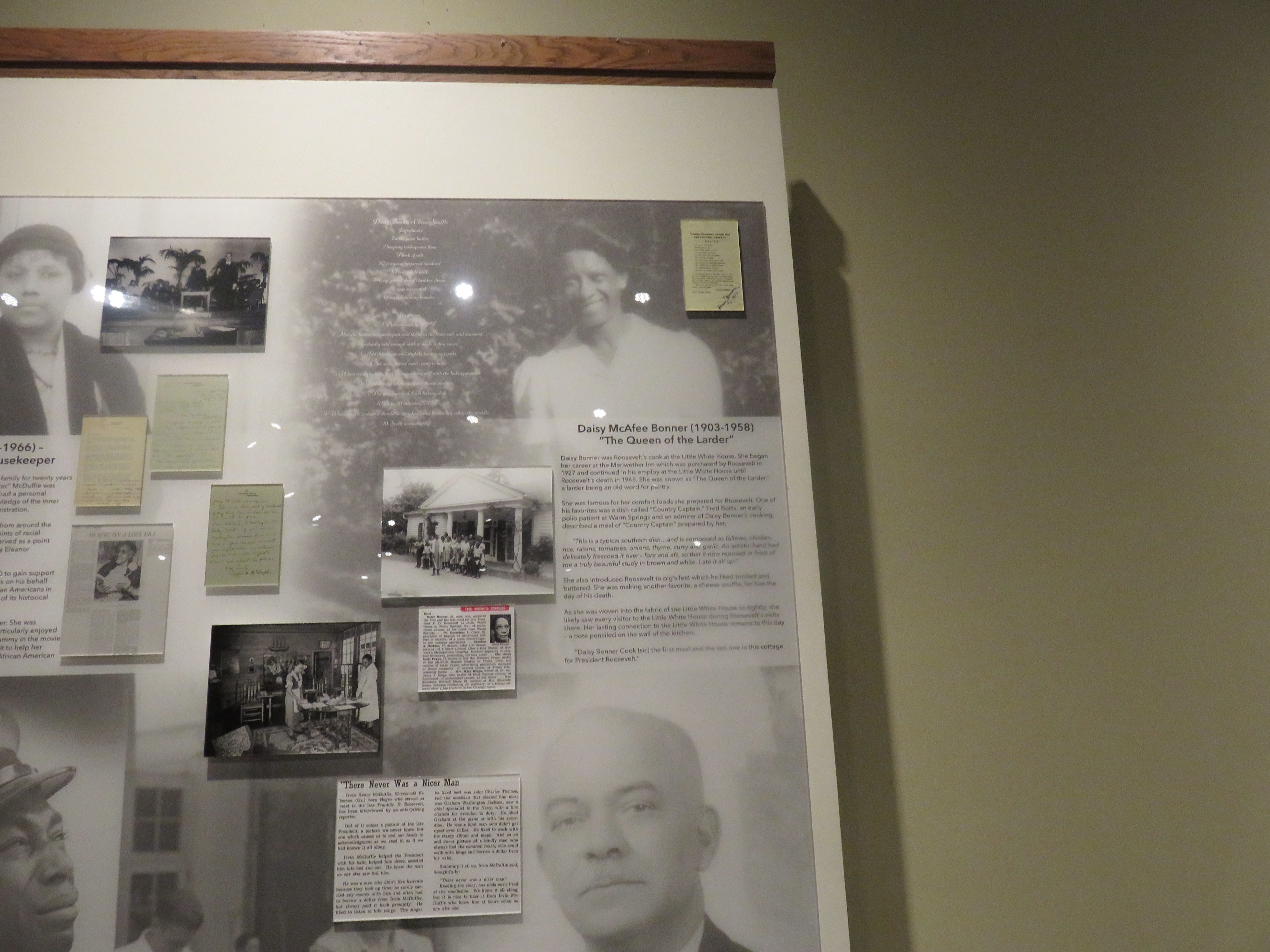
These people were Roosevelt’s servantsat Warm Springs. He had a cook, a valet, a driver, and a housekeeper. The valet helped him get out of bed, get dressed, and go to the bathroom. My wife has been disabled for 29 years, and I perform all 4 duties. They could have saved money by hiring someone like me. Roosevelt’s favorite dishes made by this cook were country captain chicken and broiled pigs’ feet with melted butter.
Vintage electric range used to cook Roosevelt’s meals. The Little White House had modern electricity and indoor plumbing, both of which were uncommon in Georgia during the 1930s.
View of The Little White House.
Roosevelt’s living room at The Little White House.
Switchboard in Roosevelt’s secretary’s bedroom.
View from the back porch of The Little White House. The whole complex was surrounded by Secret Service and Marine sentry outposts. When Roosevelt was alive he could see Alabama from here, but 2nd growth forest has grown and blocked the view.
I was surprised how small Roosevelt’s bed was. He no longer slept with his wife, Eleanor. Although they had 6 children between 1906-1916, he had an affair with his wife’s social secretary, Lucy Mercer, and the Roosevelts stopped sleeping together after Eleanor discovered the betrayal. Teddy Roosevelt’s daughter encouraged the affair. She said, “Franklin deserved some fun; he was married to Eleanor.” Eleanor likely had a lesbian love affair with a journalist after she stopped sleeping with Franklin. Lucy Mercer married a rich man, but after her husband died, Franklin asked his daughter to re-connect him with Lucy. They saw each other regularly at The Little White House, and Lucy was with him there when he suffered his fatal brain hemorrhage.
In my old age I feel less and less like traveling. I hate sitting cooped up in a car for hours, and I don’t particularly enjoy being in strange places. Paying $10 for a fast-food hamburger or chicken sandwich on the way there or back home just pisses me off. Nevertheless, my family demanded a summer vacation, so we went to Callaway Gardens in Pine Mountain, Georgia. Callaway Gardens was founded by Cason Callaway who inherited a cotton mill business from his father. During the 1930s he gave his interest in the business to his brother and instead farmed the hundreds of acres of land that he owned in Harris County, Georgia. He developed this land into the residential vacation area now known as Callaway Gardens. We stayed at the Callaway Gardens Lodge and Spa–an upscale hotel–but it is surrounded by rental cottages. There is a golf course, many swimming beaches, fishing in manmade lakes, and several interesting attractions. Unfortunately, the experimental horticultural station, site of a long-running PBS show about gardening, is no longer in operation. We did visit the Day Butterfly Center, and the Discover Center where we saw well trained rehabbed raptors fly.
Magnolia trees were in bloom. This is a common tree at Callaway Gardens.
This bigleaf magnolia has huge leaves.
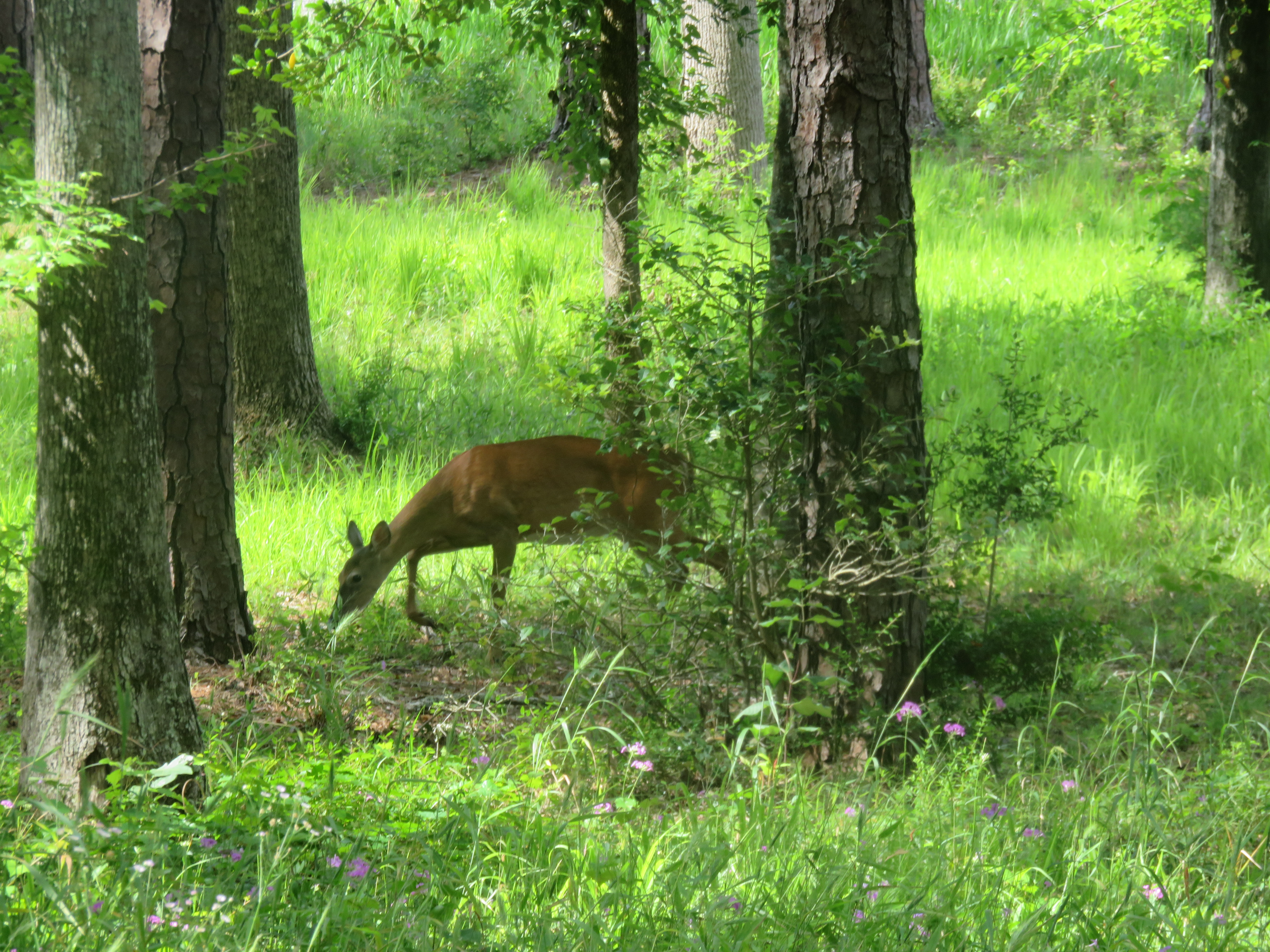
I saw a mouse in the brush and when I moved closer to identify it, I ran into this deer.
Another deer.
Many flowers to attract butterflies.Goldfish swim in the pool.
The Day Butterfly Center is named after the guy who founded Day’s Inn.
The Day Butterfly Center is fake. They import non-native tropical butterfly pupas from butterfly farms located in Asia, South America, and Africa. The plants inside the center are not host plants for their larval caterpillars, so these butterflies are in a kind of hell where they can’t reproduce.
Just think. This butterfly flies around for a few weeks, fruitlessly searching for a plant to lay its eggs on, but none of them are the right host species.
Soft-shelled turtle. It was outnumbered by yellow-bellied sliders.
One-eyed red-tailed hawk that was injured by a car and shot by a farmer. These raptors were well trained.I think they were putting dead mice on top of the posts to lure the birds into flying there.
Great-horned owl.
Harris Hawk. This species lives in the deserts of southwestern North America, and in the wild they hunt in teams.
At the Discover Center have a really nice display of replicas of rare and endangered plants found in Georgia and Alabama including Coosa Valley sunflower, giant trillium, and sandhill aster.
Madagascar hissing cockroaches on display at the Discover Center. They are even bigger than the ones in our house.
Pine savannah at Callaway Gardens.
Supposedly, there are fox squirrels living near the golf course, but I didn’t see any. I did see 7 gray squirrels. There is a good population of bluebirds at Callaway Gardens, and they do have bluebird nesting boxes everywhere. Most of the natural woods at Callaway Gardens are dominated by shortleaf pine, water oak, and willow oak.
I forgot to take photos of the food we ate at the restaurants at Pine Mountain. Fox’s Pizza Den was very popular, and the food was good. I had a vegetable stromboli. I ordered it because it is sometimes hard to get vegetable servings on vacations. The 2nd night we went to Eatz on the Corner–a Jamaican restaurant. I ate jerk chicken with black beans and rice. The plantains served with this dish were the best tasting I ever ate.
Modern wolverines (Gulo gulo) have a Holarctic distribution, meaning they range just south of the Arctic circle in both North America and Eurasia. Until the 18th century, wolverines occurred as far southeast in North America as northern Ohio, but by the early 1800’s European settlers deliberately wiped out as much game as they could to starve the Indians, and wolverines were included in this extirpation. A few years ago, scientists discovered a face bone with 2 teeth attached of an extinct species of wolverine (G. sudorus) at the Gray Fossil Site in east Tennessee. This is one of the best early Pliocene sites in North America. This specimen was estimated to have lived between 4.9 million years ago to 4.5 million years ago. At this time the region of east Tennessee had a subtropical-warm temperate climate, and this species of wolverine lived alongside alligators, tapirs, rhinos, and horses. This climate was quite dissimilar to the climate of regions inhabited by wolverines today. Modern wolverines prefer climates with short summers and long snowy winters. They are adapted to hunting large deer, elk, and moose that are hampered by deep snowdrifts. Their padded paws help them travel on top of deep snows when these ungulates are floundering in them. They also can drive off many larger predators from their kills.
Map showing the distribution of wolverines during the present day, Pleistocene, and Pliocene. 1 specimen dating to the early Pleistocene was found at a site in the southern California mountains. G. sudorus was surely adapted to living in warmer climates than the modern species can endure.Image from the below reference.
This is the only known fossil specimen of G. sudorus. It is a face bone with 2 teeth attached. Image from the below reference.
The specimen is very rare…it’s the only known fossil of this species in North America. The only other specimen of a Pliocene-aged wolverine was found at the Udunga site in Russia and was assigned the scientific name Gulo minor. The American specimen shares anatomical characteristics with wolverines and fishers (Pekania pennanti). Fishers are the closest living relatives of wolverines. Wolverines are also related to pine martens (Martes sp.) and tayras (Eira barbara)–a large tropical weasel. It seems likely this Pliocene species of wolverine was very similar to a tayra in appearance. Genetic studies suggest wolverines diverged from most of the rest of the weasel family 11-12 million years ago. They diverged from fishers and martens over 5 million years ago.
The Pliocene species of wolverine that lived in parts of southeastern North America was likely similar to a tropical species of weasel known as a tayra. This one is preying on an iguana. Photo by Daniel Lopez.
Scientists gave the new species of wolverine the scientific name sudorus, meaning sweaty because it lived in warm climates. However, it likely had a short coat like a tayra. Wolverines adapted to cooler climates during the late Pliocene or early Pleistocene about 2.5 million years ago when Ice Ages began occurring.
Reference:
J. Samules; K. Bredehoeft, S. Wallace
“A New Species of Gulo from the early Pliocene Gray Fossil Site (Eastern Tennessee): Rethinking the Evolution of Wolverines”
A million years ago, our evolutionary ancestors (Homo erectus) were hunting, scavenging, and gathering to keep their bellies full. They shared their environment with many dangerous large predators. Some scientists hypothesize early humans obtained some portion of their caloric intake from scavenging large mammals killed by saber-toothed tigers and other big cats. Two species of saber-toothed cats roamed across Eurasia then including Megantereon whitei and Homotherium latidens. Panthera gombaszoegensis (formerly thought to be a species of jaguar but now thought to be more closely related to tigers) also provided meat for scavengers. These species likely ate the organs and softer parts of the carcass and left a considerable part of the coarser flesh and bones behind. Scientists believe scavenging from big cats helped H. erectus expand out of Africa and into Eurasia. They likely competed with the giant hyena (Pachycrocuta brevirostis) for this valuable source of food. A new study used computer simulations to determine the optimal size of a human group that could drive off a giant hyena. The scientists used 6 simulations, and each simulation was repeated 70 times. The data fed into the simulations included different numbers of people, large predator density, weight of the prey, intervals between kills, caloric return, and energy consumption. Scientists didn’t factor in canids, such as species related to African hunting dogs and early wolves, because packs of those species usually consumed the entire carcass.
Chart from the below study showing some of the data fed into the computer simulations.(Rodriguez 2023).
Mauricio Anton’s illustration of Homo erectus competing with Megantereon for food.
The giant hyena. Scientists don’t know whether it was a solitary or group animal. It had a smaller brain than spotted hyenas, a species that eventually replaced giant hyenas.
It’s not known for sure if the giant hyena was solitary or lived in packs, but they did have smaller brains than extant, modern, spotted hyenas (Crocuta crocuta). There is some archaeological evidence of humans competing with giant hyenas for an elephant carcass at the Fuente Nueve-3 site in southeastern Spain. Humans did break the bones for marrow, and there are cut marks on the bones, but there are also gnaw marks from hyenas on the elephant bones. A group of humans making noise and throwing projectiles could hypothetically chase away a large predator. Modern chimpanzees occasionally use sticks and stones to take prey away from leopards.
The authors of the below referenced study estimated it would have taken at least 5 humans to drive off a giant hyena. The optimal size of a group of humans to drive away a hyena was 13. A larger group of humans than this wouldn’t be able to get enough meat to make the effort worthwhile. Two simulations showed giant hyenas outcompeted humans when ecosystem productivity was low. Early humans required rich environments with large populations of apex predators to thrive.
Table showing the results of the below referenced study’s computer simulations. (Rodriguez 2023)
Giant hyenas became extinct following the extinction of Megantereon. I suspect humans drove Megantereon to extinction in Africa and Eurasia. Sometime during human evolution, we evolved the teamwork necessary to take on saber-tooths directly. Homotherium latidens became rare in Eurasia during the late Pleistocene, but saber-toothed cats survived in the Americas until humans started arriving there in significant numbers.
Note: This study is highly speculative. I always think studies that use extensive amounts of statistics are not much different than wild guessing. Statistics can be manipulated to show anything.
References:
Palmqvist, P. et. al.
“Deja vu: On the use of Meat Resources by Sabretoothed Cats, Hominins, and Hyenas in the early Pleistocene Site of Fuente Nuevo-3 (Gaudix-Baza Depression, SE Spain)”
Archaeological and Anthropological Sciences 15 2023
Eastern cottonwood trees rapidly grow to an enormous size. They reach heights of over 100 feet tall with diameters over 9 feet thick. The U.S. national champion in Beatrice, Nebraska is 89 feet tall and has a canopy 108 feet wide. The largest cottonwood in the world was planted in New Zealand circa 1870 where it is not native, and it is 138 feet tall and has a canopy 34 meters wide. Normally, cottonwoods live for 70-100 years, but they can live for 400 years. The Balmville Tree in New York was 316 years old before it was felled.
Photo of the largest known cottonwood tree in North America.
This is the largest known cottonwood tree in Georgia.
A grove of cottonwood trees in Arkansas.
Leaves and seeds of cottonwood.
Cottonwood trees depend upon flooding rivers for their existence. Floods wash away competing vegetation, leaving bare soil where cottonwood seeds can germinate. They are a shade intolerant species as well, and repeated floods thin the surrounding vegetation. This dependency explains why cottonwoods are so common on western river bottomlands. They have less competition alongside rivers that snake through prairies. Wind carries cottonwood seeds and pollen great distances, and they readily colonize bottomlands following scouring floods. Cottonwood trees are also commonly found in the east, but they particularly thrived during Ice Ages when grasslands prevailed over woodlands. There isn’t much fossil evidence of cottonwood trees dating to the Pleistocene, and their pollen barely shows up on pollen graphs, but fossil cottonwood leaves have been found in the Rita Blanca site in Texas alongside leaves from oak and willow. Cottonwoods are in the same family as willows, another tree that prefers wetlands. The Rita Blanca site in Texas was formerly a lake during the early Pleistocene.
Big tooth aspen (P. grandidenta), a related species, occurs north of the Last Glacial Maximum boundary. This species colonized New England within the last 10,000 years. It must have occurred further south during Ice Ages. It co-occurs in some parts of its range with the closely related quaking aspen (P. tremuloides), but they don’t hybridize in the wild because they flower at different times. Plant breeders have managed to hybridize them in cultivation.
Cottonwood trees are grown commercially for paper pulp. Their rapid rate of growth is an economic benefit. The wood is also used to make boxes.
Keith Richards is more interesting than a tree. I have a blog article about a species of tree ready, and I will probably publish it next week, but I have been reading Keith Richards autobiography lately, and his life holds more fascination for me than a tree. I enjoy reading biographies of rock stars because they experienced unfettered lives when they were youthful and had all the money, women, and drugs they desired. Keith Richards has been the guitar player for the Rolling Stones for about as long as I have been alive. (They are going on yet another farewell tour this summer, and Mick Jagger and Keith Richards are 80 years old.) The Rolling Stones are one of the greatest rock bands of all time with a deep catalogue. My favorite Rolling Stones songs include “Can’t you hear me knocking?” “I know (it’s only rock’n’roll but I like it),” “Brown Sugar,” “Gimme Shelter,” and “Shattered.”
“Can’t you hear me knocking?” is my favorite Rolling Stones song. I have listened to this song quite a few times while I am drunk.
Keith Richards grew up in a working-class household in England at a time when the English economy was struggling to recover from World War II. He had a low opinion of the educational system in England at the time he went to school. I’ve also read biographies of Ozzy Osbourne and Bernie Taupin, and they share his assessment. Keith learned to play guitar in his teens and was soon covering Chuck Berry songs. Chuck Berry along with Muddy Waters and Chicago blues artists were his biggest influences. He didn’t live far away from Mick Jagger who was able to get blues albums from Chess Records directly–hard to get items in England at the time. The two of them formed the Rolling Stones and started writing songs together. When the Rolling Stones first toured England they opened for the Everly Brothers, but by the time the tour ended the Everly Brothers were opening for them. This was before the Stones even had any hits and were merely covering Chicago blues songs.
Keith Richards is an exceptionally innovative guitar player with a unique sound. He changed the strings around on his guitar to give him the sound he was seeking. It sounded so good, Ike Turner of Ike and Tina Turner forced Keith at gunpoint to show him how he was playing his guitar. Keith created the famous hit, “Satisfaction,” in his sleep. He says he woke up one morning and played back a cassette. He heard the riff for “Satisfaction,” then 10 minutes of snoring. He also learned he liked the way his acoustic guitar sounded distorted when he played it back on cassette. Songs such as “Jumping Jack Flash” sound like they use electric guitar, but actually Keith was using distorted acoustic guitar. Oddly enough, “Start me up” was originally a reggae song. For years the group couldn’t get it to sound right until they played it as a straight up rock song. It became one of their most popular songs that they usually use to begin their concerts.
On the Stones first tour of the U.S., they played in some southern cities including Nashville and Memphis. Keith recounts how the white side of town would be completely closed by 10:00 pm, so the group would cross the railroad tracks where most of the black side of town was still jumping with juke joints playing music and serving booze all night. He’d wake up in the morning in bed with his face in some black woman’s enormous cleavage, while her mother served them breakfast in bed.
Photos of Keith Richards when he was young and old. Considering his unhealthy habits, it is surprising he is still alive and performing strenuous rock concerts at the age of 80.
The entire band took a great variety of drugs. Keith met a Jewish survivor of the Holocaust who was a fan of the band. He was a shady businessman and owner of drug stores where doctors on the take agreed to send people for recreational drug prescriptions. He supplied Keith with pharmaceutical grade cocaine, a much purer form than could be found on the street. However, it was heroin that got Keith into the most trouble. He was a junkie throughout the 1970’s and early 1980’s. When he was on heroin he would stay up for many days, working on his music. His record for being awake was 9 days straight when he suddenly collapsed, stumbled down some stairs, and finally fell asleep. He was busted for drug possession in several countries including England, France, and Canada. Canadian authorities tried to nail him for distribution (a minimum 10-year prison sentence), but the judge sentenced him to give a free concert to blind people. He finally got the monkey off his back in the early 1980’s.
A more remarkable story involves Keith’s bandmate, Bobby Keys–the saxophone player. On the way home from a tour of Asia the band had to stop at customs in Honolulu. Bobby forgot he had hidden a heroin syringe in his saxophone. The customs agent turned the saxophone upside down to look at the serial number, and the syringe fell out and landed needle side down, like a dart in a dart board, on the customs agent’s desk. They arrested Bobby, but the rest of the band had already left for the continental U.S. The only number Bobby had to call was Mr. Dole, owner of Dole Pineapple who gave him his business card when he caught Bobby fooling around with his daughter in his mansion. Mr. Dole had enough influence to get the charges dropped.
The band members left England to avoid paying an 85% tax rate. They became non-resident citizens to prevent the government from confiscating so much of their wealth.
Keith enjoyed countless groupies, but he had 3 important lovers in his life. His first great love was Anita Pallenberg, actress and former girlfriend of fellow bandmate, Brian Jones. Keith basically stole her from Brian, but that relationship had been falling apart for some time. Keith and Anita had a lot of fun together, and the relationship produced 3 children. She also was addicted to heroin. Their relationship couldn’t survive their mutual addiction. Keith moved on to Lil Wergelis who helped him get over his addiction to heroin. Keith has nothing but good things to say about Lil, but he admits he “dumped” her for Pattie Hensen, a Vogue cover girl model. He is still married to her some 40 years later. At the time he met her Mick Jagger was also dating a supermodel, and in my opinion Keith might have wanted to keep up with Mick.
Keith and Mick are the heart of the Rolling Stones. There was some resentment between them in the late 1980’s when Mick attempted to kindle a solo career but mostly played Rolling Stones songs on his tours. Keith played guitar on tour with a reggae group, then formed his own band known as the X-pensive Winos. Keith and Mick reunited and have played together on many mega-tours since.












 GeorgiaBeforePeople